About this blog..

This is a blog that I started in April 2006, just after I first put on my bogu (kendo armour). It collects the advices given by more experienced kendo practitioners as well as those from my own experiences. Both technical and the mental aspects of kendo are written in the blog. I hope someone will find them useful or interesting at least!

Thursday, December 17, 2009

Ozawa Sensei's Visit 2009

As promised last year, Ozawa Sensei came again this winter, and brought Tanemichi Chiba Sensei 8th Dan Kyoshi (Kendo lecturer in the Japanese Imperial Guard), Takano Sensei 7th Dan Kyoshi (Kobukan) and Fukui Sensei 7th Dan Kyoshi (Noma Dojo).

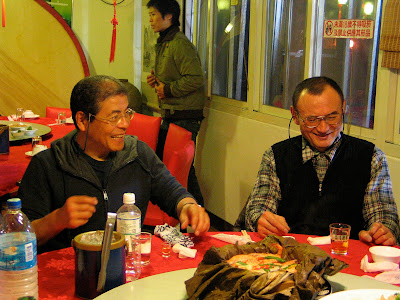
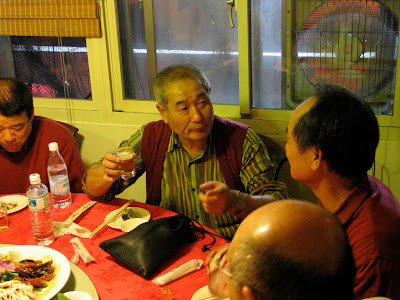
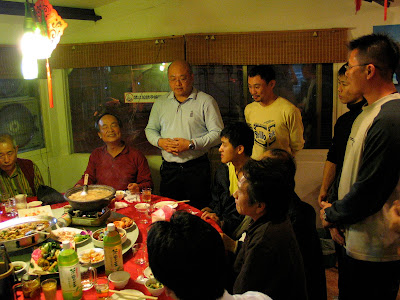
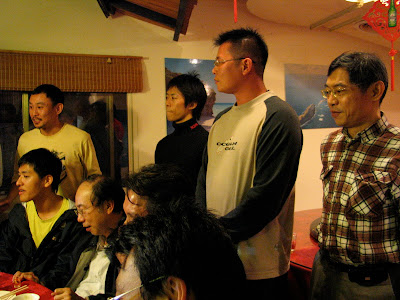
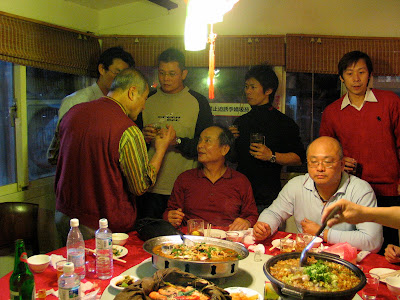
[First dinner in Taiwan.]
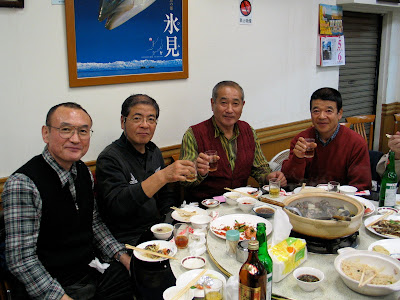
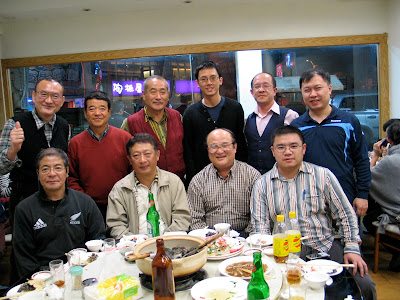


They came for 5 days, three of which had kendo practices in the evening. The first one was at the Taipei Kendokan. I've wanted to invite Ozawa Sensei to come here because I feel it's one of the dojos that play the kendo style most similar to Japan, or international kendo, instead of some simple whacking-on-the-head activity. And the members here are dedicated to improving their kendo, and strong kenshis. Of course, certain aspects are still missing compared to what is considered "beautiful kendo" in Japan, but I so far I really haven't seen much that outside Japan.

I went to the airport to pick up the Senseis. When I saw Ozawa Sensei coming out from the arrival gate, I had the feeling of seeing an old friend again after a long while! Indeed it has been percisely a year since I saw him last time, during which I've moved from Germany to Taiwan, changed a new job, and moved from Taipei to Hsin-Chu, having lots of changes. It felt like a much longer time!

The next two days I took days off at work and accompanied with the senseis to travel.


Monday, 7th Dec
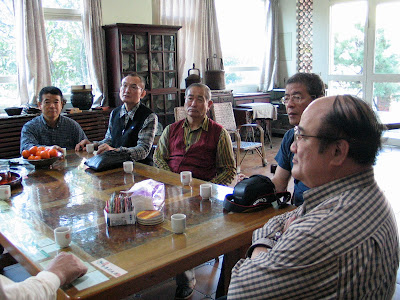
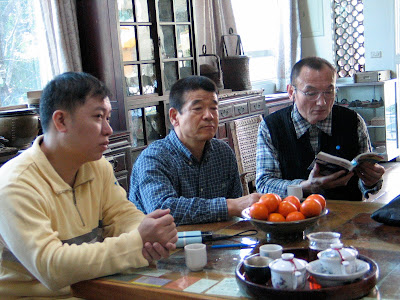
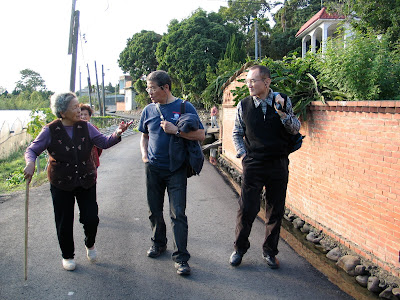
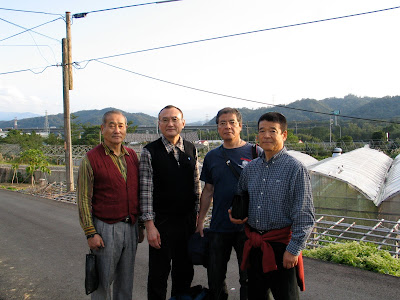
[Visiting the Hakka Cultural Heritage Center.]


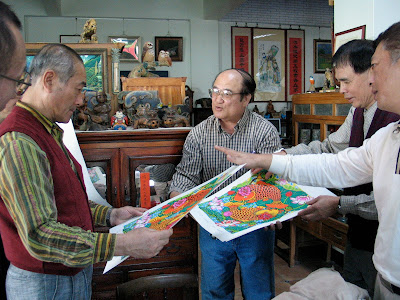
[Presents for the Senseis.]


[Senseis had never tasted the dragon fruits.]
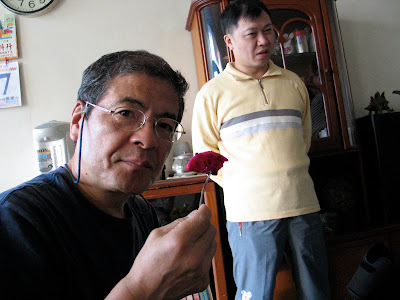
[The old lady spoke fluent Japanese and chatted to the Senseis.]

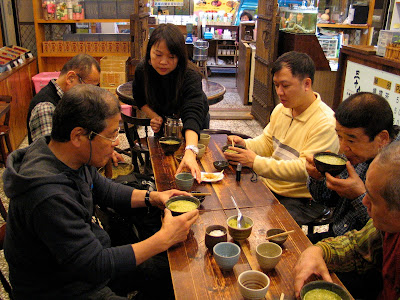
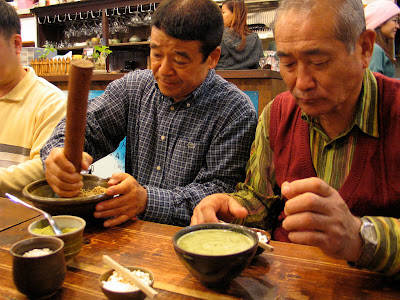
[Hakka traditional grinding tea.]


On Monday we went to the Taipei Kendokan. The turn out was good - about 20+ kenshis. I think everyone enjoyed practising with the 4 Japanese sensei. I was very glad about that.

Chiba Sensei gave us some feedbacks at the end of the training:
  • In kihon geiko, some people's men-strikes were too small. Kihon is very important, and one should try to strike properly.

  • One has to break the opponent's kamae before striking. This is achieved by applying pressure, or seme, and occupy the centerline. The most effective way to apply pressure is to direct the tip of the sword towards anypoint between the throat and the middle of his chest, and move in. This is the most uncomfortable place a person feels when something is approaching.
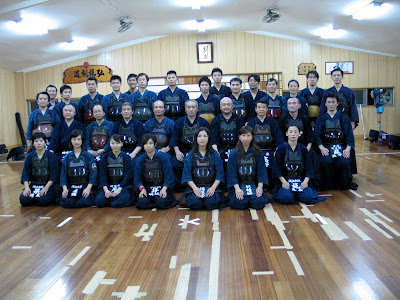
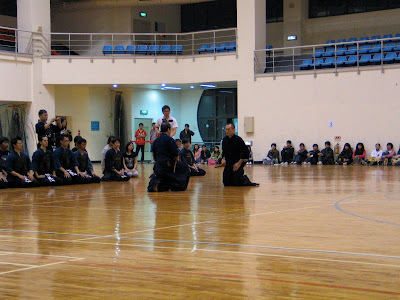
[At Taipei Kendokan]


[Listening to advices from Chiba Sensei.]


Tuesday, 8th Dec


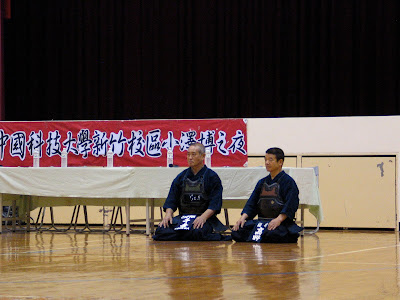
On the next day, after some sight-seeing on the Yang-Ming Mountain, we went to the China University of Technology, where a shot seminar is to be held.

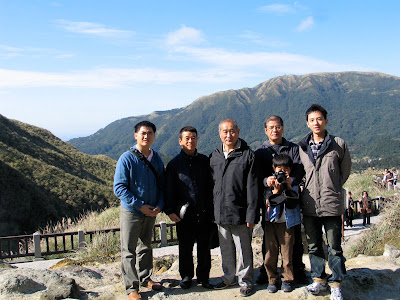
[Yang-Ming Mountain]


I assisted Takano Sensei in teaching the beginners without the bogu, about kendo etiquette (reiho) and kamae. The most challanging thing was to translate what Takano Sensei was saying from Japanese into Chinese. I could manage most of it, since I knew roughly what he was saying. However, to tranlsate word by word would still be difficult. I need to study Japanese harder!


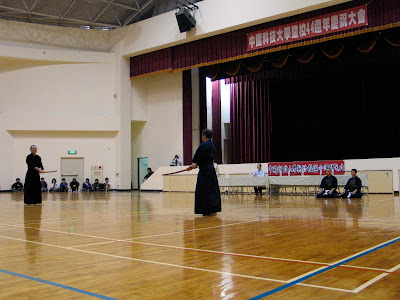
Ozawa Sensei and Fukui Sensei demonstrated the Mizoguchi-ha Itto-ryu kenjutsu. (click to view the full size)


Ozawa Sensei and Chiba Sensei demonstrated Kirikaeshi.


Wednesday, 9th Dec

On the Wednesday I had to go back to work, and only joined them in the evening practice at the Hsin-Chu Kendokan.

Ozawa Sensei and Fukui Sensei demonstrated again the Muzogushi-ha Itto-ryu kenjutsu. I feel I can appreciate more and more of its beauty every time I see it.

After the practice, I asked Ozawa Sensei how my jigeiko was. He said that I should relaxe my body more. I think I wanted so much to do my best in front of him that I tensed up my muscles too much. He then invited me come to the Thank-you Dinner from him and the other senseis.


Thursday, 10th Dec

The whole was filled with meetings after meetings at work. Fortunately, the last meeting didn't drag on, so I could take the High Speed Railway to Taipei and take the dinner in time. We had good food and drink. At the end, when Chou-san took the senseis to the nearby night market for sight-seeing, Ozawa-Sensei invited me to stay and have some drink at the hotel bar.

We talked for 2 hours, which passed by very quickly, about kendo, travel, friends and life. He said one day he wants me to travel to England and Czech together. I said, "then I have to become very good in kendo!"

About kendo:

  • One has to learn the correct kendo forms and develop good seme techniques, instead of relying one's kendo on the stamina, like many players nowadays in All Japan Kendo Championship, and some of other competitions. So kihon is very important as well as waza-practices. It is not good to let winning in competition as one's main goal in kendo.

  • To strike small men, one should hold the shinai in chu-dan, and moving in with the hip without the shinai moving. At the correct distance (only towards the end), strike immediately. He said it is incorrect, like some people say, to extend the arms forwards from the begining when the body moves forwards.

  • It is bad to strike too small. He explicitly said that right wrist should also flex up and down as well as the left. Some people might say this creates debana moment for the opponent. For this he replied:

  • One should use seme and strike at the right moment, so that the opponent will not be able to execute debana kote.

  • To have good and strong seme, one relies on having confidence with one's own techniques, or WAZA. So we should improve our waza.

He also said, to learn men-strikes, there are three stages:

  1. First raise the shinai above head, and then strike with the body moving fowards at the same time.

  2. First raise the shinai above head, then move the body forwards, and lastly strike.

  3. Keep the shinai in chu-dan while moving the body forwards, and strike.

This is a good reference for all the instructors when teaching the beginners.


Monday, December 14, 2009

National Chung-Cheng Cup 2009

Last weekend probably the biggest kendo competition took place in Hsin-Chu. I participated both in the team and the individual category. The total number of participants were massive. My feeling at the end of the two-days event was, "Gosh, I'm tired". It was hard to imagine the level of stamina a kendoka needs to fight until the finals. Ones really needs to be strong mentally and physically.

I didn't perform too bad, but I didn't bring any suprises either. I fought with Taipei Kendokan in the team shiai. So Sempai (蘇耿賢) said my performance was good, though I didn't win anything. I think he didn't put very much expectation on me. My expectation for myself was not to be nervous. I think I managed that. However, Ho Sensei told me I fought too conservatively. Indeed, I didn't take the initiative to step in and "provoke" my opponent. Instead, what happened was that I took one step in, my opponent took one back, and I took another step in, so on. In the end, what my opponent was doing was waiting for me to strike first, and use oji-waza against me. (Damn the number of men-nuki-men that I received!!)

I lost my first individual's match against a student from Taiwan Sports University. I didn't have enough confidence with myself, and didn't apply enough pressure. A kohai who watch aside told me my performace was very different from that in the jigeiko. Quite right. I think there's something I need to adjust with my attitude either when I fight in a competition or in the jigeiko, in order to connect to two.

Another big issue is that I am not confidence enough with my men cut. I need to work on that. So now is time to be back with more kihon...

Monday, November 30, 2009

More seme techniques

Yesterday there was an invitaional Jigeiko session in Hsin-Chu, at the Tsing-Hua University. About 50-60 people from Taipei, Hsin-Chu and Taichung joined the practice, including one 8th Dan, three 7th Dan, and a couple of national team members.

The practice lasted for about 1.5 hours with a small break in-between. I had about 6 jigeiko, some of which were difficult for me. My techniques for seme are still too few, and I didn't how to go in sometimes when fighting with more experienced kendoka.

Wen-Chie Chang Sensei from Hsin-Chu Kendokan pointed out to me that my men-strike is not straight enough. It tends to come in from my right side. It's probably because I tried to seme from this side so that the shinai came in from that direction. However, I need to take more care.

I also need to push my body forwards faster when striking. It's always faster to somewhat first jump forwards and then move the hands to strike in the last minute.

Saturday, November 14, 2009

Sticky right foot is no good


  • When stomping the right foot while doing kote-men, make sure the foot is not sticking to the floor. It should be agile enough to bounce up again quickly to take another step.
  • When doing hiki-men, stomp the floor with the right foot while striking to gain the initial momentum backwards, and then use the sole of the feet to sprint back.
  • When doing hiki-do, make sure the shinai hits on the side of the do sharply. And it's ok to go a little towards the left-back.
  • when doing hiki-kote, make sure the distance is enough when striking.
  • I ask Chang Sempai about how to execute small men-strike correctly. He said to push the left hand forwards, and make the left elbow straight. The right hand naturally becomes straight as well. The tsuba will be slightly below the shoulder if striking someone of the same height.
  • Ho-Sensei told me to use my eyes more to observe my opponent and react accordingly. Also, I shouldn't let my emotion overcomes by senses, striking when there's no chance. (Hmm... I was thinking, there's no chance for me to hit him anyways...)
I'm sometimes wondering how much have I improved since I came back to Taiwan. Sensei and Sempais told me every now and then the same things on which I should improve.

Ho-Sensei asked a few people including me if we want to participate in team competition in the National Chung-Cheng Cup on 12-13th Dec. (Don't ask me why there're all called Chung-Cheng, the other name of the former president Chiang Kei-Shek. Anyways, this is the whole country whereas, the one I just participated was for Taipei and mostly northern counties.) I said yes right away, which was unlike me who always has to "think about it". And later he asked me if I want to fight also in the individuals. To that, I also answered quickly, "Maybe not." Thinking, "Jeez, this is the national tai-kai. What a mountain to climb!" But now I'm reconsidering, since I need to get as much shiai-experience as possible while I still could.

Ozawa Sensei is visiting Taiwan in December. He will come with one 8th Dan and 2 other 7th Dan teachers. I'm glad that I can take them to Taipei Kendokan to see good kendo in Taiwan. I'm looking forward to it!


Monday, November 09, 2009

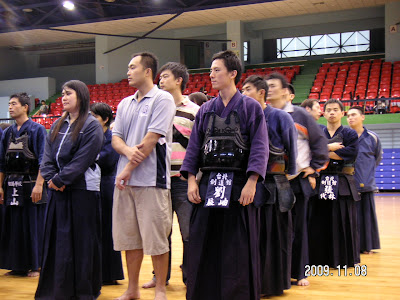
2009 Taipei Chung-Cheng Cup


Yesterday, perhaps the biggest yearly kendo competition in Taipei took place in the Taipei Sports Hall. We (Taipei Kendokan) have two men teams, one above 30 years-old and the other under, and two female teams. This was the second time I fought in the competition in Taiwan, which was also the second time I represented the Taipei Kendokan. I feel privileged, of course, because there are full of strong players in my dojo, and still Ho-Sensei and Sempais asked me every time if I want to participate in the competition.

I've been also eager to accumulate competition experiences, since it's always been my problem bringing out anything resembles the level of my kendo in practices. Nervousness had always made my muscles tense.

This time though I proved to myself that I can do it, thanks to my teammates who encouraged me to fight in the final. They could have sent the best five, all at the 3rd/4th Dan level. "Do you want to give it a shot?" Our captain asked me. With a slight hesitation, I nodded. What went across my mind was, "What if I lose? Or worse, what if I can't even put up a good fight and make a fool out of myself and the team?" I don't know. But what I knew was that if I didn't try, I'd never know and never cross that barrier.

I was assigned the senpo position (the first fighter), meaning that my job was to either win or draw. Because it matters to the overall spirit of the team. Up from sonkyo, I immediately applied pressure and striked men. My opponent blocked it, and pushed me to the floor. It was only seconds into the match. I bet my teammates were speechless. They told me from the outside that I should jump a little to loosen up my body, which also refocus my mind. I did as told, which you can see from the video. :) My moment came as my opponent missed a strike and, immediately after turning back, he wanted to strike. I took his kote. What a sensation! Especially from the cheering of my teammates! Though I lost in the end, my teammates were very happy about my performance and gave a lot of encouragement. They went on to recover and finally win the whole match. Wow!

To be honest, I think he wasn't much stronger than I was, but he certainly had more competition experiences than I did. I was pleased with myself that I didn't let my nerve took over, which had been my biggest problem so far. If I can achieve this every time in the future, it will be much easier for me to learn and gain the experiences I need.

(I was the red)


Some thoughts:
  • If the opponent is large and keeps pushing, step sideways so that his momentum doesn't come directly at me.
  • Execute hikki-waza immediately when the strike was invalid and we end up in tsubazeiai.
  • Observe the habits of the opponent and react accordingly. For example, how he blocks strikes.
  • When separating from tsubazeriai, becareful of strikes from mid-distances. For example, the second men point he got in the match.
  • Eat more and put up some weight!