This is a blog that I started in April 2006, just after I first put on my bogu (kendo armour). It collects the advices given by more experienced kendo practitioners as well as those from my own experiences. Both technical and the mental aspects of kendo are written in the blog. I hope someone will find them useful or interesting at least!
This year Ozawa Sensei came again to Taiwan for a few days. Again this year, Takano Sensei and Fukui Sensei (both 7th Dan) came with him. It was his first time in Taiwan after obtaining the 8th Dan, and was invited to give a seminar aimed at kendo instructors and senior students at university kendo clubs and alike. It was different from the past two years when he came just to visit different dojos and practised, this year he actually instructed, and taught A LOT -- more than what I have ever seen him talking in such a short time.
The seminar ran for two days with many 4-5th Dan kendoka attending.
Warm-up and Kihon
Ozawa Sensei started with some exercised for warming up, like taking large leaps forwards and backwards while maintaining the body balance. This strengthens the leg muscles.
Then he explained some kihon. Kirikaeshi and men-uchi. Because most of the participants are seasoned kendoka, he didn't say too much about them. Only that there are two types of pace for the kirikaeshi: For beginners the cuts should be clear and speed is less important, and for advanced, the cuts will be fast and continuous. Later during lunch, while he answered people's questions, he said that there are three types of receiving the sayu-men cuts for the motodachi:
Holding the shinai straight up vertical. This is the normal way.
Cutting against the kakarite's shinai while he cuts. This is for against stronger kenshis whose cuts are powerful, or when you want him/her to make powerful cuts.
Be flexible with the shinai. This is for receiving cuts from children, women or less powerful kenshis.
Oji-waza
After some basic cuts when we were ready for some more advanced stuffs, we started practising oji-waza. Ozawa Sensei explained some techniques:
Men-nuki-do: Seme. When the opponent just raises his shinai to attack men, raise the shinai to strike do while quickly stepping to the right. The step to the side needs not to be big, but the timing is critical. The body should stay up-right and should not bend.
Men-suriage-men: Use the middle part of the shinai to deflect the opponent's shinai in an upward sliding motion, then immediately strike down.
Men-debana-kote: The critical point is to take the opponent's centerline before he launches his attack. In this way, his shinai naturally moves to his left side to expose his kote. If the opponent takes the centerline, then you must take it back. Otherwise, the kote is hard to hit.
We also practised kata, but I won't write the details here.
Others:
I am truly grateful that the senseis took special attention to my performance. Whether kihon or kata, the senseis asked me either to demonstrate in front of the others or watch critically. While I was doing suburi, he also watched to check if I was doing it correctly.
The small men cut is not different from the big cut, except only that the shinai is not raised as high. The rest of motion, raising the arms and cutting down are all identical. He said it's bad to extend the arms and do an upward arc movement. However, I know some senseis specifically teach this way. Well, choose whatever suits you I guess. But I stick to whatever Ozawa sensei says. Unless I become as good as him someday (maybe it will never happen).
During the only one jigeiko that I managed to have with Ozawa sensei, I took time to seme. Although my performance was poor, especially my lower body was too tired to follow up, it was different from before when I more or less struck relentlessly.
Takano Sensei said that he understood my will to become stronger, but in jigeiko I should not bend or dodge, otherwise, I would never improve.
During the dinner on day 1, Ozawa sensei said my upper body became stronger and broader compared to before. He jokingly said that I was so thin that wind can just blew me away, haha. However, my legs are not strong enough. He said that I should strengthen them by doing the exercises he taught me.
I told Ozawa Sensei that I want to be strong at shiai when I'm still young, and asked him how to prepare for shiais. He only said, " Never give up!"
After Sensei when back to Japan, he wrote me and said that I must now try to use wazas learned in jigeikos. I will try my best!! See you next year!!
(I've become quite busy in the past few weeks, so finding anytime to write blog has been difficult. Sorry for not writing it in a style more pleasurable for reading!)
To elaborate on the method of gripping the shinai I talked about in my last blog entry, I extract some figures from the manuscript from Toshio Matsumoto (9th Dan Hanshi), the same document which I quoted for describing the Natural Stance Kamae.
The position of the end of hand grip should rest in the left hand as shown here:
The two muscles circled in the upper figure should be used to squeeze the end of shinai. (Aki Suzuki Sensei form Tokyo once told me the same.) Likewise, the same muscles of the right hand have also the same function.
The feeling is like supporting an egg with these two muscles without breaking it, as shown above.
The right hand should grip the shinai in a way that is hard outside but soft/flexible inside. To explain, he use the analogy of a "bull crap under the sun (hi na ta gu so)", which is hard outside but soft inside (rather interesting don't you think ;)?).
The position and angle of the thumb should be straight and relaxed, directed roughly parallel to the floor, as shown below:
This is connected to what I described with the right hand grip in my last entry.
After two weeks of absence, my feet become slow again. After striking, I felt that I was dragging my feet over the floor.
However, Hsu Sensei corrected the way I hold the shinai with my right hand. I should hold it in such a way that makes the V-shape more apparent, facing myself. In other words my index finger is less perpendicular to the hand grip. This way, I naturally use more of my little finger for clutching the shinai.
I really want to get the speed up with my men cut. The slowness seems to have something to do with my foot work. Maybe it's because I don't push fast enough with my left foot, and my body center is not low enough. An indicator is the sound of fumigomi. The ideal should be a sharp "slapping" sound as almost all the japanese kendokas seem to have somehow.
Sometimes I get striked on the men when I doesn't cover it properly with my shinai. I raise my shinai to block, but my upper body bends back instead of dodge to the direction of the shinai. The bending backward creates a space open for the opponent to reach my men.
The other day while practising with Chou-Sempei (周群堯), I got hit again like this. I realised that I didn't trust my shinai enough. I didn't have the confidence that it can defend me against my opponent.
But then isn't it the same with attacking? To commit the strike, throwing the body onto the opponent to execute a powerful strike, is also to trust in the weapon in your hand that it's going to slice the opponent in half.
Didn't the folk use to say: "Becoming one with the sword?"
My performance in the last few trainings have been up and down. In some trainings my strikes were solid and confident, while in some I couldn't seem to commit my strikes fully. In situations where confidence was lacking, I not only attacked less and reacted slowly but I tend to bend my upper body backwards too often to avoid strikes. What a waste of training time.
In last night's training, however, I could commit to my strikes. It was almost like a conscious decision that I was going to launch my strikes forwards with confidence, and then I did it. It had also a lot to do with the fumigomi. When I stomp solidly on the ground, it helped to bring power and speed in my strikes.
Last night I also strike the do successfully for the first time against Ho sensei. First I put some seme and strike his shinai from the omote side as though I'm going for the men cut, and then I quickly switched to do.
Chang-sempai (張代林)let me practised small men-cuts after doing jigeiko with him. He asked me extend my arms up until the tip is just above the opponent's men, and then extend my arms and wrists forwards. Importantly, the wrist should not flex backward before striking, which was difficult for me since I was afraid of not having enough power. Bring the power in strike in this way requires good tenouchi with the body going forwards at the same time. I need to practise more.
For some reason, in the last training while practising with Ho-Sensei I could do clean and solid cuts. I could bring my body forwards, and could feel that my posture was straight from the beginning of the strike to the end zanshin. Ho-Sensei gave me some encouraging words because of that.
However I then asked myself, how can I do this in every training? For that, knowing the reason why I did well is important. I suspect that it was because I was very focused on every strike, partly due to the weather condition, the ONLY thing I was able to put on my mind was me in kamae, and my opponent in his kamae. In other words, focusing on just myself and the opponent is essential in bringing out powerful and committed strikes. I need to remember this and try to do this every time.
Another good news is that we have another young visitor, Marek Novak, from the Czech Republic, in addition to our already old friend Adam Urban, training for the summer in our dojo. Welcome!
Last Saturday I went to the morning keiko (Asageiko) at the Taipei Japanese School again, where Kamiyama (上山) Sensei (7th Dan Kyoshi) heads the training.
After the keiko he gave very valuable advices on the correct fumigomi and the practice for it, which I will describe in the following.
Step 1: Take one large step forward with the right foot. One main point is that when the right foot makes contact with the floor, there is a sheer-like force going, not straight down, but forward-down as shown in the picture below.
Step 2: Quickly draw the left foot to the right one, and stand on the soles of the feet, so that the body is going slightly up.
Step 3: Repeat the exercise.
This is really the tip that I have been looking for to improve my men-strikes, for a long time. So I'm eager to share with you guys here! Hope it helps!
This weekend will be one of the biggest event held by Taipei Kendokan so far - the 30th Anniversary - on this Saturday. There will be over 100 invited guests from other dojos in Taiwan and Japan, doing jigeiko and some team shiai. There will be 4 teams from us, 1 women and 3 men teams, and I will be fighting as Senpo in one of them.
Last night's training I didn't make my left foot follow up quickly enough after the strike so that my body tend to lean to the right. Sigh.... the annoying mistake popped up back again. When can I get rid of it completely?
Kuroda-san and I met in Czech Republic about 4 years ago, when Ozawa Sensei was invited to Prague to hold a kendo seminar. Since then we've kept in touch, and met up for kendo and drink every time when I went to Japan. It all seemed like yesterday, and yet so far away. He is truly a special friend. Now I'm happy that he finally comes to Taiwan and visit me.
He arrived on Friday 3/29, and in the evening I took him to the Taipei Kendokan. As usual the training started with kihon, waza-geiko, mawari-geiko and jigeiko. Kuroda san's perfect body posture and balance could not be more familiar to me, and that's his uniqueness.
After the training at Taipei Kendokan.
My practice that evening was not so great as my right arm was too tense all the time. But it was nonetheless enjoyable to play kendo again with my old friend.
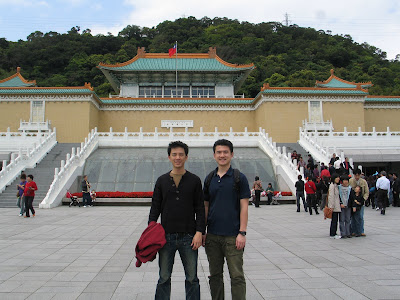
At the world-famous National Palace Museum.
Monday, 29th March
I took him to the Nation Chiao Tung University (NCTU) kendo club, and Kuroda san was asked to lead the session. The members who turned up for training were:
upon the point of contact between shinai and the men, the left arm is inclined with the shinai when looking from the side.
one should practise more large men-cuts. If one is good at large cuts, he/she is naturally good at small cuts.
Wednesday, 31st March
On Wednesday I took him to the National Tsing Hua University kendo club. The members who turned up that evening included many more advanced, who have trained for 2-3 years. Kuroda san was again asked to teach. So I told him that, and suggest he gave more tips on seme-techniques and correct attitudes as well as how to obtain them during training:
Kote strikes:
when practising kote, the kakarite should occupy the centerline first, and then the motodachi should push back at the same time create an opening while the kakarite makes the kote strike.
the kakarite should strike along the centerline.
Seme:
always keep in touch with the motodachi's shinai before striking.
when sliding the shinai against the opponent's shinai, the kensen should lower slightly, so that it is difficult for the opponent to move the shinai to the other side and hit kote.
Do-strikes:
To seme, move the body forwards and direct the tip of the shinai towards the opponent's kote at the same time pressing his shinai down. This makes him want to raise his shinai up. At this moment strike do.
For me, he gave me the following advices:
My seme is too quick, and the opponents raise shinai easily to block. I should make the movement more subtle and slower, in order to let him feel the pressure and strike first while I use oji-waza.
Relax my right arm.
I hope Kuroda-san comes again soon!!
Here is one short clip of our jigeiko. Note: At the end of the clip I struck men when he attempted a kaeshi-do, but didn't manage to block the men-strike.
Last night I practised at Taipei Kendokan. There are some sempais from the dojo whom I just don't know how to fight. What makes me feel the most hopeless is when I loose over and over again the simplest ai-men strikes. When this happens, I get annoyed and want to make more men-strikes to prove that I can do it, which only makes my moves become even more predictable. I'm not sure how to act in this situation...
This Wed I practised at the Hsing-Hua University Kendo Club. There was a good turn-out rate, especially considering that they just had a competition last week. We started with the ooikomi-geiko with sayu-men, and then renzoku-wazas. My forearms were mildly tense after these exercises. "I used the correct parts of the muscles," I thought.
In the end we had about 20-minutes jigeiko. My opponents were all junior to me, so my goals were to use as much oji-waza as possible. However, I also found that most of them don't know how to hold the center, and how to attack the centerline of their opponents.
This is something really difficult to explain. For me, I understood what the "center" is after training with many Senseis and Sempais with strong centers. I think only when training with such people can one understand what it is.
Tomorrow I will attend the joint practice for all kendokas in Taipei. Looking forward to it!
Happy Chinese New Year!! Wish you a good health and fortune in the year of Tiger!!
There have been full of end of (Chinese) year parties from my company as well as working for deadlines, which occupied most of my Fridays in the past few weeks. So I trained seldom. This Wednesday my body couldn't stand anymore, and took a train to and back from Taipei on the same day just for kendo.
My left fingers felt rather weak from a mild injury, which I think was caused by overstressing it when I did suburis at home. And my body felt a little heavy from all that eating, so I didn't feel so agile. However, I tried my really best, especially when doing jigeiko with Ho Sensei.
Ho Sensei commented after our jigeiko that when I should hit kote straight-on instead of turning already sideways and hitting with an angle.
In every training I've been to since coming back to Taiwan, the senpais have helped me a lot to correct some of my bad habits. Apart from extending my arms farther, relaxing my right arm more, and yesterday Chang senpai pointed out my upper body leaned a little backwards when striking, while I should keep it up-straight. On the good side, my hip is coming forward, on the downside, the range of my reach is shortened.
This Sunday I will take the new High Speed Railway to Kaohsiung City and participate in the Asian City Cup. This is an invitational competition with teams from Taiwan, Japan, Korea and other nearby cities. So, many strong players will take part. There will be about 10 guys from my dojo going. I will try my best!
The temperature in Taiwan these days are getting warmer and warmer. Humidity, is the main problem. Luckily Taipei Kendokan has a good ventilation system, but even so the floor feels especially sticky, and needs some getting-used-to.
The training routine here is roughly as the following:
Kirikaeshi
Men-strike from issoku-itto-no-maai (large strike).
Men-strike from to-maai with seme (small strike).
Kote-strike from issoku-itto-no-maai (large strike).
Kote-strike from to-maai with seme (small strike).
Dou-strike from to-maai with seme (small strike).
(Sometimes tsuki)
Men-hiki-men/kote/dou-men.
Kakarigeiko
Waza-geiko
Mawari-geiko
Jigeiko
During jigeiko people are free to take a break and drink some water, though some would carry on without any break, who in my opinion have unbelievably strong stamina.. Because the training routines before then are very intense, plus in this kind of temperature.
There were many notable instances in the training yesterday.
While doing the ai-kote-men with Ho Sensei, my men-strikes could never win his, which were faster and stronger.
Mr. Shu-Hsin Du (杜時鑫), 4th Dan, does blitzing men-strikes, which caught me many times when doing jigeiko with him.
Advices from Ho Sensei:
Make sure the left hand is struck-down solid and forwards when striking. Raising the shinai too much makes the kote prone to debana-strikes.
Do not hold back when doing tsuki.
From the training in the past few weeks, I think my body-posture during men-strike has greatly improved. My left foot can also follow-up easily now. However, my tenouchi is still way too weak. Need to improve on that..
Kendo aside, I took some pictures from my trip to Tainan, a southern city in Taiwan, an old town full of cultural history.
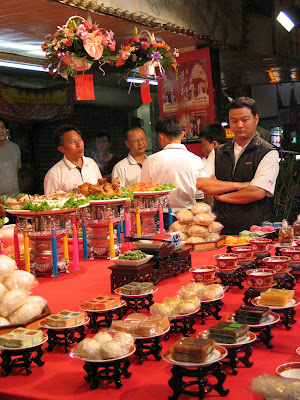
Here I bumped into a Taoist ceremony for the thousand-year birth of a god.
Yesterday was my second training at Taipei Kendokan. As expected, many people turned up on the Friday's session, and the good thing about this dojo is that, there are enough space and enough people to practise the whole evening without rest. After two hours of solid training, I could hardly walk straight.
I expressed my wish to the leading teacher Ming-Hua Ho Sensei (7th Dan who had been on the national team many times until 2006 WKC despite being almost 50 years old) that I would like to join the dojo. After the training I went to have some food and drink with him and other sempais. I felt much welcomed there.
There were plenty of advices from sempais and sensei:
The left foot should not raise upwards during the men-strike. It should follow quickly up with the right foot.
When striking kote, extend the arms forwards more, instead of making the kensen pointing vertically upwards.
Got the same advice from another sempai to relax my right arm when striking men, so that I can extend the kensen forwards more. So it must be an obvious mistake..
For doing small men-cuts, raise the hands until the right one is roughly at the level of the oppoent's tsuki tare, then flex the wrist to strike.
Ho Sensei said my kendo became worst compared to last time when I was here !!! He said I had much stronger seme before (a few months ag0), but this time it was gone... It sounded like a sharp knife carving from my forehead straight-down to my testicles. But I know what he meant and it was true. It was partly because I was too tired already when fighting with him and I just wanted to do men-uchigomigeiko. However, on the positive side, he thinks I HAD seme. ;-) I need to work hard now.
Two Sempais, a male (Mr. Su) and a female (Ms. Hsieh), kendokas from the dojo who happened to be a married couple are selected to represent Taiwan in the World Kendo Championship this year. I was told that for the selection of the men's team, there were 63 candidates, all 3rd Dan above (which was a minimum requirement), and they must fight with each other until the final 7 or so winners. Imagine the number of matches they had to go through ... Anyways, I wish them luck!
Yesterday evening was my first training after arriving in Taiwan, at the Taipei Kendokan. Not so many people turned up, because it was a Monday, however, I had a good practice, and recieved very valuable advices from Mr. Dai-Lin Chang (張代林), 5th Dan.
Some advices he gave me:
He asked me to extend my right arm farther forwards in order to gain an extra distance. It makes a lot of difference indeed.
He also encouraged me to push my hips more when doing kote-men.
There was a lady I-Chi Liao (廖依綺) who is probably 2-3rd Dan, whom I had a chance to do jigeiko with. I was surprised by how fast she was and the pressure she put forward.
Though only 6 people were at the training, it was a good starter for me, and I am already excited by how much I can learn in the forth-coming years.
One of the things that I have concentrated on since last year training in Tokyo is to increase my wrist strength. And fortunately, I have been making steady improvement.
It is told by almost any teacher that the wrist strength is important for making the strikes sharp, and hence validating a point. However, its significance is much further beyond the mere sound effect. The following is a list of the other benefits:
It keeps the upper body up-straight. A lot of young kenshis (for example high school students) and beginners whose sole interest is winning tend to let the upper body lean forwards when striking men, in order to add an extra speed and strength to the strike. If this can be achieved by the wrist movement along, the leaning of the body can be avoid. This of course looks better, and is also essential if one were to make continuous strikes.
Better ki-ken-tai-ichi and more explosiveness. These are direct consequence of the previous point. Because if one keeps the body up-straight during seme or at the initial stage of the strike, it is very difficult for the opponent to detect when the strike will come.
Shikake-wazas rely heavily on wrist strength, as elucidated by Ozawa Sensei when I was in Tokyo. They include harai, maki, osae, and of course kote-men, etc.
How to increase wrist strength?
Many ways. In fact, I have seen many people telling each other special exercises on how to increase wrist power, but I think the most effective exercises are the OLD SCHOOL STUFFS: kirikaeshi, renzoku-waza and continuous men-strikes raising the shinai to the "medium" position (see here for explanation). While doing them, make sure the arms and the wrists are fully extended. Especially the right index finger, if straightened, should point downwards as much as possible, instead of pointing horizontally (with the right arm being horizontal).
In the past few months, I've focused more on the correctness of strikes, and it's been a while since I spoke of fighting spirit and the controlled aggression towards my opponent. I think it's about time that I bring more of that element into my kendo again.
It seems that the improvement in kendo is a perpetual process of proving ki (fighting spirit), ken (sword) and tai (body). The meaning of fighting spirit is self-explanatory. The sword is, for example, the sharpness of the strike. The body means, of course, good posture, brining the hip forwards and good footwork.
Today I was practising my footwork after the men-strikes using the mindset I mentioned in the last entry, which helped a lot still. But one more problem was that my strikes weren't sharp enough after I became tired. I almost "gave up" at the moment when I launched forwards with my feet.
I should commit to every men-strike whole-heartedly and execute proper movements in jigeiko, instead of making half-way and mediocre strikes.
Since coming back from Kyushu I have been training everyday apart from the weekend. The training time in Kobukan is temporarily shortened to just more than 1 hr due to neighbours' complaints. Hopefully after putting on sound-proof walls the training time can be extended to normal length. For this reason, training in Kobukan is not enough, I feel. Fortunately, I have also been to Nittaidai (Nippon Sport Science University) and Rikkadai (Tokyo University of Science) about once a week.
When striking...
Up to now I have received much more advices and instruction from Ozawa Sensei and other Senseis on Kihon and Waza than last year. Footwork is the most urgent thing I have to improve. He told me that one should attack from the lower abdomen. One should tense up the muscle when striking and stomping. He made me feel his lower abdomen when he struck. Indeed, the muscle tensed up rock-hard momentarily and relaxed.
Kirikaeshi
On kirikaeshi, I practised with Kaji Sensei in every training when he was present. First time he told me to swing the shinai up and down along the centerline. And to extend the right wrist more when striking sayu-men. On the second time, he asked me to relax me shoulder more. On the third time, my strikes slid off sometimes. It's hard to be perfect indeed, but I'm on my way...
Tenouchi
On our way back from Rikkadai Chiba Campus to Tokyo, Suzuki Sensei looked at my left and right palms to inspect the calluses. The right one should not have any callus, as for the left one she said the following. "The sides of the thumb and index fingers that touch the shinai grip should not have calluses," she said, "because they are not used to exert force. The important part is the muscle below the thumb. This part is used to grip the shinai when doing tenouchi. " "When gripping, the thumb wraps the shinai in the direction of the middle/ring finger, and not the index finger, which is a common beginners' mistake."
Are you making this mistake?
I will write about my trainings in Nittaidai and Rikkadai in the next entry.