Match 1
Showing posts with label videos. Show all posts
Showing posts with label videos. Show all posts
Tuesday, April 17, 2012
Was I asleep?
The title is the conclusion from my competition at the end of March. Our team didn't advance into the finals. And I won only 1 match. The points I lost was by the total lack of maai, and the seme was not strong enough. I was rushing to attack. However, the performance by my teammates in the single competitions were really good. Here I show some clips. The prizes were all won by my teammates. Click into the youtube link to see who the competitors are:
Match 1
Quarter Final 1
Quarter-final 2
Semi-final
Final:
Match 1


Thursday, March 22, 2012
After a short break
After a 3-weeks break from the kendo training, which felt like ages while the guilt was piling up, I went to the training last evening. Since my senpai asked me to participate the competition in two weeks, I really have to practise now.

In the pass 3 weeks, I was busy with my own outside-of-work project, and also took the chance to fix my neck-shoulder problem with some physiotherapy and acupuncture.
In the training yesterday, my body was drained quickly. However, with a couple of more trainings I should be able to get back in shape.
The video below is a clip from two strong kendokas practising yesterday. Liang Senpai (the slimmer and steadier guy) is the new Taiwanese nation team member who is currently 5 dan. Another is a young 20 year old kenshi, Yasuraoka, 3 dan, who studies aboard at the renowned Tsukaba (筑波) University for the kendo program, and now on vacation. He has a Japanese surname because he is half Japanese and half Taiwanese.

In the pass 3 weeks, I was busy with my own outside-of-work project, and also took the chance to fix my neck-shoulder problem with some physiotherapy and acupuncture.
In the training yesterday, my body was drained quickly. However, with a couple of more trainings I should be able to get back in shape.
The video below is a clip from two strong kendokas practising yesterday. Liang Senpai (the slimmer and steadier guy) is the new Taiwanese nation team member who is currently 5 dan. Another is a young 20 year old kenshi, Yasuraoka, 3 dan, who studies aboard at the renowned Tsukaba (筑波) University for the kendo program, and now on vacation. He has a Japanese surname because he is half Japanese and half Taiwanese.
Tuesday, January 10, 2012
Selection of National Team Members
Ok, so, I went for the nation team member selection on last Saturday, a tough day it was! In total, 65 male and 35 female candidates from all over the island took part in the selection. We were divided into 4 pools, meaning that each team has 16 people, and each of us had to fight 15 matches, whether you advance into the next stage or not.
The top from each pool will be selected as the team member, and the 2nd, 3rd, and 4th from each pool advance to the next round. In the end, 7 are selected as the first players and 3 are selected as the backup players.
The large number of participates meant that we had to fight for 7 hours. It was absolutely exhausting, both physically and mentally. I started out performing badly in my first 3 matches or so. My reaction and movement were slow. It's like I hadn't woken up yet. And it gradually got better.
Everyone fought differently, so I had to adjust my strategy for different opponents. I definitely lost far more matches than I should have, however, being able to perform wazas like kote-uchiotoshi-men a couple of times made me feel good.
My thoughts for the day are:
The top from each pool will be selected as the team member, and the 2nd, 3rd, and 4th from each pool advance to the next round. In the end, 7 are selected as the first players and 3 are selected as the backup players.
The large number of participates meant that we had to fight for 7 hours. It was absolutely exhausting, both physically and mentally. I started out performing badly in my first 3 matches or so. My reaction and movement were slow. It's like I hadn't woken up yet. And it gradually got better.
Everyone fought differently, so I had to adjust my strategy for different opponents. I definitely lost far more matches than I should have, however, being able to perform wazas like kote-uchiotoshi-men a couple of times made me feel good.
My thoughts for the day are:
- Fighting spirit is very very important. I found the best way to get it out of me is to regard every opponent as a strong a respectable player. This way, my mind become sharp, as well as my movement. Because I found that my performance was much better against people whom I thought were stronger than me.
- My kote-men should be faster. This lies on my footwork. So I have to improve this during training.
- Sometimes I raise my kensen before striking men. DONT DO THIS.
- Relax my body more.
- Keep my foot close to each other.
- Be careful of my zanshin. Very often I let my men open after striking kote, and also not separating myself far enough from the opponent.
- Be careful when the opponent is at the close range, and also do not let go of chances to attack.
The below were two matches. I'll let the action speak for itself!
(I'm the white on in the first video, and red in the second.)
(I'm the white on in the first video, and red in the second.)
Friday, January 06, 2012
Happ New Year 2012

First of all, let me wish everyone a Happy and Successful New Year!!!
I had done so much in 2011 - making a lot of new friends, founding a rotary club, starting a new blog, finding a new direction in career, while maintaining regular kendo practices. Sure, I cannot say that I achieved a great deal in kendo last year, but overcoming obstacles and attending practices required a lot of self-motivation in my circumstances. I am glad that I was able to do it.
My kendo level has gone from kihon-only style to a style involving more wazas. Putting pressure and creating "false openings" to lure the opponent in striking. This requires very good timing and attention on the maai, as well as a full concentration.
However, I still need to make more effort on my practising kihon and suburi at home. My body condition has declined due to the long commuting everyday, hopefully I will be able to switch my job later this year to somewhere closer to home.
Ozawa Sensei visited in December as usual. I told him that I kept loosing in competitions in recent times, and I haven't been able to overcome this problem. And the thing is, sometimes I do not know what the problem is, that my performance in competitions is so much worse than in the normal practices.
He told me that, if only I give out 50% of my performance in practices, I would win. And the most important is to keep the fighting spirit high, and never give up.
He also said that the kendo in keiko, competition and examinations are the same. I should not do differently. I should always keep this in mind.
Below is a clip between Ozawa Sensei and Tokura Sensei (7th Dan, former national team coach of China)
Tuesday, December 06, 2011
Congratulations Suzuki Sensei on passing 7th Dan!

 |
| I met Suzuki san (right) for the first time in 2007. |
The below is a video clip showing Suzuki san (in blue) demonstrating the kakari-geiko with a femail Czech kendoka. Notice her swift footwork!
Wednesday, November 09, 2011
Developing one's own style
Ho Sensei said at the end of today's training, that as we advance into higher Dan-grades we should start to be more aware of ourselves, and at the same time develop our own kendo styles. It will come naturally with the personality and the physical conditions.
Below is the video from Monday's training between two Senpais (there's HD version if you click on it)
Below is the video from Monday's training between two Senpais (there's HD version if you click on it)
Tuesday, November 01, 2011
Training video
A little thought: In Kamae, if I apply equal force on both hands to grip the shinai, I tend to strike with the right. However, I found that if I grip harder using the left. I naturally use the left hand to strike, which evidently much more powerful.
Now this is a video in yesterday's training, between Chang senpai (5th Dan on the left) and a visiting Ogawa Sensei (7th Dan) from another dojo. Good kendo and a good fight!! Enjoy!!!
Tuesday, July 12, 2011
Training video
Two Sempais, Chang and Liang, both 5th Dan doing jigeiko. Sorry about the noise of the electric fan. If I turned it off everyone would be steamed to dead in the summer climate.
Thursday, April 01, 2010
Kuroda-san's Visit in Taiwan
Kuroda-san and I met in Czech Republic about 4 years ago, when Ozawa Sensei was invited to Prague to hold a kendo seminar. Since then we've kept in touch, and met up for kendo and drink every time when I went to Japan. It all seemed like yesterday, and yet so far away. He is truly a special friend. Now I'm happy that he finally comes to Taiwan and visit me.
He arrived on Friday 3/29, and in the evening I took him to the Taipei Kendokan. As usual the training started with kihon, waza-geiko, mawari-geiko and jigeiko. Kuroda san's perfect body posture and balance could not be more familiar to me, and that's his uniqueness.
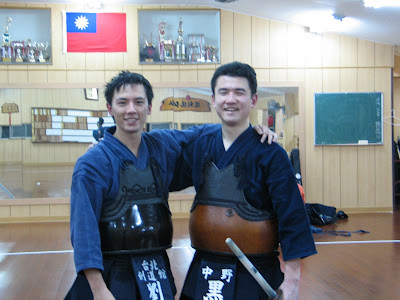
After the training at Taipei Kendokan.
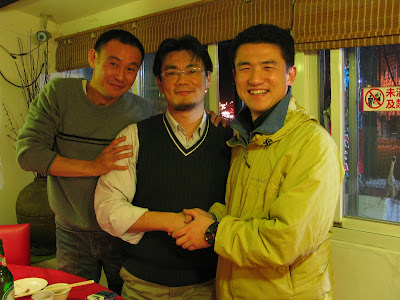
My practice that evening was not so great as my right arm was too tense all the time. But it was nonetheless enjoyable to play kendo again with my old friend.
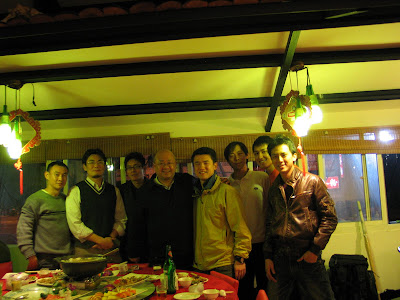
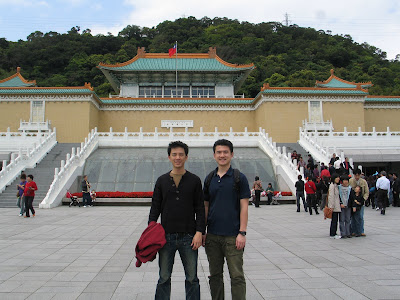
At the world-famous National Palace Museum.
He arrived on Friday 3/29, and in the evening I took him to the Taipei Kendokan. As usual the training started with kihon, waza-geiko, mawari-geiko and jigeiko. Kuroda san's perfect body posture and balance could not be more familiar to me, and that's his uniqueness.
After the training at Taipei Kendokan.
My practice that evening was not so great as my right arm was too tense all the time. But it was nonetheless enjoyable to play kendo again with my old friend.
At the world-famous National Palace Museum.
Monday, 29th March
I took him to the Nation Chiao Tung University (NCTU) kendo club, and Kuroda san was asked to lead the session. The members who turned up for training were:
- upon the point of contact between shinai and the men, the left arm is inclined with the shinai when looking from the side.
- one should practise more large men-cuts. If one is good at large cuts, he/she is naturally good at small cuts.
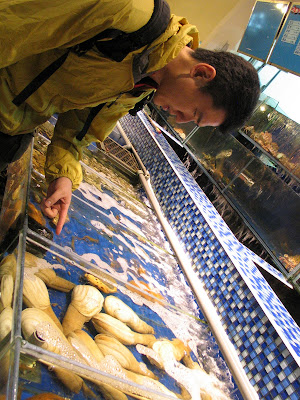
Wednesday, 31st March
On Wednesday I took him to the National Tsing Hua University kendo club. The members who turned up that evening included many more advanced, who have trained for 2-3 years. Kuroda san was again asked to teach. So I told him that, and suggest he gave more tips on seme-techniques and correct attitudes as well as how to obtain them during training:
Kote strikes:
- when practising kote, the kakarite should occupy the centerline first, and then the motodachi should push back at the same time create an opening while the kakarite makes the kote strike.
- the kakarite should strike along the centerline.
Seme:
- always keep in touch with the motodachi's shinai before striking.
- when sliding the shinai against the opponent's shinai, the kensen should lower slightly, so that it is difficult for the opponent to move the shinai to the other side and hit kote.
Do-strikes:
- To seme, move the body forwards and direct the tip of the shinai towards the opponent's kote at the same time pressing his shinai down. This makes him want to raise his shinai up. At this moment strike do.
For me, he gave me the following advices:
- My seme is too quick, and the opponents raise shinai easily to block. I should make the movement more subtle and slower, in order to let him feel the pressure and strike first while I use oji-waza.
- Relax my right arm.
I hope Kuroda-san comes again soon!!
Here is one short clip of our jigeiko. Note: At the end of the clip I struck men when he attempted a kaeshi-do, but didn't manage to block the men-strike.
Sunday, January 17, 2010
Short Kendo Film
A short kendo film about kendo, made by Hungarian film maker George Perrin, starring mambers from Budapest Fonix Kendo Club. The trailer is very well made that touches me as a kendo practitioner who is going through these stages of training.
Thursday, December 17, 2009
Ozawa Sensei's Visit 2009
As promised last year, Ozawa Sensei came again this winter, and brought Tanemichi Chiba Sensei 8th Dan Kyoshi (Kendo lecturer in the Japanese Imperial Guard), Takano Sensei 7th Dan Kyoshi (Kobukan) and Fukui Sensei 7th Dan Kyoshi (Noma Dojo).
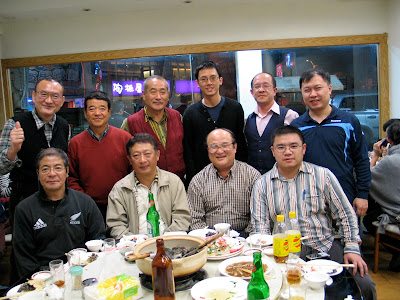
[First dinner in Taiwan.]
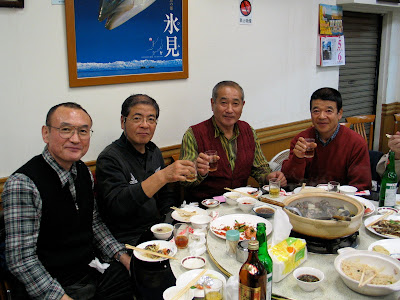
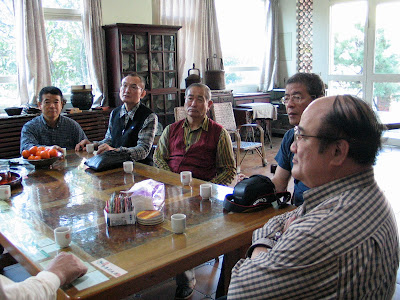
They came for 5 days, three of which had kendo practices in the evening. The first one was at the Taipei Kendokan. I've wanted to invite Ozawa Sensei to come here because I feel it's one of the dojos that play the kendo style most similar to Japan, or international kendo, instead of some simple whacking-on-the-head activity. And the members here are dedicated to improving their kendo, and strong kenshis. Of course, certain aspects are still missing compared to what is considered "beautiful kendo" in Japan, but I so far I really haven't seen much that outside Japan.
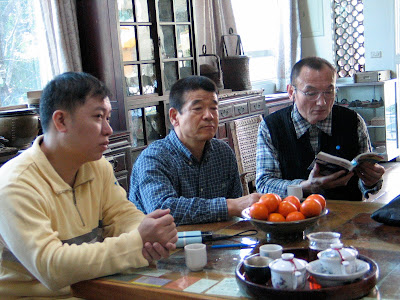
[Presents for the Senseis.]
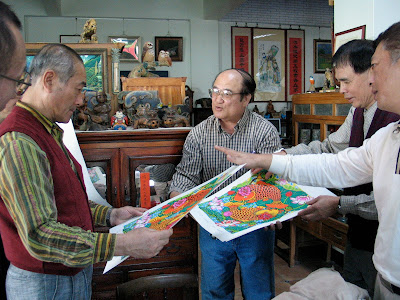

[Senseis had never tasted the dragon fruits.]
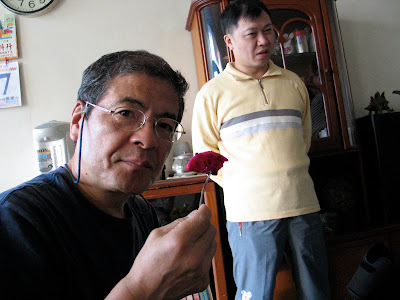
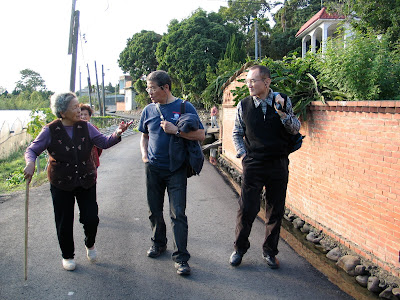
[The old lady spoke fluent Japanese and chatted to the Senseis.]
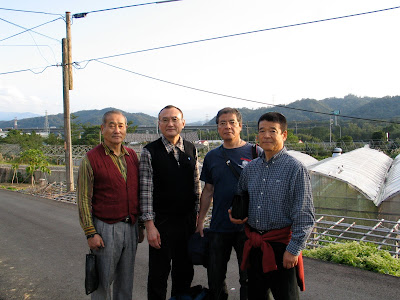
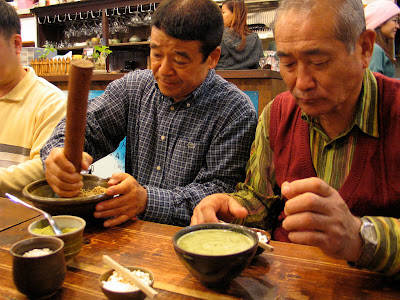
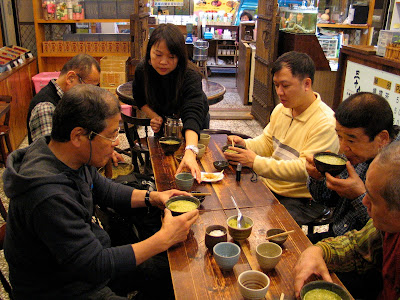
[Hakka traditional grinding tea.]
On Monday we went to the Taipei Kendokan. The turn out was good - about 20+ kenshis. I think everyone enjoyed practising with the 4 Japanese sensei. I was very glad about that.
Chiba Sensei gave us some feedbacks at the end of the training:
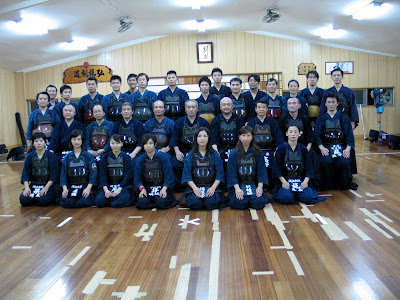

[Listening to advices from Chiba Sensei.]
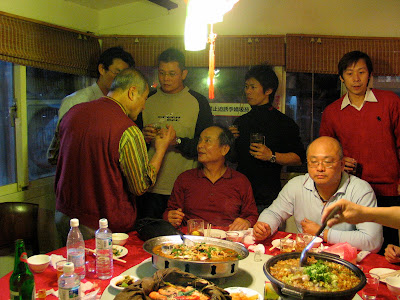
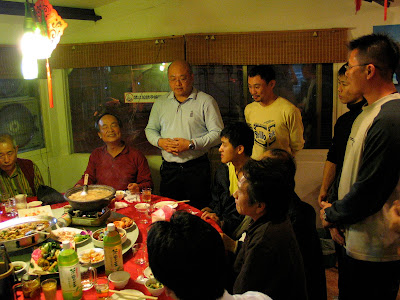
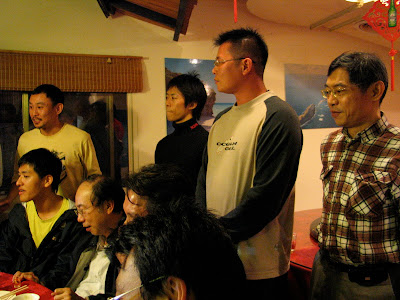
On the next day, after some sight-seeing on the Yang-Ming Mountain, we went to the China University of Technology, where a shot seminar is to be held.
[Yang-Ming Mountain]
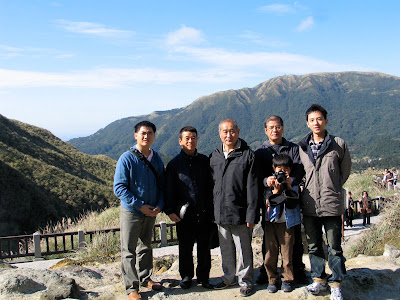
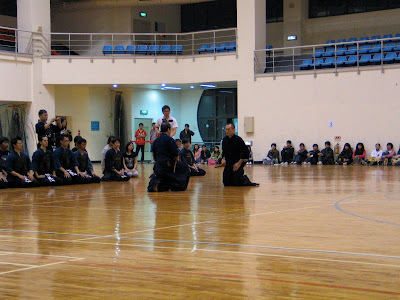
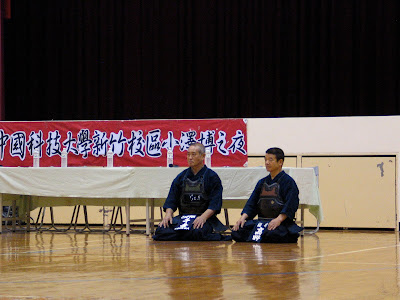
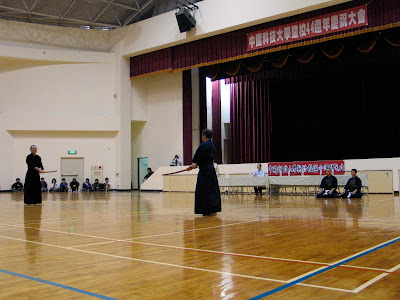
Ozawa Sensei and Fukui Sensei demonstrated the Mizoguchi-ha Itto-ryu kenjutsu. (click to view the full size)
[First dinner in Taiwan.]
They came for 5 days, three of which had kendo practices in the evening. The first one was at the Taipei Kendokan. I've wanted to invite Ozawa Sensei to come here because I feel it's one of the dojos that play the kendo style most similar to Japan, or international kendo, instead of some simple whacking-on-the-head activity. And the members here are dedicated to improving their kendo, and strong kenshis. Of course, certain aspects are still missing compared to what is considered "beautiful kendo" in Japan, but I so far I really haven't seen much that outside Japan.
I went to the airport to pick up the Senseis. When I saw Ozawa Sensei coming out from the arrival gate, I had the feeling of seeing an old friend again after a long while! Indeed it has been percisely a year since I saw him last time, during which I've moved from Germany to Taiwan, changed a new job, and moved from Taipei to Hsin-Chu, having lots of changes. It felt like a much longer time!
The next two days I took days off at work and accompanied with the senseis to travel.
Monday, 7th Dec
[Presents for the Senseis.]

[Senseis had never tasted the dragon fruits.]
[The old lady spoke fluent Japanese and chatted to the Senseis.]
[Hakka traditional grinding tea.]
On Monday we went to the Taipei Kendokan. The turn out was good - about 20+ kenshis. I think everyone enjoyed practising with the 4 Japanese sensei. I was very glad about that.
Chiba Sensei gave us some feedbacks at the end of the training:
- In kihon geiko, some people's men-strikes were too small. Kihon is very important, and one should try to strike properly.
- One has to break the opponent's kamae before striking. This is achieved by applying pressure, or seme, and occupy the centerline. The most effective way to apply pressure is to direct the tip of the sword towards anypoint between the throat and the middle of his chest, and move in. This is the most uncomfortable place a person feels when something is approaching.

[Listening to advices from Chiba Sensei.]
Tuesday, 8th Dec
On the next day, after some sight-seeing on the Yang-Ming Mountain, we went to the China University of Technology, where a shot seminar is to be held.
[Yang-Ming Mountain]
I assisted Takano Sensei in teaching the beginners without the bogu, about kendo etiquette (reiho) and kamae. The most challanging thing was to translate what Takano Sensei was saying from Japanese into Chinese. I could manage most of it, since I knew roughly what he was saying. However, to tranlsate word by word would still be difficult. I need to study Japanese harder!
Ozawa Sensei and Fukui Sensei demonstrated the Mizoguchi-ha Itto-ryu kenjutsu. (click to view the full size)
Ozawa Sensei and Chiba Sensei demonstrated Kirikaeshi.
Wednesday, 9th Dec
On the Wednesday I had to go back to work, and only joined them in the evening practice at the Hsin-Chu Kendokan.
Ozawa Sensei and Fukui Sensei demonstrated again the Muzogushi-ha Itto-ryu kenjutsu. I feel I can appreciate more and more of its beauty every time I see it.
After the practice, I asked Ozawa Sensei how my jigeiko was. He said that I should relaxe my body more. I think I wanted so much to do my best in front of him that I tensed up my muscles too much. He then invited me come to the Thank-you Dinner from him and the other senseis.
Thursday, 10th Dec
The whole was filled with meetings after meetings at work. Fortunately, the last meeting didn't drag on, so I could take the High Speed Railway to Taipei and take the dinner in time. We had good food and drink. At the end, when Chou-san took the senseis to the nearby night market for sight-seeing, Ozawa-Sensei invited me to stay and have some drink at the hotel bar.
We talked for 2 hours, which passed by very quickly, about kendo, travel, friends and life. He said one day he wants me to travel to England and Czech together. I said, "then I have to become very good in kendo!"
About kendo:
- One has to learn the correct kendo forms and develop good seme techniques, instead of relying one's kendo on the stamina, like many players nowadays in All Japan Kendo Championship, and some of other competitions. So kihon is very important as well as waza-practices. It is not good to let winning in competition as one's main goal in kendo.
- To strike small men, one should hold the shinai in chu-dan, and moving in with the hip without the shinai moving. At the correct distance (only towards the end), strike immediately. He said it is incorrect, like some people say, to extend the arms forwards from the begining when the body moves forwards.
- It is bad to strike too small. He explicitly said that right wrist should also flex up and down as well as the left. Some people might say this creates debana moment for the opponent. For this he replied:
- One should use seme and strike at the right moment, so that the opponent will not be able to execute debana kote.
- To have good and strong seme, one relies on having confidence with one's own techniques, or WAZA. So we should improve our waza.
He also said, to learn men-strikes, there are three stages:
- First raise the shinai above head, and then strike with the body moving fowards at the same time.
- First raise the shinai above head, then move the body forwards, and lastly strike.
- Keep the shinai in chu-dan while moving the body forwards, and strike.
This is a good reference for all the instructors when teaching the beginners.
Monday, November 09, 2009
2009 Taipei Chung-Cheng Cup
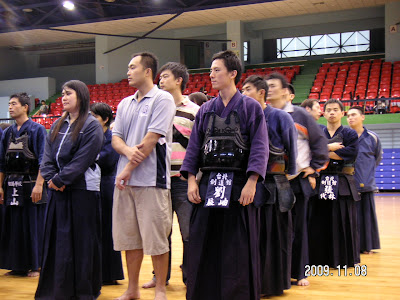
Yesterday, perhaps the biggest yearly kendo competition in Taipei took place in the Taipei Sports Hall. We (Taipei Kendokan) have two men teams, one above 30 years-old and the other under, and two female teams. This was the second time I fought in the competition in Taiwan, which was also the second time I represented the Taipei Kendokan. I feel privileged, of course, because there are full of strong players in my dojo, and still Ho-Sensei and Sempais asked me every time if I want to participate in the competition.
I've been also eager to accumulate competition experiences, since it's always been my problem bringing out anything resembles the level of my kendo in practices. Nervousness had always made my muscles tense.
This time though I proved to myself that I can do it, thanks to my teammates who encouraged me to fight in the final. They could have sent the best five, all at the 3rd/4th Dan level. "Do you want to give it a shot?" Our captain asked me. With a slight hesitation, I nodded. What went across my mind was, "What if I lose? Or worse, what if I can't even put up a good fight and make a fool out of myself and the team?" I don't know. But what I knew was that if I didn't try, I'd never know and never cross that barrier.
I was assigned the senpo position (the first fighter), meaning that my job was to either win or draw. Because it matters to the overall spirit of the team. Up from sonkyo, I immediately applied pressure and striked men. My opponent blocked it, and pushed me to the floor. It was only seconds into the match. I bet my teammates were speechless. They told me from the outside that I should jump a little to loosen up my body, which also refocus my mind. I did as told, which you can see from the video. :) My moment came as my opponent missed a strike and, immediately after turning back, he wanted to strike. I took his kote. What a sensation! Especially from the cheering of my teammates! Though I lost in the end, my teammates were very happy about my performance and gave a lot of encouragement. They went on to recover and finally win the whole match. Wow!
To be honest, I think he wasn't much stronger than I was, but he certainly had more competition experiences than I did. I was pleased with myself that I didn't let my nerve took over, which had been my biggest problem so far. If I can achieve this every time in the future, it will be much easier for me to learn and gain the experiences I need.
(I was the red)
Some thoughts:
- If the opponent is large and keeps pushing, step sideways so that his momentum doesn't come directly at me.
- Execute hikki-waza immediately when the strike was invalid and we end up in tsubazeiai.
- Observe the habits of the opponent and react accordingly. For example, how he blocks strikes.
- When separating from tsubazeriai, becareful of strikes from mid-distances. For example, the second men point he got in the match.
- Eat more and put up some weight!

Monday, September 28, 2009
Hsin-Chu Cup 2009


Although I didn't fight in the final match, since I didn't perfom well enough on the day and I thought the opponents might be too strong for me, I didn't loose the earlier matches, and had two wins and a draw.
The north-south competition featured 39 kenshis from the northertn half of Taiwan and 39 kenshis from the southern half. Much like the Tozai (East-West) Competition in Japan. Being a mere Nidan I was placed as the second person to fight, or aka the jiho. I didn't know I had to go up so early, therefore it was a little shock to me. Anyhow, I won 2-1 with two kote points.
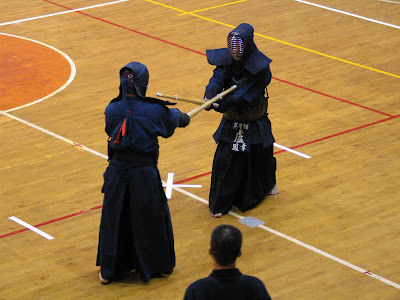
My performance on the day was unsatisfactory because my body was too tense, and at the same time my mind wasn't calm enough. It's only when there were large gaps between our kills could I perform clean cuts.
Some thoughts from the day:
- Learn to analyse my opponent and adjust fighting strategy accordingly.
- When facing an aggressive and young opponent, be calm and use oji-waza.
- Need more shiai experience!!
Here are some videos from the final match, the red side is Taipei Kendokan, and the white is Hsin-Chu Kendokan.
Senpo
Jiho
Gosho
Yonsho
Sansho
Fukusho
Taisho
Monday, June 08, 2009
2009 Asian City Cup, Kaohsiung
Last weekend was full of excitement and fun. About 10 of us from Taipei Kendokan traveled south to Kaohsiung to participate in this year's Asian City Cup Kendo Taikai, held at the historical Butokuden built during the Japanese occupation period. Renovated in recent years, it is a beautiful architectual work with nice atmospheric surroundings. It's also interesting to note that, the manager of the Butokuden and the organiser of this competition, Kin Chin (陳信寰), is one of the three 11th generation Soke (Headmaster) of the Hyoho-Niten-Ichi-Ryu, which is the school created by the lengendary samurai Miyamoto Musashi.
After arriving in Kaohsiung and dropping off our luggage, we headed for some food and drink - Taiwanese style. The video explains it.
Fortunately, I got up in the morning without headache. There was keiko before the competition instead of after, which was a little strange I thought.
The competition started after an hour. The system is 3 against 3 with winning by Ippon-Shobu. My first match took place after a long wait. I fought as senpo, and was in a team with a 3rd Dan and a 5th Dan senpais. Our opponent was one from the local teams, who seemed relatively unexperienced. I was, nonetheless, still a little nervous and didn't take every opportunity to strike. A point should have given to me much earlier in the match, but instead I won the match with a men-strike, which shouldn't have counted. A rather funny situation.. Anyhow, after looking at the video afterwards I was please to see improvement in my posture during men-strikes, that my upper body was kept up-right. See the men-strike at 0:26 seconds in the video (which should have counted). I was the red.
We came out of the pool, but unfortunately lost to the Korean team B. They are extremely good at attacks in close range, and my kote was hit just after we separated from tsubazeriai.
After arriving in Kaohsiung and dropping off our luggage, we headed for some food and drink - Taiwanese style. The video explains it.
Fortunately, I got up in the morning without headache. There was keiko before the competition instead of after, which was a little strange I thought.
The competition started after an hour. The system is 3 against 3 with winning by Ippon-Shobu. My first match took place after a long wait. I fought as senpo, and was in a team with a 3rd Dan and a 5th Dan senpais. Our opponent was one from the local teams, who seemed relatively unexperienced. I was, nonetheless, still a little nervous and didn't take every opportunity to strike. A point should have given to me much earlier in the match, but instead I won the match with a men-strike, which shouldn't have counted. A rather funny situation.. Anyhow, after looking at the video afterwards I was please to see improvement in my posture during men-strikes, that my upper body was kept up-right. See the men-strike at 0:26 seconds in the video (which should have counted). I was the red.
We came out of the pool, but unfortunately lost to the Korean team B. They are extremely good at attacks in close range, and my kote was hit just after we separated from tsubazeriai.
Another team from our dojo beat the Korean Team B, and advanced to the final. Here is the semi-final match. We won with 2-1. (We were red.)
Senpo
Chuken
Chuken
Taisho (Gun-Hsien So Senpai who is in the national team and will be fighting in Brazil this year)
The tension was built-up so high after the first two matches, with a tie. In the Taisho match, So Senpai won with a blitzing kote strike. Look at how everyone cheered!!
The final against Korean Team A was another dramatic event. We lost the senpo, but won the chuken match. The taisho match was a draw, so it's down to the representative match. Unfortunately, they won it with a men-strike. Though we lost, we were not disappointed at all. Everyone tried their best and showed good kendo.
Final - Representative match Taipei Kendokan (white) So senpai vs Korean Team B (red)
Here are some clips from other matches:
Leung senpai (梁文曲) (red) fighting. He has a very good form combined with agility and power.
Sunday, April 19, 2009
Farewell Germany
[ My farewell Kakarigeiko in Dresden. ]
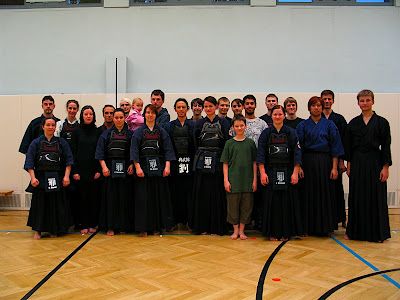 |
Some people had to leave for the national squad training this weekend, who therefore couldn't participate in the training. However, before they left, Stephan gathered everyone together so that we could take a picture. Of course.. the BAKKA photo - Dresden style.
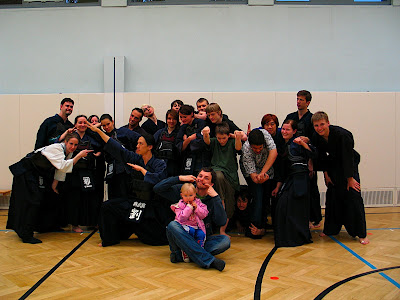
I think it's been a long time since we have done that all together. There was a full load of nice memories...


Thank you all Dresden kenshis. Starting kendo here 3.5 years ago was one of the best things I have done during my 6-years-stay in Germany. I remember the first time I met Stephan was at the presentation of Dresden-Budo-Club at the St. Benno Gymnasium. Patrick, Liv and Jasmin were there as well. I wonder what they went through their minds when they saw me.
!! Rambling Alert !!
Stop here if you don't want to read my lengthy rambles.
The Beginning
My first class was at the Dresden-Budo-Club. At the time, Rohus was still actively teaching. Then I combined my training at both DBC and the university (TU Dresden) club - 3 times a week.
It was not until four months had passed, I could get into the Bogu. A month later, I participated in the Leipzig Kendo Championship. I looked so dum, and had no idea what was going on, but somehow fought my way into the quater-finals.
[2006 Leipzig Kendo Championship]
Apart from my terrible kendo form, you also see many familiar faces in the background, some of whom are still active while the others not (what a shame! I miss them sometimes.).
Meeting Ozawa Sensei
One of the most important events in my kendo life was the meeting with Hiroshi Ozawa Sensei, Kuroda-san and Iinuma-san in Prague during the Toru Giga Cup in 2006. And in 2007, I visited him in his dojo Kobukan in Tokyo for a month of training and leisure.
First win in tournament - 16th Leipzig Kendo Championship 2007
Paris
At the end of 2007, I worked in Paris for 3 months. During this time I could train 3-4 times a week, at Bodu XI, where Yoshimura Sensei (8th Dan) teaches. I was surprised by the high level of kendo there, but only by the Japanese immigrants but also the local French kendoka. I think France has the highest overall standard in kendo of Europe, and it made me even more humble again.
Back to Dresden, off again to Tokyo and Taiwan
In 2008, one of the most important work in my life - PhD - was handed out, which took a tremendous weight off my shoulders. My training was kept as the second priority, and I was just glad that I still went to the training regularly. I think it is still important to go to the training once a week during busy times.
Fast-forwarding to now..
In all aspect, I'm looking forward to moving back to Taiwan, for both kendo and general life. There are countlessly many kendoka much stronger than I am, so obviously there will be many high mountains to climb. I hope I will be able to break these barriers and become strong.
I will for sure keep writing when I get to Taiwan.
Wednesday, April 01, 2009
JP vs TW kendoka
I found this video clip from 2007 when a Japanese delegation visited I-Shin Kendojo in Taipei, led by Masanori Shiroishi Sensei (8th Dan Hanshi) including the winner of 54th All Japan Kendo Championship, Satoru Harada, and other Japanese national team members. The first section of the clip shows Harada (staring on the right) fighting with Mr. Liao (starting on the left), who told me to strike with kihon when I trained at the Taipei Kendokan (click). Here you can see what I meant when I praised his kendo. Just look at that sharpness when he strikes men! And that takes only ten years?
Saturday, January 24, 2009
Taiwan 6: Videos
Here are some nice and fun videos recorded when I was in Taiwan, to show you what an interesting country it is. Please click the clip to link to Youtube for more descriptions!
Fish Market in Tao-Yuan County
Eating a Palm-sized Oyster
Local Tea House in Hsin-Chu City with Ozawa Sensei and Hara Sensei
Look towards the end to see how to drink with the tall (for smelling) and small cups!
Natural Hot Spring Water in Taiwan
Long-Shan Temple, Taipei
Fish Market in Tao-Yuan County
Eating a Palm-sized Oyster
Local Tea House in Hsin-Chu City with Ozawa Sensei and Hara Sensei
Look towards the end to see how to drink with the tall (for smelling) and small cups!
Natural Hot Spring Water in Taiwan
Saturday, May 24, 2008
17th Leipzig Kendo Championship
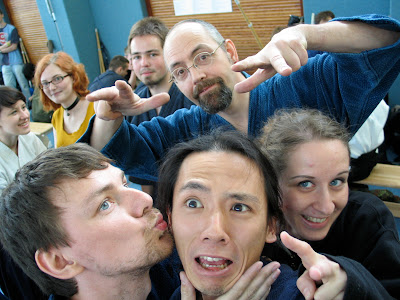
Just came back from the 17th Leipzig Kendo Championship, which was a nice day out. I didn't prepare for it like I did last year, so I didn't have a particular goal and the pressure that came with it. It is important, however, that I attend Taikai occasionally, and I'm glad I did.
As a newly donned Yudansha I fought in the Dan division. I helped out with the refereeing, which was my first time in a championship. A valuable experience. It's very tiring to be a referee, because not only one needs to validate scores, there are so many things that can happen. If the binding of the armour is loose, for example. At the same time, the three referees need to maintain good relative positions as the kendoka move.
The whole day I fought only four matches, 1 in the Dan division and 3 in the team division. In the Dan division, I was very unfortunate to meet Tomowari Miwa Sensei (6th Dan Renshi) from Berlin, who is also the trainer of KenVO squad. I was overwhelmed by the pressure coming from him and myself, that when I watched the videos, I saw many passed debana moments. The fight was quickly over. I will let the video speak for itself.
In the team division, I was in the Dresden A team (with Stephan, Georg, Tino, and Partrick), fighting as Taisho. Normally Stephan fights in this position, but today we placed each person in order to win the Berlin team. And since Miwa Sensei is their Taisho, heh heh..., I'm the sacrifice (quite happily in fact, since how many people at my level have the chance to fight a 6th Dan sensei in Taikai?). We met them in the final match. And before that, I won my two matches against less experienced kendoka, so they weren't that difficult (no videos unfortunately). My match against Miwa Sensei was the last of the day. I changed my style from the first to the second fight. I jumped too much in the last fight. Everyone told me afterwards that the first men should have counted (including one of the referees and Miwa-Sensei himself, which was comforting). Again I'll let the video speak for itself. (note: I lost to 1 kote-suriage-men and 2 Hanzoku :((.. )
In the end, our team won the second place. Our all-women team also won against all-men team, which was exciting to watch! In the other divisions, we also have good results. Lilli won the women's division and the third place in the Kyu division. She performed very nice and strong kendo today as well as all the other Dresden girls. Seeing the great performance by the Dresden kenshis inspired me to train harder.
Here are some thoughts:
- Overcome the nerve and be more stable. In the past I could bring at least 70% to competitions, but this time only 50%...
- Train the eyes.
- Some of my men strikes were good but the rest so so. I need to be consistent.
- Train the eyes even more.
The other videos will follow shortly.
Saturday, March 29, 2008
Team shiai-geiko
First week of training back in Dresden since last November. On Tuesday I lead the training at the university because Stephan and Georg both weren't there. Probably because I felt that many people here lack rigorous basics, I spent some time explaining just simple suburi, men-uchi and sayu-men uchi. Maybe spoke too much.. Leading practice session is quite fun, but in some sense it is also distracting because the leader has the responsibility to look after everyone.
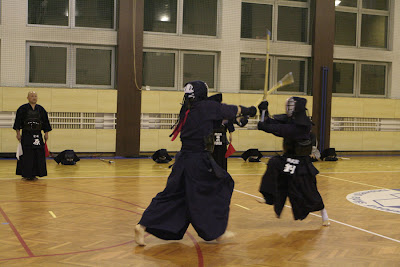
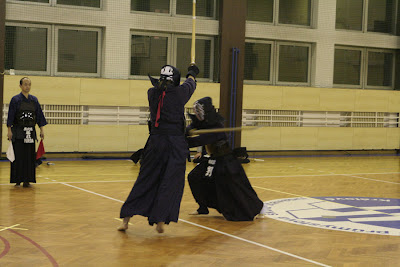
Yesterday's training was short but quite intersting. My left foot is now back in shape except minor soreness, but the left wrist is acting up. I couldn't do kirikaeshi properly because my left wrist couldn't rotate freely. Sucks... I hope the weekend-rest will do it good.
After some kihon we started jigeiko, and then team shiai-keiko, which was fun. I was the senpo in the 5-men team consisting (in fighting order) me, Patrick, Lilli, Tino and Stephan. The other team: Rico, Matthias, Daniel, Theo, Ralph and David, 6 people. The system is that the winner stays on the court and keeps fighting until he looses or draws. I won my first three matches but lost in the fourth from a "tsuba"-kote. Amazingly two flags were up. However, I couldn't get point because I was too tired and didn't put enough seme... more jigeiko needed.. I still need to work on my men-uchi as well. I wish that my matches were recorded on video so that I could see what I have to improve...
I found some photos of the Czech seminar taken by Czech photographer (please inform me so I can put your name here), here are picture of me in the shiai-geiko when I had just arrived.
Here I also found a video from the Paris Taikai this year, which is a big event that takes place every three years, each time involving many 8th Dan visitors. The video is the 36+ team shiai from Budo XI, the dojo I trained at. I know all the three Senpai and fought with them on at least one occasion. They are the red, Naito-san, Nori-san, and Labru Sensei. Very nice kendo. It's interesting to note that Nori-san has a distinctive kamae, namely, with wide feet separation.
Friday, March 21, 2008
Opening and closing Shinto Ceremony
Here are the clips I took for the opening and closing shinto ceremonies for the Czech National Championship 2008 on last Sudnay. It was performed by Hara Sensei.
Subscribe to:
Posts (Atom)


