This is a blog that I started in April 2006, just after I first put on my bogu (kendo armour). It collects the advices given by more experienced kendo practitioners as well as those from my own experiences. Both technical and the mental aspects of kendo are written in the blog. I hope someone will find them useful or interesting at least!
Two weeks of Chinese New Year break arrived timely for me to catch up some sleep. But in the end, I guess most of you would feel the same, was that I couldn't wait to get to the dojo.
Gradually I am exploring the finer details of kendo. It feels like a natural progression that in order to improve I must understand these details. Like seme and timing, with their associated footworks.
For example, when fighting against fast and powerful kendokas, I tend to not hitting straight because I am too afraid of being hit with a debana-men. The advices I got were:
I need to see and feel when the opponent is going attack. Just before that moment, strike immediately to win the debana-men. The right foot should be ready to jump forwards at any moment, meaning that the left foot should be staying put on the ground.
If the opponent has strong seme and takes the centre, then I must take it back with my shinai. Otherwise, striking when the opponent has the centre is a sure suicide.
Striking kote and kote-men:
One tip to hit on the kote without looking at it is to make the kote strike long the line going through the opponents right eye.
It doesn't always happen that more than two sensei/sempais are telling you about the same problem. But when it does, you know you've found a critical thing to improve on, and that's fantastic.
What Tseng-Sensei (曾育仁) told me when practising with him was that I was "a beat too slow", and I tend to kneel down a bit before I strike, which made me slow.
While practising with Liao Sempai (廖泳畋) he also observed similar problem: I hesitated at moments when I should strike, or I would wait for the opponent's action and step backwards, basically not going forward enough.
He commented also that when I do shikake-waza, such as kote-men or maki-men, the body should go forwards already on the first strike to create pressure on the opponent.
These are great advices which can take me to the next level - a competitive kenshi.
My performance in the last few trainings have been up and down. In some trainings my strikes were solid and confident, while in some I couldn't seem to commit my strikes fully. In situations where confidence was lacking, I not only attacked less and reacted slowly but I tend to bend my upper body backwards too often to avoid strikes. What a waste of training time.
In last night's training, however, I could commit to my strikes. It was almost like a conscious decision that I was going to launch my strikes forwards with confidence, and then I did it. It had also a lot to do with the fumigomi. When I stomp solidly on the ground, it helped to bring power and speed in my strikes.
Last night I also strike the do successfully for the first time against Ho sensei. First I put some seme and strike his shinai from the omote side as though I'm going for the men cut, and then I quickly switched to do.
Chang-sempai (張代林)let me practised small men-cuts after doing jigeiko with him. He asked me extend my arms up until the tip is just above the opponent's men, and then extend my arms and wrists forwards. Importantly, the wrist should not flex backward before striking, which was difficult for me since I was afraid of not having enough power. Bring the power in strike in this way requires good tenouchi with the body going forwards at the same time. I need to practise more.
For some reason, in the last training while practising with Ho-Sensei I could do clean and solid cuts. I could bring my body forwards, and could feel that my posture was straight from the beginning of the strike to the end zanshin. Ho-Sensei gave me some encouraging words because of that.
However I then asked myself, how can I do this in every training? For that, knowing the reason why I did well is important. I suspect that it was because I was very focused on every strike, partly due to the weather condition, the ONLY thing I was able to put on my mind was me in kamae, and my opponent in his kamae. In other words, focusing on just myself and the opponent is essential in bringing out powerful and committed strikes. I need to remember this and try to do this every time.
Another good news is that we have another young visitor, Marek Novak, from the Czech Republic, in addition to our already old friend Adam Urban, training for the summer in our dojo. Welcome!
It's summer now in Taiwan, and training in a dojo without air-con is one hell of an achievement itself. One constantly need to regulate his own training tempo in order not to dehydrate or faint from this crazy temperature and climate.
What I do is that I shift more from using the shikake-waza to the oji-waza in the jigeiko, and take more time to seme and experiment with the different seme techniques.
On Friday we had a looong training from 8pm-10:30pm, because Ho Sensei wasn't there and So Sempai led the training. The extra time was due to additional program following the jigeiko, which included the kakarite executing kote-men-hiki-men/kote/do followed immediately by men-debana-kote.
In order to have enough time to hit the debana-kote, one needs a solid taiatari, which makes the motodachi pause.
At the end I was really exhausted, trying to keep on going. The movement however became more and more proper - always happens.
Saturday morning at the Taipei Japanese School
The lack of sleep didn't prevent me from getting to the Taipei Japanese School (TJS) at 7:30 in the morning. There Kimura-Sensei (now 7th Dan, a former student of Ozawa Sensei) was expecting me.
2007 Autumn - my first time in Tokyo. Ozawa Sensei, Kimura Sensei and me.
When I got there the children were practising kihon without the bogu. Three 7th Dan Japanese teachers and a few other adult ones were instructing them. It was interesting to see how they explained the basics, and of course I got to practise my Japanese listening skills! For almost every item, men-uchi and hiki-men etc, the children had to use the sliding footwork all the way across the hall after the strike. This really trains their leg muscles and fluency to the movements.
Afterwards we put on the bogu and became motodachis to the children. It was a new experience for me to have so many kids coming to practise with me, and to teach them. At the end it was mawari-geiko for the adults.
I got a few insightful advices from Kimura Sensei:
Try to communicate with the opponent with kensen from to-maai.
When doing seme, no matter how tall you or your opponent are, direct your movement downwards and not upwards.
The second advice I had never head before. However, it solves some of the questions I had in mind. So it was really a unexpected reward of this visit, as well as making a couple of new Japanese friends who are teachers at the school! I think I'll be back there soon!
Yesterday I took the train up to Taipei to practise, because I felt the lack of practise and disipline led to my kendo basics becoming loose. Especially after watching my old Dresden kendo friends great performance at the 19th Leipzig Championship, and how much they have improved, it really stimulated me and gave me a positive motivation to train harder.
Recently I focused on improving kote-men, and trying to put pressure on the opponent making him strike first so that I can use oji-waza.
Ho Sensei gave some tips during the class:
kote-men should be as fast as possible, and it is important to bring the shini smoothly forwards right after striking the kote. To strike fast, the left foot stays sometimes at the same spot while the right foot stomps twice for the kote and men-strike.
when seme to strike kote, one can lower the kensen while moving in a little. This makes the opponent feel pressured and at the same time thinking that there is an opening for a men-strike. When he intends to strike men, execute a debana-kote.
when striking men-kaeshi-do, make sure to extend the arms up and forwards to block the men-strike, instead of blocking from the side. This is faster and safer since the opponent's shinai wouldn't get so close.
After my jigeiko with him, he gave the folloing advices:
Do not let the striking opportunities pass. When I see an opportunity, strike at once without thinking. I tend to make a pause before I strike, so that Ho Sensei and make a oji-waza on me.
The weather is getting warmer making it difficult to train...
Kuroda-san and I met in Czech Republic about 4 years ago, when Ozawa Sensei was invited to Prague to hold a kendo seminar. Since then we've kept in touch, and met up for kendo and drink every time when I went to Japan. It all seemed like yesterday, and yet so far away. He is truly a special friend. Now I'm happy that he finally comes to Taiwan and visit me.
He arrived on Friday 3/29, and in the evening I took him to the Taipei Kendokan. As usual the training started with kihon, waza-geiko, mawari-geiko and jigeiko. Kuroda san's perfect body posture and balance could not be more familiar to me, and that's his uniqueness.
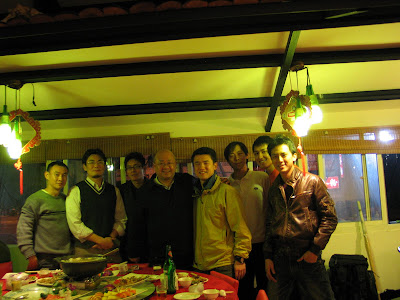
After the training at Taipei Kendokan.
My practice that evening was not so great as my right arm was too tense all the time. But it was nonetheless enjoyable to play kendo again with my old friend.
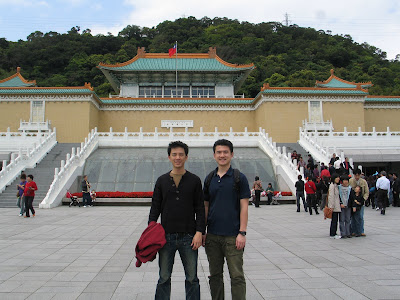
At the world-famous National Palace Museum.
Monday, 29th March
I took him to the Nation Chiao Tung University (NCTU) kendo club, and Kuroda san was asked to lead the session. The members who turned up for training were:
upon the point of contact between shinai and the men, the left arm is inclined with the shinai when looking from the side.
one should practise more large men-cuts. If one is good at large cuts, he/she is naturally good at small cuts.
Wednesday, 31st March
On Wednesday I took him to the National Tsing Hua University kendo club. The members who turned up that evening included many more advanced, who have trained for 2-3 years. Kuroda san was again asked to teach. So I told him that, and suggest he gave more tips on seme-techniques and correct attitudes as well as how to obtain them during training:
Kote strikes:
when practising kote, the kakarite should occupy the centerline first, and then the motodachi should push back at the same time create an opening while the kakarite makes the kote strike.
the kakarite should strike along the centerline.
Seme:
always keep in touch with the motodachi's shinai before striking.
when sliding the shinai against the opponent's shinai, the kensen should lower slightly, so that it is difficult for the opponent to move the shinai to the other side and hit kote.
Do-strikes:
To seme, move the body forwards and direct the tip of the shinai towards the opponent's kote at the same time pressing his shinai down. This makes him want to raise his shinai up. At this moment strike do.
For me, he gave me the following advices:
My seme is too quick, and the opponents raise shinai easily to block. I should make the movement more subtle and slower, in order to let him feel the pressure and strike first while I use oji-waza.
Relax my right arm.
I hope Kuroda-san comes again soon!!
Here is one short clip of our jigeiko. Note: At the end of the clip I struck men when he attempted a kaeshi-do, but didn't manage to block the men-strike.
My mind had been a little weak lately, in both work and kendo. Yesterday I went to Taipei Kendokan as usual on a Friday for a major fix-up. I got what I wished for - 1.5 hr of focused mind, and a reminder of what determination means.
My body was really tired after my first jigeiko with Ho Sensei. Then Yung-Tien Liao was the second. I knew I had to try my best to attack, because it gets on his nerves if his opponent is moving backwards a lot, and he would really show that he loose interest. The result was good. I tried my best, though still he was much faster, I was able to make the best out of the 3mins of fighting with him. A little note about him is that, he often corrects promptly on my ettiquette at the dojo. At first, it is almost irritating. But then I had realised that it was good for me, and he meant well. So everytime when he corrects me, I accept and appreciate his criticism. And everytime when I can truly accept my mistake, I feel like a better person. So thank you, Yung-Tien!
Ho Sensei commented:
During my seme, I want to occupy the centerline, but the movement is too big, such that my kenzen is too off-center.
I missed a lot of striking chances. I should use my eyes better and hit accurately.
Wednesday, January 13, 2010
Ryuzo-kun came for a short 2-days trip in Taipei this Sunday - how wonderful to see my brother friend here in Taiwan, after so many talks in Paris about Taiwan, its culture, and people over bottles of beer and wine! It feels strange to meet up finally here, no? Ryuzo?
Two things about kendo I learned during his visit:
When doing fumigomi, the left knee bends a little immediately after pushing the body forwards. The purpose is to drop the body weight fast at the same time drawing the left foot to the right one. The result is a much sharper stomping sound. I noticed in particular when Ryuzo do it, because it sounds very different.
When I seme my upper body leans a little forwards. I should keep it up-straight, and as Ryuzo mentioned it, like someone is pulling my hair up.
When stomping the right foot while doing kote-men, make sure the foot is not sticking to the floor. It should be agile enough to bounce up again quickly to take another step.
When doing hiki-men, stomp the floor with the right foot while striking to gain the initial momentum backwards, and then use the sole of the feet to sprint back.
When doing hiki-do, make sure the shinai hits on the side of the do sharply. And it's ok to go a little towards the left-back.
when doing hiki-kote, make sure the distance is enough when striking.
I ask Chang Sempai about how to execute small men-strike correctly. He said to push the left hand forwards, and make the left elbow straight. The right hand naturally becomes straight as well. The tsuba will be slightly below the shoulder if striking someone of the same height.
Ho-Sensei told me to use my eyes more to observe my opponent and react accordingly. Also, I shouldn't let my emotion overcomes by senses, striking when there's no chance. (Hmm... I was thinking, there's no chance for me to hit him anyways...)
I'm sometimes wondering how much have I improved since I came back to Taiwan. Sensei and Sempais told me every now and then the same things on which I should improve.
Ho-Sensei asked a few people including me if we want to participate in team competition in the National Chung-Cheng Cup on 12-13th Dec. (Don't ask me why there're all called Chung-Cheng, the other name of the former president Chiang Kei-Shek. Anyways, this is the whole country whereas, the one I just participated was for Taipei and mostly northern counties.) I said yes right away, which was unlike me who always has to "think about it". And later he asked me if I want to fight also in the individuals. To that, I also answered quickly, "Maybe not." Thinking, "Jeez, this is the national tai-kai. What a mountain to climb!" But now I'm reconsidering, since I need to get as much shiai-experience as possible while I still could.
Ozawa Sensei is visiting Taiwan in December. He will come with one 8th Dan and 2 other 7th Dan teachers. I'm glad that I can take them to Taipei Kendokan to see good kendo in Taiwan. I'm looking forward to it!
Today I realised in jigeiko that I backed out at some of the most crucial moments while doing seme. If I see the opponent's intention to strike, this is the tipping point where if I just apply slightly more pressure, he would launch the strike, which would allow me to use the oji-waza.
Yesterday evening 7 people turned up for the training, and I led the session. As always an extensive package of kihon-geiko was on offer. After about 300+ suburi swings, we did 4 x kirikaeshi, 2 x do-kirikaeshi, and few rounds of big men and middle men strikes to practise the wrist snap. Then loads of kote-men and kote-men-men strikes.
We also practised seme and men-strike starting from to-maai when the tips of shinais just touch each other. And by moving both feet inch by inch whiling maintaining a good kamae, the kakarite reaches the isso-ku-itto-no-maai at which point he strikes. Just before extending the arms to strike, the left foot is kept still while the right foot glides forwards.
Some 15 minutes were left for jigeiko towards the end of the training, which is rather short. Next time hopefully I can control the time better so that we can do 25 minutes jigeiko.
One difficult thing for most people including both advanced kenshis or beginners is that, many bad habits show up in jigeiko: upper body leans forwards when striking, constantly moving backwards, blocking, jumping backwards/forwards or evening sideways (which is back footwork).
It seems that for most people, the motivation to win overcomes far more than to do good kendo in jigeiko. There is a very good article on the Attitude to Jigeiko by Sotaro Honda Sensei (click). There are plenty tricks that work when fighting against players of relative low grades (including me) but they are useless against higher grade kendoka. If we indulge ourselves into these temporary moments of victory, the road to obtaining a good kendo would only be made longer and more difficult. Because these habits will become harder and harder to correct, and after one has corrected them, he would realise that much time has been wasted.
I joined the afternoon session of the squad training yesterday. There was a long jigeiko session which was a good chance to work on seme. However, before that we practised about one hour of more advanced techniques:
From issoku-itto-no-maai, seme with the shinai on the right side of the opponent's shinai, until the kensen reaches about the nakayuki (the leather tie) then drop the shinai and immediately raise up to strike men. Because the opponent's shinai would tilt momentarily to the left, an opening is created. The important thing to remember is that the shinai should lower straight down and raised straight up to attack, without swirling in the course.
Hiki-dou with stepping to the left-back to avoid possible men attack. If done correctly the oppoent's shinai would fall on the right shoulder.
Miwa-Sensei also encouraged us to try different techniques for opening the target during kote-strike.
The jieiko session was good. My timing for oji-waza has improved which was encouraging.
At the end of yesterday's training, we had a team shiai practise, I was the oldest of the team so became the taisho and was up against Stephan. It's been a while since I fought in a shiai-situtation, therefore it was a good opportunity to see how well I cope with it. We had a draw and no one got a point. I think I applied good pressure and often forced him to step backwards, but I didn't use the pressure well. I had this same feeling a while ago. It was as if I was afraid if I missed I would have gotten a hit. This prevented me from striking when where was opportunity. I need to practise applying pressure and scoring as a whole complete routine in every training from now on.
I arrived in Hradec Kralove without delay, fortunately, as this was by no means the easiest town to get to. A few minutes after I arrived the sports hall where the seminar was held, the Japanese delegation arrived, including Yamanaka Sensei (8th Dan Kyoshi), Ozawa Sensei (7th Dan Kyoshi), Ninomiya Sensei (7th Dan Kyoshi), Hara Sensei (7th Dan Kyoshi) and Fujida Sensei (5th Dan). I then immediately went up to greet Ozawa Sensei and Ninomiya Sensei. It was wonderful to see them again in Europe.
The seminar started at about 6pm with a shiai between the male Czech national team and a team with mixed nationality, and the female Czech national team and polish girls (with a couple of national team members). Somehow I was in the team fighting with the Czech. I fought as the Jiho and drew. My opponent scored a men first, and after I tried a few unsuccessful men- and kote- strikes, I scored with a nuki-do. I couldn't keep my fighting spirit high because of my foot injury, and the traveling. But I gradually picked it back up in the following days.
We then started the first day of seminar with kihon and then mawari-geiko. During Kihon-geiko Yamanaka Sensei emphasised that the left foot should not move when doing a men strike, otherwise the opponent can score debana-men or kote. This is exactly the same as what Kuroda-san told me in Tokyo. Ozawa Sensei pointed out that I should seme with the hip not just my upper body. I had the chance to do mawari-geiko with Ozawa Sensei. It frustrated me a little when he let an opening for men, but when I struck he could always do either suriage-men or keishi-dou.
Saturday
In the morning we divided into three groups: yudansha, kyusha and beginners and children. With the permission of Ozawa Sensei, I joined the yudansha group, which was instructed by Hara-Sensei.
We started with a few rounds of kirikeishi, and men-uchi. Hara Sensei then told us to put seme into our strikes, and take care of the distance. It is sometimes necessary to dynamically adjust the distance until one is ready to strike. The correct distance also depends on other factors, such as the height of the opponent. He mentioned that it's ok if it takes a little more time. Be patient.
We practised oji-waza against men, including debana-kote and men, nuki- and kaeshi-dou, followed by oji-waza against kote, such as nuki-men and suriage-men. Here are some fine points:
Nuki-dou: use diagonal footwork, namely the right foot goes the the front right while making the strike. First seme, and when the opponent just raise his shinai to strike men, this is the moment to strike dou. Otherwise it would be too late. The diagonal footwork in important to avoid the men-strike. The body or the hip need not twist sideways, in contrary to some other people say, however, Ozawa Sensei also says so, so I will try it this way.
Kaeshidou: basically the same as nuki-dou, just add the blocking. The blocking motion is the same as suriage.
Kote-nuki-men: the arms should raise quickly up and strike down without any hesitation.
In the jigeiko, I fought with Yamanaka Sensei, Hara Sensei and Ninomiya Sensei. I didn't do too badly with Yamanaka Sensei, so I was relieved. The practice with Ninomiya Sensei was perhaps the highlight as I felt could control my body to have a good posture, so I could put pressure. But I still lost the ippon shyobu by inches. We were locked in chikma (close distance) where one of us had to strike. I was putting even more pressure by tapping quickly his shinai with a very small motion. As expecting he launched men-strike and I went for kote. My shinai arrived first but only touches the edge of his kote which slipped off. And it was over. I wasn't fast and accurate enough. However, I thoroughly enjoyed the tension at the last moment. I had a short jigeiko just moments before the end of the session. It was hard, but I tried my best. Then I did uchigomi-geiko with him. I don't know where I had the energy from, but I just wanted to keep going and going, every strike with loud kiai and big swing. A couple of time he pushed me from the back that made me crash into the waiting queue, I just bounced myself back and continued. It was exhausting but fulfilling.
Evening party
In the party in the evening I sat opposite to Fujieda-Sensei, Ninomiya-Sensei and Hara-Sensei, and had a lot of fun conversations with them. Ninomiya Sensei said I had great improvements since last time he saw me in Kobukan in October. He was surprised that I could apply pressure to my opponent. Hara-Sensei said to me, "Liu-san, genki na~~", commenting on my uchigomi-geiko with him earlier.
The evening was fun with beer, bowling, and dancing. It was fun to see the Senseis having a go at the bowling lane, well, without too much success, might I say?
Sunday
The morning was the Czech national championship. It was a very short one as not many people attended. The female winner was Veronika, who won with a beautiful kaeshi-dou. The male winner was Jan Cliek, and the runner-up Martin Fritz. Martin plays impressive kendo despite being only 20 years old.
After the championship was the good-will keiko and kata. In the good-will keiko I practised with Fujieda Sensei. He uses a lot of oji-waza, and is more dynamical than the other Senseis. Something one might indeed expect from a 5th Dan kendoka. I managed to hit a clear men-nuki-kote.
In the Kata practice, again I joined the advanced group. I learned the 8th-10th form with kodachi from Czech Senpais. Yamanaka Sensei demonstrated many fine points. Especially he stressed that the blocking with kodachi in the 8th and 9th form requires much strength from the elbow instead of using the wrist alone. He further showed the different sounds from the two techniques despite their same appearance. The one with sharper elbow movement results in a more energetic and sharper sound than the one with just wrist and not enough elbow.
Ending
At the end Yamanaka Sensei said:
"Kendo is like communication. Every time when you practise, you have to train it in a way that the other person wants to do it again with you."
This, I feel, is the principle behind the keiko.
Things I learned from this seminar: seme, waza, and kata. The equally precious gifts I took away from this event were the new friendships with the participants.
I just came back from Kenyu, another dojo in Paris amongst the many Chinese shops and restaurants. Owing to the great number of kenshi at Budo XI on Saturdays (meaning very little room and very few jigeiko), I opted to come to Kenyu on Sundays instead.
The training was superb. Many 4th/5th Dan senpais and a couple of 6th/7th Dan Senseis (one of them is Olivry Sensei). We spent 20 mins on kihon and then mawari-geiko for an hour. Interesting note is that I have never been to any dojo that spends as much time as they do on warming up and stretching, which I think is very good given the number of sensei who have chronicle back problems.
There are two "hickies" on my neck from running into the opponents' kensens. A lesson to be learned! However, what annoys me is that some people are very quick to lower their kensen to the navel level when I was attacking, so that with chudan-no-kamae I couldn't put his kensen off-centre. And the result is that I get stopped by the kensen stuck to my chest. Some people do it so often that I wonder: Is it good kendo? I have a couple of ideas to try for breaking the centre in this senario. I will try this to see if it works before writing it here..
Last Wednesday Wakimoto sensei 8th Dan Kyoshi in the police force sent by Japanese kendo federation lectured the training, which involved lots of explanation, so we didn't get to move very much. He explained mostly basics, like men-uchi, and we practised also a bit of men-suriage-men. Incidentally, I forgot to put on my contact lenses, but it didn't make much difference anyway since we didn't have to move much. It was a pity that I couldn't understand entirely what he said, since I can't understand French and could only guess with my limited Japanese.
On Friday I went to the free-jigeiko seession. There were more people than usual, which I guess was probably because they felt that they didn't exercise much on Wednesday. I had four jigeikos. two with more beginner and two with 4th/5th Dan senpai, including Maurie senpai. I made sure that I gave my best when practising with him, and the result was fruitful. I wasn't as agitated as last time, and I even managed to win the ippon shobu with a kote.
Another interesting note was fighting against one of the less experienced, who measures more than two meters tall! I felt like fighting with a giant, and men strike was virtually impossible. Because he only needed to raise his shinai slightly to block it. However I was happy that I hit the top of his men with a solid "pop" with a kote-men. His kensen was completely off-centre to block my kote-strike which made way for my following men-strike.
I still need to make stronger cuts with my left hand, and push my hip when striking. Otherwise, I think my seme skills are slowly improving.
In the past two weeks, the training had up and downs. Last night at the free-jigeiko session I had the weakest centre in weeks. I couldn't apply proper seme, and was very agitated. When the opponent came, I got scared and lost my centre. However, in the previous trainings I preformed well. So I don't really understand how this difference can happen suddenly.
I fought Maurie sempai for the first time, who is one of the most senior students and always gives commands at the beginning and the end of the trainings. He's a man of large build, so I haven't practised with him so far, because I tend to want to practise with someone of similar size as me. This is not to mention that at the back of my head I thought that larger people cannot move fast. The practice with him completely let me with awe. I just could not do anything!! He scored debana-kote even when I executed renzoku (continuous-striking) techniques. Usually, people are overwhelmed by this kind of techniques, and they defend, step backwards or dodge. Doing debana-technique in-between fast strikes is very difficult indeed. He did it all the time! In the whole ten minutes I only got a kote...
The advice he gave me was to keep my centre and do not move away my shinai so much. The fact is, my mind seemed blocked and my instinct was to defend.. I really need more experiences.
Yesterday evening was the first training in the new year. I had not gone to training since more than a week because of the family visit and holiday closure of the dojo. So, in the first 10-20 minutes of the training, my body was slowly waking up.
Yoshimura Sensei lead the training as usual on Wednesdays. We did exercises, included, for example, seme-men x 4 for the kakarite, and the motodachi would strike debana-men, debana-kote, and debana-dou at the 2nd, 3rd, and 4th time. The two senpai in the small group whom I trained with told me to step in one step to "seme" from to-maai (with about 5cm separation between kensen), which I wasn't so happy with, because in Tokyo I was told that, in seme, one doesn't move his left foot. Moving it is like suiciding since at this moment, you're vulnerable to debana strikes. However, because I'm new in this dojo I think I should follow what they do. On the other hand, not everyone is doing the same thing here. I guess it just the senpai thought it's correct and he could tell me to do that. So this didn't help me much to improve, considering my current goal.
I had a jigeiko with Yoshimura-sensei and Ryuzo-kun (5ht Dan). I had a full-out session with Sensei. With Ryuzo-kun I tried to put more pressure and create openings before striking. It's indeed very difficult to find one. There were many times I let him too close, and was hit by his fast straight men. I need to learn how to strike fast like that...
My body was too tense because I wanted to be aggressive, and that led to an imbalanced posture, as pointed out by Ryuzo-kun. He also said that I need to gain more experience, for example, when is the debana moment. So, more jigeiko!