I found this video clip from 2007 when a Japanese delegation visited I-Shin Kendojo in Taipei, led by Masanori Shiroishi Sensei (8th Dan Hanshi) including the winner of 54th All Japan Kendo Championship, Satoru Harada, and other Japanese national team members. The first section of the clip shows Harada (staring on the right) fighting with Mr. Liao (starting on the left), who told me to strike with kihon when I trained at the Taipei Kendokan (click). Here you can see what I meant when I praised his kendo. Just look at that sharpness when he strikes men! And that takes only ten years?
Showing posts with label Taiwan. Show all posts
Showing posts with label Taiwan. Show all posts
Wednesday, April 01, 2009


Friday, February 06, 2009
Taiwan and Japan 2008: Final Thoughts
Taiwan
This time in Japan I felt that the conversations I had with people went deeper, on both kendo and just life in general. Of course, this is mainly because I've now known them for longer. And maybe also because deep-down they no longer think that I'm just another foreigner who shows up once and then disappear in their lives.
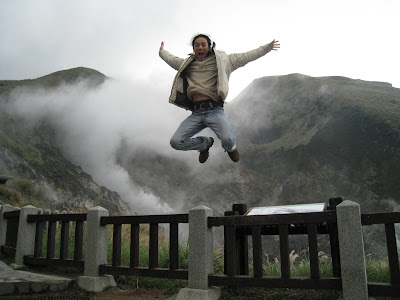 |
| Yang-Ming Mountain in Taipei |
The tradition of kendo in Taiwan was established during the Japanese occupation period (1895-1945). However, after the defeat of Japan in the war and the subsequent move of the Chinese regime to Taiwan, the anti-Japanese sentiment was strong. This caused a period of vacuum when very few Japanese Senseis were able to visit Taiwan to teach. Therefore, the Taiwanese kendo almost developed independently on its own.
The result is a diverse style of kendo between schools, ranging from the pre-war style kendo, to the current shiai-orientated kendo. My guess is that kendo in Japan in the last 50 years or so underwent much standardisation, which was absent in Taiwan. There are also some old regulations that remain today, such as using the katana for examinations of 5th Dan or above.
 |
| The young guns from I-Shin Kendokan |
There are several 8th Dan Senseis in Taiwan, perhaps more than a handful. They are mostly the second generation kendoka counting from the Japanese occupation period. It is interesting to note that they all come from very well-educated families, such as medical doctors and engineers alike, because the cost of kendo equipment was high and people with low income could not afford such things.
I was lucky this time to have met and practised with Chia-An Liu Sensei from Jia-Yi. But unfortunately had no chance to practise in the Shudokan in Taipei, where a couple of renowned 8th Dan Senseis teach. I practised also with a few 7th Dan Senseis, indeed everyone plays kendo that are quite distinctively different.
Japan
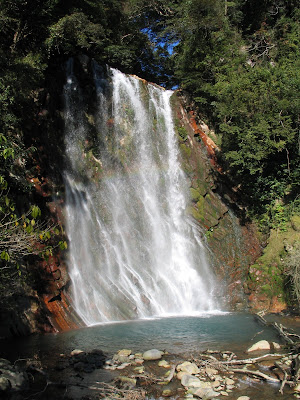 |
| Miyazaki |
This time in Japan I felt that the conversations I had with people went deeper, on both kendo and just life in general. Of course, this is mainly because I've now known them for longer. And maybe also because deep-down they no longer think that I'm just another foreigner who shows up once and then disappear in their lives.
I received many advices from them, ranging from the more general idea of kendo, what goals should be achieved, to the more specific details on how a particular techniques should be executed. The most valuable thing was, believe or not, the kihon trainings I received from Ozawa Sensei, and kihon-related advices from Yamanaka Sensei, Suzuki Sensei and Kaji Sensei.
I think my most significant improvements are wrist power in striking and kirikaeshi. The most urgent thing I have to work on is my footwork - my legs are clumsy. I'm also continuing my suburi (almost) everyday as instructed by Ozawa Sensei.
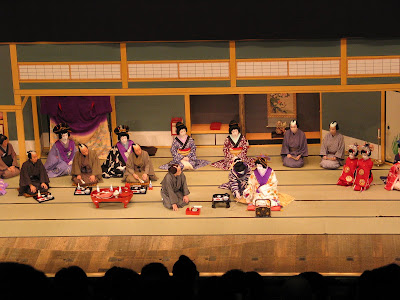 |
| Traditional Japanese play - Kabuki |
The concept of "tadashii" (正しい) or proper/straight kendo was repeatedly mentioned by many teachers, and it is also apparent from the kendo that these great kendoka are playing. I think that this is a goal that should be aimed for from the start, instead of much later or when one gets old, as believed by some. I have received advices from some amazing kendo teachers who majored in kendo at universities, now teaching as their professions, and past winners of all Japan Kendo championships. They all pointed to me in the same direction, that is tadashii kendo.
The importance of kensen (tip of shinai) and the contact between those of the kendo players was pointed out during a private discussion between Ozawa Sensei and Hara Sensei, after visiting a dojo in Taiwan. The main point of the discussion is that, Kendo is about communication, therefore without the tips of shinais touching, it is a meaningless fight.
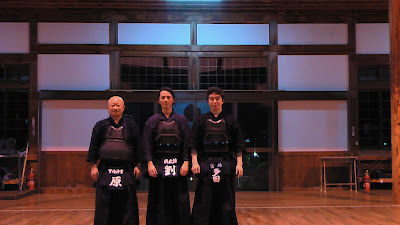 |
| Miyazaki Police dojo with Hara Sensei and Ryuzo kun |
In summary, this journey consolidated further the goals in kendo I want to achieve, and I am convinced that kendo will always be a part of my life. It has bound me together with my culture and my beliefs; it has given me a life without boarders between countries, and the chance to know many open-minded friends. I feel that the modern-day kendo is no longer an art to kill, but an art to connect between people and cultivate the mind. My wish is that it won't become just a game of winning and losing but maintain the much cultural qualities that makes it so much richer than some of the other martial arts.
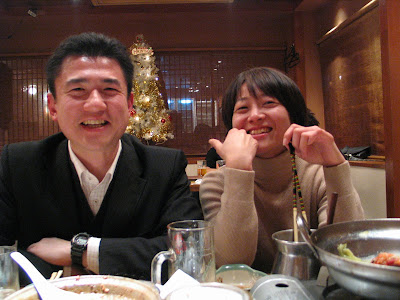 |
| Kuroda san and Kodama san |
Saturday, January 24, 2009
Taiwan 6: Videos
Here are some nice and fun videos recorded when I was in Taiwan, to show you what an interesting country it is. Please click the clip to link to Youtube for more descriptions!
Fish Market in Tao-Yuan County
Eating a Palm-sized Oyster
Local Tea House in Hsin-Chu City with Ozawa Sensei and Hara Sensei
Look towards the end to see how to drink with the tall (for smelling) and small cups!
Natural Hot Spring Water in Taiwan
Long-Shan Temple, Taipei
Fish Market in Tao-Yuan County
Eating a Palm-sized Oyster
Local Tea House in Hsin-Chu City with Ozawa Sensei and Hara Sensei
Look towards the end to see how to drink with the tall (for smelling) and small cups!
Natural Hot Spring Water in Taiwan
Thursday, January 01, 2009
Taiwan 5: Striking with Kihon
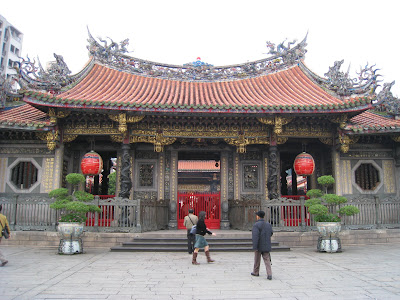 |
| The famous Long-Shan Temple in Taipei |
I had a couple of very helpful practices at the Taipei Kendokan and I-Shin Kendokan. I practised with Mr. Liao at the Taipei Kendokan who commented that I should not forget my kihon when practising in jigeiko, and that I should not leave my hips behind. Indeed, when I look at his men-strikes, the fact that he maintained his body-posture straight throughout the motion made the attack look so aesthetically pleasing. When I asked, he told me that he played kendo for 10 years. "I hope I strike men as beautiful as that after I've done kendo for 10 years!" I thought. So far I have done kendo for 3 years. Sometimes I feel that my kihon is still shaky. There's no way I can make further progress if I don't work on this. And I have to bring that into my jigeiko instead of just doing a bashing-up.
In my last training at the I-Shin Kendokan Tsai Sensei commented that the pushing from my leg is strong enough but I didn't extend my wrist fully to strike.
Friday, December 26, 2008
Taiwan 4: Travelling with Senseis
The next few days after coming back to Taiwan, I travelled with Ozawa Sensei (who came with me on the same flight), Hara Sensei (flying from Miyazaki), and Mr. Chou in several cities to practise kendo and some sight-seeing. I joined them on the second day to Shin-Ju, on the 3rd day to Tao-Yuan, and the 4th to Jia-Yi.
From what I have seen and heard, the kendo styles in Taiwan is diverse to say at best, chaotic at worse. I have been very impressed by many young kendoka in their 20s doing strong kendo with good postures and basics, but have seen also high grade Sensei with loose centre and basics. The people here attribute the differences to the differences in "style". But I think (or educated to think) that kendo without a strong centre is simply bad kendo. So this is one aspect of Taiwanese kendo for me hard to accept. Another aspect is the ugly politics in kendo here. Uhh.. I don't even want to get into to it.
In Jia-Yi, I practised with Chia-An Liu Sensei, 8th Dan Kyoshi. His kendo is indeed very strong and I tried very hard to break his centre. Once I fell onto the floor backwards due to his pushing and my loss of balance during taiatari. Bloody hurt, but I went on.
His young students are very well trained indeed - fast with correct movements - which made me believe that he is a good Sensei. This reflects how important it is for a student to do his best in order to bring a good reputation to his teacher. Before I went on this trip with Ozawa Sensei I knew I had this responsibility. It was a heavy one, but I felt I had to do it and do it with dedication. Especially not to shame his name and the name of Kobukan. Fortunately, the feedbacks from the others were mostly positive.
Oh, I forgot to mention that another thing I dislike in Taiwan is the drinking culture.. They make you down glasses (about 10 cl, two shots) of whisky or other kinds of strong liquor, as a gesture of friendliness... This happened with us at almost every dinner after the training.
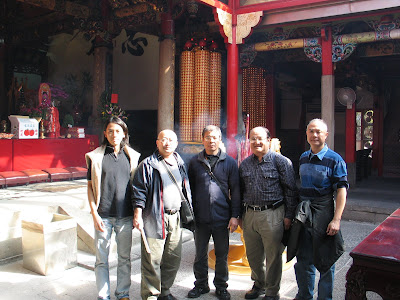 |
| In a Taoist temple in Shin-Ju |
From what I have seen and heard, the kendo styles in Taiwan is diverse to say at best, chaotic at worse. I have been very impressed by many young kendoka in their 20s doing strong kendo with good postures and basics, but have seen also high grade Sensei with loose centre and basics. The people here attribute the differences to the differences in "style". But I think (or educated to think) that kendo without a strong centre is simply bad kendo. So this is one aspect of Taiwanese kendo for me hard to accept. Another aspect is the ugly politics in kendo here. Uhh.. I don't even want to get into to it.
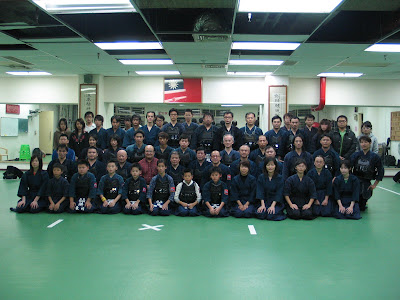 |
| Shin-Ju Kendokan |
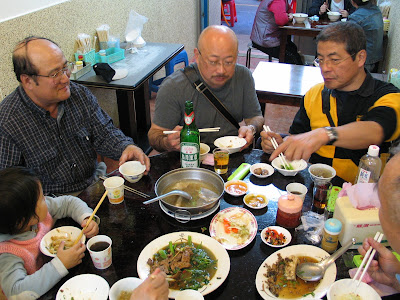 |
| A feast from the host in Shin-Ju |
In Jia-Yi, I practised with Chia-An Liu Sensei, 8th Dan Kyoshi. His kendo is indeed very strong and I tried very hard to break his centre. Once I fell onto the floor backwards due to his pushing and my loss of balance during taiatari. Bloody hurt, but I went on.
His young students are very well trained indeed - fast with correct movements - which made me believe that he is a good Sensei. This reflects how important it is for a student to do his best in order to bring a good reputation to his teacher. Before I went on this trip with Ozawa Sensei I knew I had this responsibility. It was a heavy one, but I felt I had to do it and do it with dedication. Especially not to shame his name and the name of Kobukan. Fortunately, the feedbacks from the others were mostly positive.
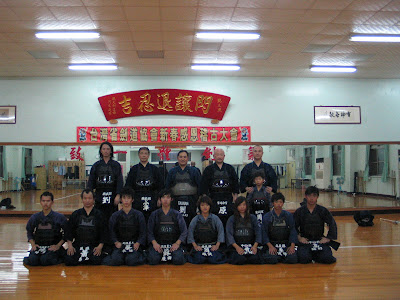 |
| Liu Sensei's Dojo in Jia-Yi |
Oh, I forgot to mention that another thing I dislike in Taiwan is the drinking culture.. They make you down glasses (about 10 cl, two shots) of whisky or other kinds of strong liquor, as a gesture of friendliness... This happened with us at almost every dinner after the training.
Tuesday, November 25, 2008
Taiwan 3: Tao-Yuan Kendokan 桃園劍道館
 |
| From Taiwan 2008 |
 |
| From Taiwan 2008 |
 |
| From Taiwan 2008 |
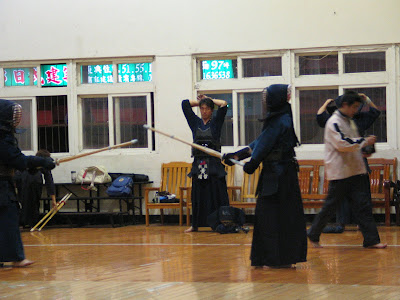
So I came back last night alive from the Tao-Yuan Kendokan in Tao-Yuan Tao-Yuan County, which is about 1.5 hours far from where I live by driving. Fortunately, Mr. Chou a Sempai affiliated to Tokyo Kobukan drove me there.
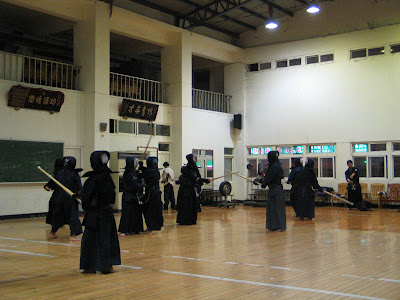
The keiko consisted of only jigeiko and mawari-geiko at the end, for about two hours. There were about 20 kendoka in total, all yudansha coming from not only Tao-Yuan, but Taipei and nearby places.
Most of the national team members come from this place because they had much resources to develop their kendo from very early since the Japanese occupational period, combing with the effort of Hsu Sensei, 7th Dan Kyoshi, currently the national team coach, to train his talented students.
Atmosphere is very relaxed there, much like a social club. People arrived gradually at different time and started keiko on their own in pairs. Some sat on the side and chatted for a long time before putting on men and practise. It didn't appear to me that they take it seriously, but somehow they do strong kendo. So much so that they won 22 times in a row in the national championship. I fought with Mr. Chou and Huang Sensei first, then the rest of the national squad members. Because of the mawari-geiko at the end of the training. I had the opportunity to fight with most of the squad members.
The style here in this dojo is much sportive I felt. Young, fast, a lot of techniques and the distance between the opponents is short, usally at chikma. It's not my favourite type of kendo, but I can still learn from them, and people can do very well with it in competitions. Their techniques are however very good, and because they started at a young age, they have solid foundations.
I didn't do so badly, and was able to put pressure and use waza to score points. However, I know pretty well that I was pushing myself to the limit to match some of them.
I was again told that I should improve my basics, like pushing with the left leg, using more left hand, and move forwards instead of right when striking kote. Then I will be very powerful.
I was again told that I should improve my basics, like pushing with the left leg, using more left hand, and move forwards instead of right when striking kote. Then I will be very powerful.
Monday, November 17, 2008
Taiwan 2: Taipei Kendokan 台北劍道館
 |
| From Taiwan 2008 |
 |
| From Taiwan 2008 |
 |
| From Taiwan 2008 |
 |
| From Taiwan 2008 |
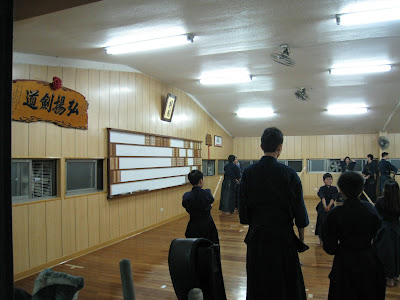
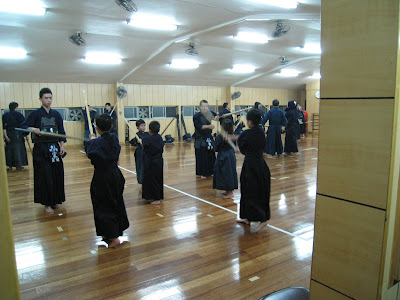
Today I visited the Taipei Kendokan, led by Ming-Hwa Ho, 7th Dan Kyoshi, who also represents Taiwan to fight in the individual division in the world championships. The 1.5 hours training is only for yudansha, starting with kirikaeshi, followed by men-uchi, kote-men uchi, oji-wazas and then jigeiko. Hsu Sensei commented pointed out that when striking men or kote, one should always win at the seme stage first. "Striking without having the centre is like suicide," he said, "you'd get killed certainly."
I fought 4 jigeikos, first with a 3rd/4th Dan, and then with Ho Sensei, Hsu Sensei and finally Mr. Do who is 4th Dan. The overall level is very high and the average age of the kendoka is relatively young, perhaps 28 years old. Most of them fights very competitively, however with also good postures, which is an impressive thing.
It was rather impossible with Ho Sensei. When he sees the moment he just went for it like a blitz. With Hsu Sensei I could manage some ippons, but he commented afterwards that my Kamae was not good. Perhaps I moved my kensen away from the centre too much.
I was really exhausted towards the end. My left leg just could not follow up quickly anymore, which is a shame. But there's not point complaining if I'm not putting in enough time to strengthen my leg muscles.
Next Monday hopefully I will visit the dojo where most of the Taiwanese national team members train. I hope that I will come out alive.
Sunday, November 16, 2008
Taiwan 1: I-Shin Kendojo 一心劍道館
 |
| From Taiwan 2008 |
 |
| From Taiwan 2008 |
 |
| From Taiwan 2008 |
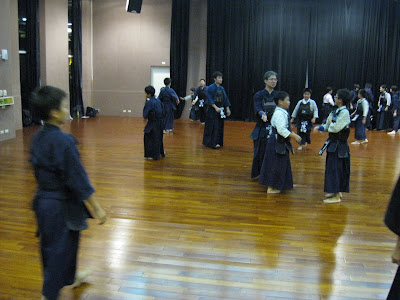
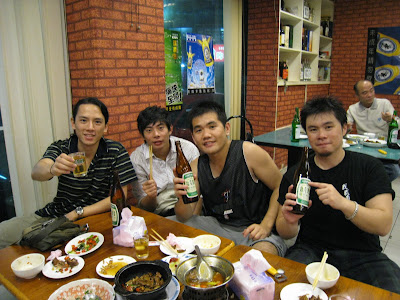
On the third day of being in Taipei, I had my first ever kendo training with the Taiwanese kendo community at the I-Shin Kendojo. The dojo is led by Tsai Sensei, 6th Dan Renshi, who is also a good friend of Ryuzo kun. And Ryuzo's wife contacted him a couple of weeks ago from Paris that I will be visiting his dojo, so Tsai Sensei very kindly drove me to his dojo in case I didn't know the way. The dojo is unfortunately 1.5 hours away from where I live by public transportation, but that's life...
I attended two sessions on the day. The first two hours was for beginners alike, from no grades to about sho-dan level. There were about 25 kids, 10 high school students and 7-8 adults (me being one of them). It was surprising to see the kids doing good and proper cuts, and having such a level of energy!
After suburi, we did a lot of renzoku-waza practice - combinations of men, dou, and kote cuts as well as taiatari-hiki-men/dou/kote. Though my level exceed most of them who attended this beginner's session, it was good to recap the basics, like what people do in kendo seminars.
The feed back I had from Tsai Sensei is that my wrist snap at the end of the strike is not enough.
The second session of the evening is for yudansha. About 15 people attended the class. Tsai Sensei wife Mihara san, 5th Dan, also joined the training as well as I-Chung Lin, 4th Dan, whom I have contacted previously by email. There were also I think 2 other 4th Dan and a handful of 3-2 Dan kendoka.
Not suprisingly, they have solid basics - cuts and foot works. Their taiatari was also solid. One can see these by simply recognising their movement after the strikes. People who have good body posture and footwork moves almost like a bullet before and after the strike - the whole body (especially the hip) moves as one gaint bullet.
We started with small men and kote strikes, and then Waza geiko in teams. Tsai Sensei emphasized that in waza-geiko, the one who executes the oji-waza must apply seme. This doesn't mean simply "stepping in'' but with pressure.
He commented on my debana-kote, and said that I should step in after the kote-cut instead of turning immediately sideways.
We had about 10 mins of mawari-geiko during which I fought with I-Chung and Tong-Fung Li, who I think is 3-4th Dan. I could got hit mostly but could also score a few kote or men cuts.
In the final jigeiko with Tsai Sensei, I didn't feel I was doing my best, because I hesitated too much before striking, which is really a beginner's mistake. I couldn't land any strike on him, and received coutlessly many straight men-cuts from him. He has practised kendo for 30 years, and had truely the level of kendo to match the 6th Dan grade, which I'm very cetrain of.
Feed backs:
- Tsai Sensei: Think but don't think too much during jigeiko.
- The left side of my body (left hand and foot) needs to be strengthened.
- The left foot must follow up quickly while executing tsuki.
- I-Chung: Good timing with the kote strike.
Subscribe to:
Posts (Atom)


