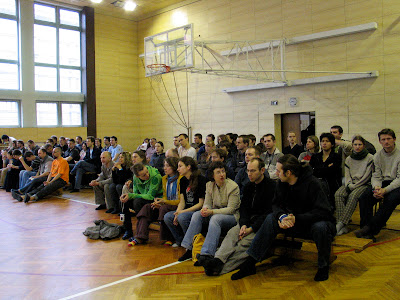
Yesterday there was an invitaional Jigeiko session in Hsin-Chu, at the Tsing-Hua University. About 50-60 people from Taipei, Hsin-Chu and Taichung joined the practice, including one 8th Dan, three 7th Dan, and a couple of national team members.
The practice lasted for about 1.5 hours with a small break in-between. I had about 6 jigeiko, some of which were difficult for me. My techniques for seme are still too few, and I didn't how to go in sometimes when fighting with more experienced kendoka.
Wen-Chie Chang Sensei from Hsin-Chu Kendokan pointed out to me that my men-strike is not straight enough. It tends to come in from my right side. It's probably because I tried to seme from this side so that the shinai came in from that direction. However, I need to take more care.
I also need to push my body forwards faster when striking. It's always faster to somewhat first jump forwards and then move the hands to strike in the last minute.
Showing posts with label seminar. Show all posts
Showing posts with label seminar. Show all posts
Monday, November 30, 2009


Monday, September 15, 2008
Czech beer..
.. taste wonderful!! as every time I personally experienced. Friday evening, still fighting with physics equations in Dresden. Saturday morning, threw my pillow over the alarm clock and thereby missed the original train I wanted to get on, but I still managed to arrive at noon. Orientating myself has become much easier now that I have been there for 6-7 times. It's also the second time for the Toru Giga Cup.
As I explained earlier I wasn't participating in the tournament and seminar, which turned out to be a very good idea considering how busy I am at work. Though I wish I could.. This year's event featured Shigeki Yamanaka sensei, 8th Dan Kyoshi, Hiroshi Ozawa Sensei, 7th Dan Kyoshi, and 6 other 7th Dan Senseis. Fortunately, there were jigeikos on both Saturday and Sunday, after the tournament and the examination.
When I arrived the sports hall, the first person I recognised in sight was Thomas Berger. Great to see him again in Czech after last time he came to Dresden with Jindra. Then farther down the hall were Ozawa Sensei and Yamanaka Sensei. Then I saw Aki Suzuki Sensei, 6th Dan, for the first time outside Japan. I still remember how I was astonished by her agility when I fought with her in Kobukan, and seeing her practise with Hakamada Sensei in Nittaidai. I used my somewhat improved Japanese to greet her, which from my point of view was a success, but I might have just been ignorant of my own mistakes.
The tournament had already started. The lady's matches were finished. The mens' were on-going. Some memorable moments were the polish team member Jastaks' matches (who placed 2nd), the match between Fritz and Cliek, and Hackl's matches. The large strides of Jastak during seme immediately sent out signals to the spectators that this guy is a seasoned kendoka. Large strides of the right foot during seme, while keeping the left foot still, requires physical balance as well as the mental confidence. I already saw Martin (Fritz) fighting with Cliek last time in Hradec Kralove. Last time was a tight match, this time, however, Martin looked tired and Cliek was able to score with two fast kote-men's. I met Danny Hackl at the training at Imperial College London earlier this year. It's funny to see him here again, who is a jolly nice chap. (I'll never forget about the Champaign joke.) His applied good pressure to his opponents while keeping his kensen in the centre. The built-up tension was subtle and exciting.
Saturday Jigeiko
After the match (with Cliek the first and Jastak placed second) we had free jigeiko (luuucky!) I fought (in order) with Martin, Denisa, Suzuki Sensei, Veronika, and Zawano san. Martin plays an active style of kendo, with lots of kote mens. It would be nice if I was fast enough to do oji-wazas, but I realised later that I mostly struck men and tried to hold my centre the best I could. I have met also Denisa on several occasions and liked her straight kendo. It is nice to fight with such opponent because the essence of kendo is simple and straight in nature. So, no matter one wins or looses he/she would still be on the right track to good kendo.
Fighting with Suzuki Sensei was of course the best of all, in fact, just watching her fight put me complete in awe. Her kendo reminds me of Yoshimura Sensei, 8th Dan, form Paris, because they have very similar physique, small and yet agile. Their most impressive skill is the footwork. Both before and after the strike, they seem to be floating in air - smooth and fluid movement of the body. Suzuki Sensei attacks very viciously, and in fact, I wouldn't be able to tell that she's a female kendoka in the mid 30's from the way she fights. Vivian wrote very accurate descriptions of her kendo on her blog. She got me a few debana-mens. I think I didn't give her any pressure at all.. shame..
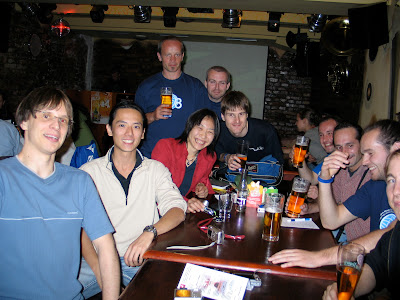

I was the first to arrive at the party venue by at least half-an-hour. No time was wasted. I immediately ordered a beer and enjoyed it quietly at the bar, before some jolly Austrian participants joined the fun.
Had very pleasant chats with Thomas Berger, Martin and Ozawa Sensei. And I even tried with my limited Japanese to talk to Takano Sensei. Sigh.. where were the words when you need them the most?
Ozawa Sensei told me there is no point to raise the shinai to block. One should attack the center. I told him that when my opponents comes, I can still hold the center, therefore, resulting in tsuki. But even though I want to do Oji-waza, most of the time I'm too slow. He said, no problem, I'm only Shodan, I just need more practice.
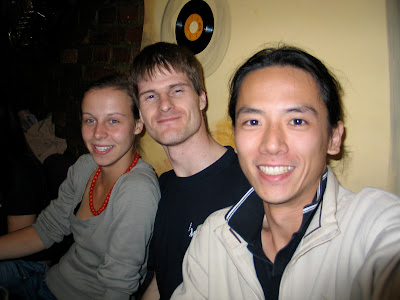 |
| From 17th Toru Giga Cup 15/09/2008 |

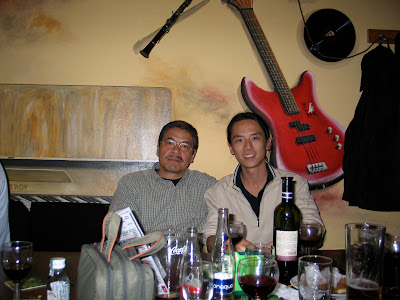
Sunday
Morning is the examination from 1st Kyu to 3rd Dan. Afterwards we had an hour of jigeiko. My first one was Ozawa Sensei, and then Takano Sensei.
There were a lot of time spend on waiting. But watching the Senseis doing jigeiko was equally exhilarating. I saw Yamanaka Sensei fighting with Ozawa Sensei and Suzuki Sensei. They fought like young people with continuous strikes often at close distances. However, there was no simple blocking but all blocking were part of oji-waza. I think this is an important thing to remember when doing jigeiko.
My jigeiko with Ozawa Sensei was invaluable. This time I knew what I was doing. He also put more pressure instead of making obvious openings for me. The most memorable was two men-strikes I received from him. One when I wanted to fake a men-strike to make him loose centre and then strike men. What a DUM idea!! As soon as I rose the shinai in front of my face, my men got a solid strike. #$^&#$%&*... The other one was a debana-men, except it was "so debana" that I probably looked like I was sleepy. In fact I wanted to also strike men, but got hit before I did any obvious movement. I wonder how our match look like to the on-lookers.
Fighting with Takano Sensei was easier because I think he was tired and also he played a more quiet kendo. My main objective is to keep a good body balance when doing seme and attack. I think I made a few good strikes.
Then finally when I was just the next to fight with Suzuki Sensei the jigeiko was over.... pity...
All in all...
- This time I saw the fighting spirit and the competitiveness of the Senseis.
- I found that if I keep my body posture straight and a good body balance, I do well and can enjoy anyway regardless of loosing or winning.
- I think my body balance is pretty good now for striking men (gliding forward with my right foot and strike men etc). One thing to improve is the footwork after the strike. I want to do it like Suzuki Sensei, with smooth and fluid movements.
- I need to be more active in applying pressure through the centre.
- I had lots of fun. Thanks to Denisa and Thomas B.!
Monday, March 17, 2008
Czech Seminar 14-16/3/2008
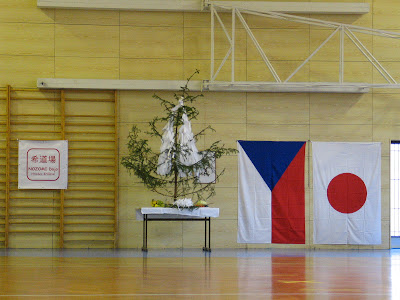
I arrived in Hradec Kralove without delay, fortunately, as this was by no means the easiest town to get to. A few minutes after I arrived the sports hall where the seminar was held, the Japanese delegation arrived, including Yamanaka Sensei (8th Dan Kyoshi), Ozawa Sensei (7th Dan Kyoshi), Ninomiya Sensei (7th Dan Kyoshi), Hara Sensei (7th Dan Kyoshi) and Fujida Sensei (5th Dan). I then immediately went up to greet Ozawa Sensei and Ninomiya Sensei. It was wonderful to see them again in Europe.
The seminar started at about 6pm with a shiai between the male Czech national team and a team with mixed nationality, and the female Czech national team and polish girls (with a couple of national team members). Somehow I was in the team fighting with the Czech. I fought as the Jiho and drew. My opponent scored a men first, and after I tried a few unsuccessful men- and kote- strikes, I scored with a nuki-do. I couldn't keep my fighting spirit high because of my foot injury, and the traveling. But I gradually picked it back up in the following days.
We then started the first day of seminar with kihon and then mawari-geiko. During Kihon-geiko Yamanaka Sensei emphasised that the left foot should not move when doing a men strike, otherwise the opponent can score debana-men or kote. This is exactly the same as what Kuroda-san told me in Tokyo. Ozawa Sensei pointed out that I should seme with the hip not just my upper body. I had the chance to do mawari-geiko with Ozawa Sensei. It frustrated me a little when he let an opening for men, but when I struck he could always do either suriage-men or keishi-dou.
Saturday
In the morning we divided into three groups: yudansha, kyusha and beginners and children. With the permission of Ozawa Sensei, I joined the yudansha group, which was instructed by Hara-Sensei.
We started with a few rounds of kirikeishi, and men-uchi. Hara Sensei then told us to put seme into our strikes, and take care of the distance. It is sometimes necessary to dynamically adjust the distance until one is ready to strike. The correct distance also depends on other factors, such as the height of the opponent. He mentioned that it's ok if it takes a little more time. Be patient.
We practised oji-waza against men, including debana-kote and men, nuki- and kaeshi-dou, followed by oji-waza against kote, such as nuki-men and suriage-men. Here are some fine points:
- Nuki-dou: use diagonal footwork, namely the right foot goes the the front right while making the strike. First seme, and when the opponent just raise his shinai to strike men, this is the moment to strike dou. Otherwise it would be too late. The diagonal footwork in important to avoid the men-strike. The body or the hip need not twist sideways, in contrary to some other people say, however, Ozawa Sensei also says so, so I will try it this way.
- Kaeshidou: basically the same as nuki-dou, just add the blocking. The blocking motion is the same as suriage.
- Kote-nuki-men: the arms should raise quickly up and strike down without any hesitation.
In the jigeiko, I fought with Yamanaka Sensei, Hara Sensei and Ninomiya Sensei. I didn't do too badly with Yamanaka Sensei, so I was relieved. The practice with Ninomiya Sensei was perhaps the highlight as I felt could control my body to have a good posture, so I could put pressure. But I still lost the ippon shyobu by inches. We were locked in chikma (close distance) where one of us had to strike. I was putting even more pressure by tapping quickly his shinai with a very small motion. As expecting he launched men-strike and I went for kote. My shinai arrived first but only touches the edge of his kote which slipped off. And it was over. I wasn't fast and accurate enough. However, I thoroughly enjoyed the tension at the last moment. I had a short jigeiko just moments before the end of the session. It was hard, but I tried my best. Then I did uchigomi-geiko with him. I don't know where I had the energy from, but I just wanted to keep going and going, every strike with loud kiai and big swing. A couple of time he pushed me from the back that made me crash into the waiting queue, I just bounced myself back and continued. It was exhausting but fulfilling.
Evening party

In the party in the evening I sat opposite to Fujieda-Sensei, Ninomiya-Sensei and Hara-Sensei, and had a lot of fun conversations with them. Ninomiya Sensei said I had great improvements since last time he saw me in Kobukan in October. He was surprised that I could apply pressure to my opponent. Hara-Sensei said to me, "Liu-san, genki na~~", commenting on my uchigomi-geiko with him earlier.
The evening was fun with beer, bowling, and dancing. It was fun to see the Senseis having a go at the bowling lane, well, without too much success, might I say?
Sunday
The morning was the Czech national championship. It was a very short one as not many people attended. The female winner was Veronika, who won with a beautiful kaeshi-dou. The male winner was Jan Cliek, and the runner-up Martin Fritz. Martin plays impressive kendo despite being only 20 years old.
After the championship was the good-will keiko and kata. In the good-will keiko I practised with Fujieda Sensei. He uses a lot of oji-waza, and is more dynamical than the other Senseis. Something one might indeed expect from a 5th Dan kendoka. I managed to hit a clear men-nuki-kote.
In the Kata practice, again I joined the advanced group. I learned the 8th-10th form with kodachi from Czech Senpais. Yamanaka Sensei demonstrated many fine points. Especially he stressed that the blocking with kodachi in the 8th and 9th form requires much strength from the elbow instead of using the wrist alone. He further showed the different sounds from the two techniques despite their same appearance. The one with sharper elbow movement results in a more energetic and sharper sound than the one with just wrist and not enough elbow.
Ending
At the end Yamanaka Sensei said:
"Kendo is like communication. Every time when you practise, you have to train it in a way that the other person wants to do it again with you."
This, I feel, is the principle behind the keiko.
Things I learned from this seminar: seme, waza, and kata. The equally precious gifts I took away from this event were the new friendships with the participants.
Sunday, November 05, 2006
12th Dresden Seminar Part II
This morning I arrived at the sports hall with Georg at about 8:30am as yesterday. From 9am onwards was the Kyu examination time. All passed. Just before we started the seminar, while the newly donned Kyusha were enjoying their new status, Kumpf-Sensei walked towards me, and asked me where I train and how long have I been doing kendo. He seemed very suprised to hear that I've only done it for a year. Well, strictly speaking less. He went on to say lots of complimentary things which I would rather not repeat here ha ha ha. ^_^;
I used this chance and asked him for advice from yesterday's jigeiko with him, he said basically
Jigeiko
I first faught with Miwa-Sensei. This time I tried to use more hiki-waza as he told me yesterday, in order to gain enough distance. I was also able to create openings myself by using quick and small footwork and maintaining a strong centre while doing seme. One particular moment I landed a kote-men on him after some seme action which felt good, and he said "Super!"
The jigeiko with Kumpf-Sensei was slightly embarrassing. My shinai flew off twice. Both happened when I was really tired, and while running through after striking my grip was probably too loose plus I lifted shinai upwards instead of forwards, plus I was too slow... He struck my shinai from behind. It was funny seeing it flying forwards out of my hand. Well, until I remembered that many people were watching...
I kept the same spirit when fighting with Kumpf-Sensei. Again like yesterday, he used a lot of men-suriage-men. But I added an extra stwist by doing harai-do. Namely, I swept the shinai first, and when he lifted his shinai up to perform suriage, I struck do. This worked, and earned some appause from the "audience". But he pushed me when I passed him, and I must say that I was too tired to run any faster, which I should have done.
At one point, I tried kote-men, with the men-strike landed on target, but I wasn't committed to it. I stood at the same place. Why did I do that? It doesn't make sense to hit kote-men without committing to the men-strike, i.e. running pass and showing Zanshin.
Summary:
The seminar ended at about 1pm. We ate some light beverages in the sportshall (bread, sausage, etc) for lunch, and then we spent all the afternoon make some samurai film for the Kendo Verband Ost website. I had a special part in it, so I'm quite curious to find out how it will turn out to be haha.
I used this chance and asked him for advice from yesterday's jigeiko with him, he said basically
- The sweeping should be small and sharp, after which the shinai should be brought straight forwards.
Jigeiko
I first faught with Miwa-Sensei. This time I tried to use more hiki-waza as he told me yesterday, in order to gain enough distance. I was also able to create openings myself by using quick and small footwork and maintaining a strong centre while doing seme. One particular moment I landed a kote-men on him after some seme action which felt good, and he said "Super!"
The jigeiko with Kumpf-Sensei was slightly embarrassing. My shinai flew off twice. Both happened when I was really tired, and while running through after striking my grip was probably too loose plus I lifted shinai upwards instead of forwards, plus I was too slow... He struck my shinai from behind. It was funny seeing it flying forwards out of my hand. Well, until I remembered that many people were watching...
I kept the same spirit when fighting with Kumpf-Sensei. Again like yesterday, he used a lot of men-suriage-men. But I added an extra stwist by doing harai-do. Namely, I swept the shinai first, and when he lifted his shinai up to perform suriage, I struck do. This worked, and earned some appause from the "audience". But he pushed me when I passed him, and I must say that I was too tired to run any faster, which I should have done.
At one point, I tried kote-men, with the men-strike landed on target, but I wasn't committed to it. I stood at the same place. Why did I do that? It doesn't make sense to hit kote-men without committing to the men-strike, i.e. running pass and showing Zanshin.
Summary:
- Fast footwork after every strike
- The shinai should point forwards when runing pass the opponent instead of upwards, the worst is if it points backwards.
- Commit to the strikes, especially the last one in a renzoku-waza.
The seminar ended at about 1pm. We ate some light beverages in the sportshall (bread, sausage, etc) for lunch, and then we spent all the afternoon make some samurai film for the Kendo Verband Ost website. I had a special part in it, so I'm quite curious to find out how it will turn out to be haha.
Saturday, November 04, 2006
12th Dresden Seminar Part I
Morning session
Today was the first day of the 12th Dresden Seminar, led by Uwe Kumpf and Tomonari Miwa, both 6th Dan Renshi. There were in total about 40 people, all from Germany, of whom roughly a quarter didn't have bogu.
First morning session was divided into three groups, people without the bogus, people with bogus who are going to the German National Single Championship, and the rest. Needless to say, the majority was the third group. I the beginning I thought, "ok, if I train with the people who are going to the Championship I could be trained harder and improve more." But when I stepped to that side, Stephan said to me that we need to train more. Well, it was a bit embarrassing and disappointing, but what followed changed my mind.
We start with maybe 5 rounds of kirikaeshi, men-uchi, kote-men-uchi, kote-do-uchi, and kote-men-do-uchi, while the other group of armoured kenshi practise tsuki and some other wazas, which seemed less physical, but more advanced techniques. However, as I always think that the kihon (basics) is more important, I was more than happy to have the whole morning devoted to kihon, and practised my cuts with correct posture and tenouchi.
The morning session finished with Kakarigeiko whereby all the kenshi attending the Championship were the motodachi. Because each motodachi had only two kakarites, and the kakarite goes to the next motodachi when s/he finished, sometimes the kakarite didn't get the chance to take a breath. After about 15 rounds each we stopped, and then the motodachi did kakarigeiko themselves. I was completely exhausted, but that's what I like. Therefore I was glad I didn't attend the other group. Well, at least for now.
At lunch we went to an Asian resturaunt nearby, and I had some fried rice. I sat next to Martin, at the same table with another two kenshis from Hesse, with whom I had very interesting conversations. The meal took a bit long to arrive, as a result the afternoon session started a little later than scheduled.
Afternoon session
The afternoon started with the beginner's shiai. They were matched in pairs and had to execute kirikaeshi and uchi-gomi. It was for me a pleasure to see that the beginners from Dresden were the best, and a few in particular had a nice "ki-ken-tai-ichi". The winner was Erik from our university kendo club. Congratulations to him!
Then the armoured kenshi all trained together, this time led by Miwa-Sensei. He emphasised in particular the tenouchi and how it looks and feels like. From his strikes, one could really see his hands twisting inwards, and the hands moving forwards after striking, almost looked like pressing the shinai with his hands at the moment of the contact. He also said that the fumikomi should not be lifting your right foot up but bringing it forwards, by extending the right thigh. Another thing he pointed out was the footwork of kote-men-uchi. It should be small and fast, the right foot stomping and the left foot tapping the floor to follow. I also noticed earlier that Marco from Leipzip had the similar footwork, as a result he is very agile. I tried to used this foot work for the rest of the day and I felt I could indeed move faster.
We then practised hiki-waza. Miwa-Sensei showed that the hit should be small and sharp, without lifting the shinai too high.
Jigeiko
Finally we did mawari-geiko and free jigeiko. In the mawari-geiko I cleverly positioned myself so that I could train with both Senseis. So I got two jigeikoes from each Sensei at the end of the day. With Miwa-Sensei the most difficult thing for me was to obtain a good distance. He always walk towards me before I can obtain enough distance to strike. With Kumpf-Sensei I tried to use a lot of harai-men but they all ended up with a countering suriage-men. He made the opening sometimes to let me strike. During the bowing he said, "good reaction".
I wasn't particular happy with my performance during the jigeiko because I couldn't make the openings myself.
Comments from Miwa-sensei:
The party started at 7:30pm with food contribution from seminar participants, mainly from the Dresdeners. They were pretty good food in fact (particularly those made by the girlfriends of the participants), and my stomach was very happy about it. yum.
Today was the first day of the 12th Dresden Seminar, led by Uwe Kumpf and Tomonari Miwa, both 6th Dan Renshi. There were in total about 40 people, all from Germany, of whom roughly a quarter didn't have bogu.
First morning session was divided into three groups, people without the bogus, people with bogus who are going to the German National Single Championship, and the rest. Needless to say, the majority was the third group. I the beginning I thought, "ok, if I train with the people who are going to the Championship I could be trained harder and improve more." But when I stepped to that side, Stephan said to me that we need to train more. Well, it was a bit embarrassing and disappointing, but what followed changed my mind.
We start with maybe 5 rounds of kirikaeshi, men-uchi, kote-men-uchi, kote-do-uchi, and kote-men-do-uchi, while the other group of armoured kenshi practise tsuki and some other wazas, which seemed less physical, but more advanced techniques. However, as I always think that the kihon (basics) is more important, I was more than happy to have the whole morning devoted to kihon, and practised my cuts with correct posture and tenouchi.
The morning session finished with Kakarigeiko whereby all the kenshi attending the Championship were the motodachi. Because each motodachi had only two kakarites, and the kakarite goes to the next motodachi when s/he finished, sometimes the kakarite didn't get the chance to take a breath. After about 15 rounds each we stopped, and then the motodachi did kakarigeiko themselves. I was completely exhausted, but that's what I like. Therefore I was glad I didn't attend the other group. Well, at least for now.
At lunch we went to an Asian resturaunt nearby, and I had some fried rice. I sat next to Martin, at the same table with another two kenshis from Hesse, with whom I had very interesting conversations. The meal took a bit long to arrive, as a result the afternoon session started a little later than scheduled.
Afternoon session
The afternoon started with the beginner's shiai. They were matched in pairs and had to execute kirikaeshi and uchi-gomi. It was for me a pleasure to see that the beginners from Dresden were the best, and a few in particular had a nice "ki-ken-tai-ichi". The winner was Erik from our university kendo club. Congratulations to him!
Then the armoured kenshi all trained together, this time led by Miwa-Sensei. He emphasised in particular the tenouchi and how it looks and feels like. From his strikes, one could really see his hands twisting inwards, and the hands moving forwards after striking, almost looked like pressing the shinai with his hands at the moment of the contact. He also said that the fumikomi should not be lifting your right foot up but bringing it forwards, by extending the right thigh. Another thing he pointed out was the footwork of kote-men-uchi. It should be small and fast, the right foot stomping and the left foot tapping the floor to follow. I also noticed earlier that Marco from Leipzip had the similar footwork, as a result he is very agile. I tried to used this foot work for the rest of the day and I felt I could indeed move faster.
We then practised hiki-waza. Miwa-Sensei showed that the hit should be small and sharp, without lifting the shinai too high.
Jigeiko
Finally we did mawari-geiko and free jigeiko. In the mawari-geiko I cleverly positioned myself so that I could train with both Senseis. So I got two jigeikoes from each Sensei at the end of the day. With Miwa-Sensei the most difficult thing for me was to obtain a good distance. He always walk towards me before I can obtain enough distance to strike. With Kumpf-Sensei I tried to use a lot of harai-men but they all ended up with a countering suriage-men. He made the opening sometimes to let me strike. During the bowing he said, "good reaction".
I wasn't particular happy with my performance during the jigeiko because I couldn't make the openings myself.
Comments from Miwa-sensei:
- Good kihon.
- Always go in, instead of going around your opponent after the strike.
- If taiatari happens then always use hiki-waza and gain the distance back.
The party started at 7:30pm with food contribution from seminar participants, mainly from the Dresdeners. They were pretty good food in fact (particularly those made by the girlfriends of the participants), and my stomach was very happy about it. yum.
Sunday, October 01, 2006
Simple and Beautiful

The scenary on my way back to Dresden
Ok, so I wrote so much. What have I learned? This is to write a short summay about the things I've learned.
Kihon:
- Use the shoulders to lift the shinai when doing men-strike.
- Breathing of Kirikaeshi, and men-uchi.
- Posture. Back straight. Ki-ken-tai-ichi.
- Reiho. Especially for sonkyo.
- Keep kensen in the centre.
- Becareful of oji-waza, like suriage-men.
- Keep the pressure on the opponent. Do not fear.
One week after the seminar the memory is still vivid in my head. The people: the Senseis, and the friends I made; the kendo: the points I made, and the points I lost. The tournament was a great experience for me. My performance was much better than in the Leipzig Championship, and I clearly knew when I was in control. How I lost showed what I should work hard on. This is the best of kendo. One doesn't just improve on ones own, through the others one learns about his or her weaknesses. The new barrier therefore appears; a higher mountain therefore rises. One should always be pateint and determined, at the same time be humble, always anticipating an even greater challange.
Of all I miss the most is Ozawa-Sensei. I hope I will be able to make the trip to Japan next year and train at Kobukan (his dojo). Meanwhile, I have to improve my kendo and build on what I have learned from him and from the other senseis.
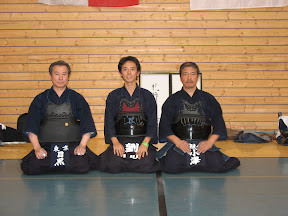
Meguro-Sensei, me and Ozawa-Sensei

Ozawa-Sensei's Autograph. It means: all except me are my teachers.
Sunday, September 24, 2006
Last day jigeiko
I got to the sports hall an hour early as in the previous few days. But I was the first and only one there, even before all the organizers. The jigeiko started 9am-somthing, after I put my men on a girl, Satoh, from Vienna invited me for jigeiko so we practised for a while, before ending it with an Ippon-Shobu. She didn't seem very experienced so it wasn't very difficult for me. I tried to hold my centre more, something I will work on in the coming months.
Next Kei came to train with me. Of course I was delighted. She has a stong centre that was hard to break, and did very well suriage. During our Ippon-Shobu, however, she didn't use it, which suggested that she's not very confident with it. It was a tough one with occationally one of us landed the shinai on target but denied a point by oneself. At the end she got a straight men-cut, because my, also men, strike could not hold the centerline. Good match!
Then a Czech girl Denise (I think it's her name) wanted to geiko with me. I feel important now having people queuing up for me! She is a strong kenshi, and I used this opportunity to practise holding my centre. It was therefore a nice match for me. In the Ippon-Shobu, I landed a harai-men to claim the point.
More people waiting. Misha from Berlin whom I promised to do jigeiko with yesterday came. He had a blitzing attack but I didn't feel very pressured because I think he didn't bring he whole body forwards. It might be due to that he is tall. However, he ducked very fast so my men-strikes missed because of that. I should have tried to do nidan waza, but it didn't come across my mind at the time. Finally I won the Ippon with kote.
I then jigeiko'ed with Kamemoto-Sensei from Austria. Very interestingly he used jodan-no-kamae with switching hands. He would suddenly swap the upper hand and the lower hand. I guess his opponent must be confused by that. But to me who is really no match to him, he used Chudan. There wasn't too much to note from this geiko, in fact except a good work out.
My last opponent was Kenji. I was keen to see what he thinks of me today compared to yesterday. Feed back from him was:
After training
The organizers brought us with the Senseis to the Italian resturaunt where we were yesterday. As soon as I walked in and said hi to the people who had already arrived, I saw Meguro Sensei waving at me and pointed at the seat next to him. So I sat next to him and chatted with him during the lunch. He went to Taiwan some years ago for tourism and like it very much. I told him that his suriage just kills me and my harai-waza didn't work at all. He said the best is to just go straight in with seme and strike men, and that from 6th Kyu to 8th Dan one should always try to acheive this. "Kendo," he said, "should be simple, and beautiful. Simple and Beautiful."
I'd be forever grateful for this advice.
After the lunch we said farewell in front of the resturaunt. When I said goodbye to Ozawa-Sensei I looked firmly into his eyes and said "See you." He responded with the same firmness and a nod, "See you."
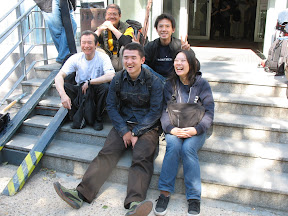
Next Kei came to train with me. Of course I was delighted. She has a stong centre that was hard to break, and did very well suriage. During our Ippon-Shobu, however, she didn't use it, which suggested that she's not very confident with it. It was a tough one with occationally one of us landed the shinai on target but denied a point by oneself. At the end she got a straight men-cut, because my, also men, strike could not hold the centerline. Good match!
Then a Czech girl Denise (I think it's her name) wanted to geiko with me. I feel important now having people queuing up for me! She is a strong kenshi, and I used this opportunity to practise holding my centre. It was therefore a nice match for me. In the Ippon-Shobu, I landed a harai-men to claim the point.
More people waiting. Misha from Berlin whom I promised to do jigeiko with yesterday came. He had a blitzing attack but I didn't feel very pressured because I think he didn't bring he whole body forwards. It might be due to that he is tall. However, he ducked very fast so my men-strikes missed because of that. I should have tried to do nidan waza, but it didn't come across my mind at the time. Finally I won the Ippon with kote.
I then jigeiko'ed with Kamemoto-Sensei from Austria. Very interestingly he used jodan-no-kamae with switching hands. He would suddenly swap the upper hand and the lower hand. I guess his opponent must be confused by that. But to me who is really no match to him, he used Chudan. There wasn't too much to note from this geiko, in fact except a good work out.
My last opponent was Kenji. I was keen to see what he thinks of me today compared to yesterday. Feed back from him was:
- Improved. My kensen is now more in the centre.
- Have no fear. Don't always walk back. Keep the pressure on.
After training
The organizers brought us with the Senseis to the Italian resturaunt where we were yesterday. As soon as I walked in and said hi to the people who had already arrived, I saw Meguro Sensei waving at me and pointed at the seat next to him. So I sat next to him and chatted with him during the lunch. He went to Taiwan some years ago for tourism and like it very much. I told him that his suriage just kills me and my harai-waza didn't work at all. He said the best is to just go straight in with seme and strike men, and that from 6th Kyu to 8th Dan one should always try to acheive this. "Kendo," he said, "should be simple, and beautiful. Simple and Beautiful."
I'd be forever grateful for this advice.
After the lunch we said farewell in front of the resturaunt. When I said goodbye to Ozawa-Sensei I looked firmly into his eyes and said "See you." He responded with the same firmness and a nod, "See you."
Saturday, September 23, 2006
Toru Giga Cup 2006
Today is the big day. I selpt much better last night. It was a disaster going home, though. My head was aching; my muscles were killing me, too. But fortunately I found something soft for putting on the floor to sleep on.
When I saw Kuroda in the sports hall, he looked tired. He said he had a bit of hang-over, from 5 or 6 beers. Geez, he probably had forgotten completely that today is the tournament. Oh, by the way, so he and Yasuko are both competing despite they were in the seminar the "Senseis". Kuroda told me, "Here people call was Senseis, but in Japan only 7th/8th Dan holders are called senseis." But I guess it still doesn't change the fact that some poeple would be horrified if they had to fight one of these two in the tournament
The opening speech took place as usual in a kendo tournament with the kendoka standing in lines. There were a few new faces among the officials. One was Kawamoto-san who I met last night, and the other was Kamemoto, 6th Dan, from Austria.
The participants of the tournament were divided into 36 groups, with 3 in each group, and the top two enter into the knock-out round. One person was absent in my group, so that means I need to only fight once and automaticaly enter into the KO round. Nonetheless, I won the match against Strnadek with one men . He was much taller and bigger than me, and it took me some time to adapt. At the begining I got constantly pushed around, and got a hansuku for being outside. Then when we're at the issoku itto no maai, I leaped forwards and striked men. Men-ari!
So I advanced into the knock-out round. The first match, against Janecek, was perhaps my favourite one of all my matches in the past. I landed a harai-men, with only one step forwards, which happened so smoothly that it's all most like a textbook example. Second point I got was, to put it in a glorious way, a san-dan waza, namely, men-men-men. When we were in the Chikama distance parrying each other's shinai, I suddenly reversed mine and attempted a men-stike, but he blocked it, however, with a bad posture. So I pursue with another one, and another one, with him going backfowards. At this moment I saw an opening on his men, and somehow I had plenty of time to draw my left foot close to me again, so I lauched a men-strike, being almost certain that I could hit it. Bang! Another point.
I lost my next match, against a member of Czech national team, Fritz. His kendo is very beautiful - fast and clean. He first scored a kote-men. At the moment when the shinai touched my kote (it was the wrong one as well) I just froze for a moment, and the men-strike landed rightafter. He won the second point with a do-strike. When I tried to block his attack, he spotted the opening - a lesson to be learned!
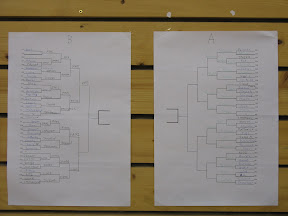
Some highlights of the day were, the two Japanese Sensei Kuroda and Yasuko were both knocked-out. Kuroda by Koss, and Yasuko by Walkiewicz. It was tough for Yasuko because Walkiewicz is a very big guy, who took it to his advantage and used a lot of body-check technique, or taiatari. She lost 0-1. But many people were very suprised to see that Kuroda lost. Afterall he trained all of us, and somehow had the "aura" beyond him, since he came with Ozawa-Sensei, and from the land of samurai. However, I'm sure he would've done better if he didn't have the hang-over. The funny thing was, when Kuroda lost, Ozawa-sensei passed by in front of me and Kei, he did the gesture of wiping his sweat of his forehead. Another example of his humour.
The match between Sugino and Mraz were a good one too. Sugino is an ex-Wasada University kendoka, and currently studying in Berlin. Mraz, a past winner of the same tournament, comes from Vienna, who fights in jodan and is very tall. I captured the match on video, so I'll let it do the talking.
Quartar-final: Sugino (white) vs Mraz (red)
Sugino eventually won the title, and in the second place was Yearwood from Poland.
Final: Sugino (white) vs. Yearwood (red)
Just before the final, Ozawa-Sensei and Meguro-Sensei performed the Itto-Ryu Mizoguchi-Ha kata. Kuroda explained to me that it's a kata which is not very well known even within Japan, and Ozawa-Sensei learned it directly from the Soke (宗家) (head master of the Ryu-Ha). It could be performed with many people at the same time, even up to ten. The kata looked like iaido and kenjutsu, with a lot of slicing motion.
Free-jigeiko
There was half-an-hour time for free-jigeiko. I practised with Kenji, whose suriage was again my killer. I realised that to prevent the opponent from a successful suriage, I can first use the harai technique, and then just as I reach for men, if the opponent has a strong centre and raises his shinai to perform suriage, I can, instead of continuing the men-strike, press my shinai against his. If I continue the men-strike, the opponent would definitely brush off my shinai and hit men.
Feedback from Kenji:
After everyone finished, Kenji did jigeiko with Takita and Kamemoto-Sensei. I admire Kenji's powerful kendo. First was his kiai. Very deep and strong, like a big wave directing at his opponent. And secondly was his explosion of men-strike.
After training
I went for dinner with the Berliners in a nearby Italian resturaunt. My body and my mind were both dying for some good food, so once I stepped into the resturaunt I smiled from within! There wasn't a big enough table for all of us so we broke into two tables, with me sitting at the same one with Kei and Saskia. Ho ho lucky me to dine with two hot kendo chicks. We kinda spoke a mixture of German and English since I still express more freely with English. We discussed about the seminar, tournament and the senseis as well as the other general things. Both of them were suprised that I've only been in Bogu for six months after seeing my matches.
After dinner some people wanted to go back to rest, but I wanted to go to the city centre, to enjoy my last night in Prague. Kei and Saskia joined. We went to the New Town and the Charles Bridge (again!), just walking around not having to worry too much about preserving energy for the hard training the next day.
This night I slept super sound.

When I saw Kuroda in the sports hall, he looked tired. He said he had a bit of hang-over, from 5 or 6 beers. Geez, he probably had forgotten completely that today is the tournament. Oh, by the way, so he and Yasuko are both competing despite they were in the seminar the "Senseis". Kuroda told me, "Here people call was Senseis, but in Japan only 7th/8th Dan holders are called senseis." But I guess it still doesn't change the fact that some poeple would be horrified if they had to fight one of these two in the tournament
The opening speech took place as usual in a kendo tournament with the kendoka standing in lines. There were a few new faces among the officials. One was Kawamoto-san who I met last night, and the other was Kamemoto, 6th Dan, from Austria.
The participants of the tournament were divided into 36 groups, with 3 in each group, and the top two enter into the knock-out round. One person was absent in my group, so that means I need to only fight once and automaticaly enter into the KO round. Nonetheless, I won the match against Strnadek with one men . He was much taller and bigger than me, and it took me some time to adapt. At the begining I got constantly pushed around, and got a hansuku for being outside. Then when we're at the issoku itto no maai, I leaped forwards and striked men. Men-ari!
So I advanced into the knock-out round. The first match, against Janecek, was perhaps my favourite one of all my matches in the past. I landed a harai-men, with only one step forwards, which happened so smoothly that it's all most like a textbook example. Second point I got was, to put it in a glorious way, a san-dan waza, namely, men-men-men. When we were in the Chikama distance parrying each other's shinai, I suddenly reversed mine and attempted a men-stike, but he blocked it, however, with a bad posture. So I pursue with another one, and another one, with him going backfowards. At this moment I saw an opening on his men, and somehow I had plenty of time to draw my left foot close to me again, so I lauched a men-strike, being almost certain that I could hit it. Bang! Another point.
I lost my next match, against a member of Czech national team, Fritz. His kendo is very beautiful - fast and clean. He first scored a kote-men. At the moment when the shinai touched my kote (it was the wrong one as well) I just froze for a moment, and the men-strike landed rightafter. He won the second point with a do-strike. When I tried to block his attack, he spotted the opening - a lesson to be learned!
Some highlights of the day were, the two Japanese Sensei Kuroda and Yasuko were both knocked-out. Kuroda by Koss, and Yasuko by Walkiewicz. It was tough for Yasuko because Walkiewicz is a very big guy, who took it to his advantage and used a lot of body-check technique, or taiatari. She lost 0-1. But many people were very suprised to see that Kuroda lost. Afterall he trained all of us, and somehow had the "aura" beyond him, since he came with Ozawa-Sensei, and from the land of samurai. However, I'm sure he would've done better if he didn't have the hang-over. The funny thing was, when Kuroda lost, Ozawa-sensei passed by in front of me and Kei, he did the gesture of wiping his sweat of his forehead. Another example of his humour.
The match between Sugino and Mraz were a good one too. Sugino is an ex-Wasada University kendoka, and currently studying in Berlin. Mraz, a past winner of the same tournament, comes from Vienna, who fights in jodan and is very tall. I captured the match on video, so I'll let it do the talking.
Quartar-final: Sugino (white) vs Mraz (red)
Sugino eventually won the title, and in the second place was Yearwood from Poland.
Final: Sugino (white) vs. Yearwood (red)
Just before the final, Ozawa-Sensei and Meguro-Sensei performed the Itto-Ryu Mizoguchi-Ha kata. Kuroda explained to me that it's a kata which is not very well known even within Japan, and Ozawa-Sensei learned it directly from the Soke (宗家) (head master of the Ryu-Ha). It could be performed with many people at the same time, even up to ten. The kata looked like iaido and kenjutsu, with a lot of slicing motion.
Free-jigeiko
There was half-an-hour time for free-jigeiko. I practised with Kenji, whose suriage was again my killer. I realised that to prevent the opponent from a successful suriage, I can first use the harai technique, and then just as I reach for men, if the opponent has a strong centre and raises his shinai to perform suriage, I can, instead of continuing the men-strike, press my shinai against his. If I continue the men-strike, the opponent would definitely brush off my shinai and hit men.
Feedback from Kenji:
- when doing seme, hold the centre. Don't let the kensen wander around.
After everyone finished, Kenji did jigeiko with Takita and Kamemoto-Sensei. I admire Kenji's powerful kendo. First was his kiai. Very deep and strong, like a big wave directing at his opponent. And secondly was his explosion of men-strike.
After training
I went for dinner with the Berliners in a nearby Italian resturaunt. My body and my mind were both dying for some good food, so once I stepped into the resturaunt I smiled from within! There wasn't a big enough table for all of us so we broke into two tables, with me sitting at the same one with Kei and Saskia. Ho ho lucky me to dine with two hot kendo chicks. We kinda spoke a mixture of German and English since I still express more freely with English. We discussed about the seminar, tournament and the senseis as well as the other general things. Both of them were suprised that I've only been in Bogu for six months after seeing my matches.
After dinner some people wanted to go back to rest, but I wanted to go to the city centre, to enjoy my last night in Prague. Kei and Saskia joined. We went to the New Town and the Charles Bridge (again!), just walking around not having to worry too much about preserving energy for the hard training the next day.
This night I slept super sound.

Friday, September 22, 2006
Ozawa-Sensei's Seminar 3
Last day of the seminar. Got up in the morning feeling still tired.. Yesterday someone took away the gym mat that I slept on, so I had to sleep on the hard surface and didn't sleep well at all. When the morning session started I was feeling sick and a little stomach pain.
Unfortunately I didn't recall much from the kihon-geiko in the morning session. But I do remember I felt gradually better.
Jigeiko
I was determined to do jigeiko with Ozawa-Sensei because the two previous times I could only do uchikomi-geiko. So I put on my men very quickly and was the third one in Sensei's line. I landed a couple of harai-men, with him nodding, but of course it was clear that he wasn't trying to fight me but to motivate me.
After another jigeiko with Kuroda-san, I was physically exhausted. So I took a early break.
Feedback:
Jigeiko with Meguro-Sensei
During the lunch break I asked Ozawa-Sensei to sign the autograph for my copy of "the Definitive Guide". I thanked him and told him that I benefit a lot from this book. He said, he too.
Afternoon session
Kata. We didn't have time to go over everything ourselves, so we only practised Kata 1-5, with the rest demonstrated by Ozawa-Sensei and Potrafski-Sensei.
Afterwards was again the group training, during which we did more kirikaeshi and men-uchi. Very few people this time in my group because people were tired. I was exhausted too. But I wanted to hold until the end. However, I did have the nauseous feeling that I was about to throw up..
Takita, a Japanese 5th Dan sensei from Romania was leading our group exercise. He stressed the importance of raising the shinai with the shoulders. Since I couldn't move very fast at this point, I did very slowly and make sure my posture was good and the strike was firm and steady.
At the end of the kihon-geiko, I was so exhausted that I couldn't make the jigeiko. So I sat aside and observed.
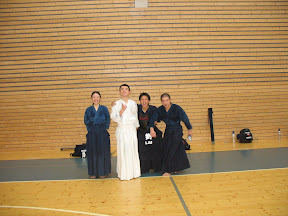
Iinuma, Kuroda, me, and Takita
Party - talking with Sensei
There was the "Thany you" party in the lounge of a nearby hotel, which took about 20 mins walking. I was at the end of the crowd on my own enjoying a moment of silence and the evening air outside the sports hall when someone called me, "Mr. Liu." I turned around, and it was Ozawa-Sensei. We then started talking about various things: travelling in different countries, and what I do etc. It turns out that he has spent a month in Newcastle teaching kendo, and was at Imperial College London for a visit as well. (I lived in Newcastle for some time, and studied at Imperial College). It was very nice to talk to him as he's very friendly and talkative. He's English is also not bad, even though during the seminar he spoke only Japanese. I told him about my plan to visit Tokyo after my PhD study next year, and he told me that I'm very welcomed to come to his dojo. He gave me his card, and wrote his moblile phone no. on it. "Call me. Please don't loose it", he said, "If you loose then you can ask the Czech Kendo Federation for my contact." I received the card with both of my hands, very grateful and very suprised.
It turned out that we were enjoying ourselves and walking so slowly that all the others have arrived at the venue.
At the party I met another yondan Japanese working temporarily in Poland, Kenji Kawamoto. He is a very friendly and approachable person. Always smiling. We partnered up to participate in the "table football tournament", but unfortunately I had to leave before we could play because I was very tired and had headache.
I chatted to Yasuko (Iinuma) and Kuroda as well. They're both very fun people to talk to. Especially Kuroda has a funny sense of humour.
Unfortunately I didn't recall much from the kihon-geiko in the morning session. But I do remember I felt gradually better.
Jigeiko
I was determined to do jigeiko with Ozawa-Sensei because the two previous times I could only do uchikomi-geiko. So I put on my men very quickly and was the third one in Sensei's line. I landed a couple of harai-men, with him nodding, but of course it was clear that he wasn't trying to fight me but to motivate me.
After another jigeiko with Kuroda-san, I was physically exhausted. So I took a early break.
Feedback:
- Ozawa-Sensei: More keiko!
- Kuroda: Bring shinai forwards, and don't raise it backwards because it takes too long to strike.
Jigeiko with Meguro-Sensei
During the lunch break I asked Ozawa-Sensei to sign the autograph for my copy of "the Definitive Guide". I thanked him and told him that I benefit a lot from this book. He said, he too.
Afternoon session
Kata. We didn't have time to go over everything ourselves, so we only practised Kata 1-5, with the rest demonstrated by Ozawa-Sensei and Potrafski-Sensei.
Afterwards was again the group training, during which we did more kirikaeshi and men-uchi. Very few people this time in my group because people were tired. I was exhausted too. But I wanted to hold until the end. However, I did have the nauseous feeling that I was about to throw up..
Takita, a Japanese 5th Dan sensei from Romania was leading our group exercise. He stressed the importance of raising the shinai with the shoulders. Since I couldn't move very fast at this point, I did very slowly and make sure my posture was good and the strike was firm and steady.
At the end of the kihon-geiko, I was so exhausted that I couldn't make the jigeiko. So I sat aside and observed.
Iinuma, Kuroda, me, and Takita
Party - talking with Sensei
There was the "Thany you" party in the lounge of a nearby hotel, which took about 20 mins walking. I was at the end of the crowd on my own enjoying a moment of silence and the evening air outside the sports hall when someone called me, "Mr. Liu." I turned around, and it was Ozawa-Sensei. We then started talking about various things: travelling in different countries, and what I do etc. It turns out that he has spent a month in Newcastle teaching kendo, and was at Imperial College London for a visit as well. (I lived in Newcastle for some time, and studied at Imperial College). It was very nice to talk to him as he's very friendly and talkative. He's English is also not bad, even though during the seminar he spoke only Japanese. I told him about my plan to visit Tokyo after my PhD study next year, and he told me that I'm very welcomed to come to his dojo. He gave me his card, and wrote his moblile phone no. on it. "Call me. Please don't loose it", he said, "If you loose then you can ask the Czech Kendo Federation for my contact." I received the card with both of my hands, very grateful and very suprised.
It turned out that we were enjoying ourselves and walking so slowly that all the others have arrived at the venue.
At the party I met another yondan Japanese working temporarily in Poland, Kenji Kawamoto. He is a very friendly and approachable person. Always smiling. We partnered up to participate in the "table football tournament", but unfortunately I had to leave before we could play because I was very tired and had headache.
I chatted to Yasuko (Iinuma) and Kuroda as well. They're both very fun people to talk to. Especially Kuroda has a funny sense of humour.
Thursday, September 21, 2006
Ozawa-Sensei's Seminar 1
Wed 20th Sep
The train arrived at 16:30 in Prague. Thinking that the first evening would be an informal keiko, I walked through the old town square before taking the subway and bus to the dojo, in order to feel the vibe of Prague once more (this is my 4th time being there). By the time I arrived the sensei's and organizers were already giving the opening speech, with the participants sitting in two rows in seiza postion. So I changed very quickly and joined the crowd who were warming up. At this moment I started to regret being late, because I'd like to know more about Ozawa-Sensei's personal background etc.

The Old Town Square
I saw that Ozawa-Sensei and Meguro-Sensei (both 7th Dan Kyoshi) were in the middle, to the left of Ozawa-Sensei were Demski-Sensei (7th Dan Kyoshi) and Potrafski-Sensei (7th Dan) from Germany, Ducarme-Sensei (7th Dan) from Belgium; to the right of Meguro-Sensei were Kustosz (5th Dan) from Poland, Kuroda and Iinuma (both 4th Dan) from Ozawa-Sensei's dojo.
During the suburi-drill Ozawa-Sensei reminded everyone the key-points of doing suburi: back straight, eyes looking forward, and big swings etc. After that, he called the yudansha out as motodachi, with whom all the others performed kirikaeshi and uchikomigeiko. After that the yudansha did the same exercise with each other.
Important points of the Kihon-geiko: one thing that was stressed repeatedly was the breathing,
Jigeiko
Waiting at the end was of course the jigeiko. I stuck to the advice that Stephan told me, first Japanese Senseis, then European Senseis, and forget the rest. But I screw up my himo (strings) as I was tying my Men, since I was trying to rush too much in order to be at the front of the queue. The queue for Ozawa-Sensei was already too long so I queued for Meguro-Sensei. He had an extremely strong centre that none of my shikake-waza works. For example, after my harai and going for men, he could always perform suriage-waza, like my harai wasn't there at all. The next I jigeikoed with Ozawa-Sensei. I found, in fact, less people queued up for the two Japanese 7th dan Sensei. Persumably because many were too shy to keiko with such high profile senseis.
I began all my jigeiko with a men-uchi, since in Ozawa-Sensei's book I read that sometimes it is appropriate to do this, so that the motodachi knows your level, and can stimulate you accordingly. During our jigeiko, I blocked too much that when he striked my kote I tried to defend it (too late) then he went for men and I defended men (too late), so this funny panicing situation continued for more than I'd like. We finished off with kakari-geiko, which was mind-blowing. When we received my taiatari he pushed me off with the shinai on my shoulder, as a result my balance was totally lost when going backwards, which meant that during my hiki-waza the opponent is still dictating. I must instead find a way to take controll instead. This was the end of the jigeiko. I went up to both senseis for advices but they gave none to anyone except saying arigatogosaimasu.
After training
After taking a shower I stood at the entrance of the sports hall while Ozawa-sensei was also there. We nodded and exchanged smiles. I might have said thank you for the training or something, he then told me: "I would like to see more of you." And I said "Hye!" Not sure why he said that, but that felt GOOD! He sat down on the bench, at which point no one was talking to him, so I took the opportunaty to initiate a conversation. So, I went: "Ano.. sensei, do you know someone called Vivian Yung? She says hi to Sensei"-- Yes, Vivian, thanks for providing me with a "chat-up line". He tilted his head while I explained more, and remembered. He then said that he might see her in Taipei during the WKC. I told him that I'm originally from Taipei, and the conversation continued from there until he felt with the organizers and other senseis for dinner.
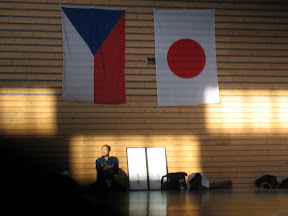
Ozawa-Sensei
A group of people consists of Czech and German kenshi went out for a drink. The first two pubs didn't have enough space so we had to keep on walking, until at some point the guys from Leipzig decided that's enough, and since I stayed overnight at the dojo (not the one where the event took place) with them, I left with them and went to one of the previous pubs and had a drink, which was very relaxing. Czech beer is good!
The train arrived at 16:30 in Prague. Thinking that the first evening would be an informal keiko, I walked through the old town square before taking the subway and bus to the dojo, in order to feel the vibe of Prague once more (this is my 4th time being there). By the time I arrived the sensei's and organizers were already giving the opening speech, with the participants sitting in two rows in seiza postion. So I changed very quickly and joined the crowd who were warming up. At this moment I started to regret being late, because I'd like to know more about Ozawa-Sensei's personal background etc.

The Old Town Square
I saw that Ozawa-Sensei and Meguro-Sensei (both 7th Dan Kyoshi) were in the middle, to the left of Ozawa-Sensei were Demski-Sensei (7th Dan Kyoshi) and Potrafski-Sensei (7th Dan) from Germany, Ducarme-Sensei (7th Dan) from Belgium; to the right of Meguro-Sensei were Kustosz (5th Dan) from Poland, Kuroda and Iinuma (both 4th Dan) from Ozawa-Sensei's dojo.
During the suburi-drill Ozawa-Sensei reminded everyone the key-points of doing suburi: back straight, eyes looking forward, and big swings etc. After that, he called the yudansha out as motodachi, with whom all the others performed kirikaeshi and uchikomigeiko. After that the yudansha did the same exercise with each other.
Important points of the Kihon-geiko: one thing that was stressed repeatedly was the breathing,
- Kirikaeshi: (1) men-strike, (2) breath, then 4 sayu-men forwards and 5 backwards, then men-strike, (3) pause and breath again (4) repeat (2) and (3).
- Men-uchi: (1) Kiai and let the air out of the chest (2) breath, followed by three men-uchi with one breathe, (3) pause and breath (4) single men-uchi.
Jigeiko
Waiting at the end was of course the jigeiko. I stuck to the advice that Stephan told me, first Japanese Senseis, then European Senseis, and forget the rest. But I screw up my himo (strings) as I was tying my Men, since I was trying to rush too much in order to be at the front of the queue. The queue for Ozawa-Sensei was already too long so I queued for Meguro-Sensei. He had an extremely strong centre that none of my shikake-waza works. For example, after my harai and going for men, he could always perform suriage-waza, like my harai wasn't there at all. The next I jigeikoed with Ozawa-Sensei. I found, in fact, less people queued up for the two Japanese 7th dan Sensei. Persumably because many were too shy to keiko with such high profile senseis.
I began all my jigeiko with a men-uchi, since in Ozawa-Sensei's book I read that sometimes it is appropriate to do this, so that the motodachi knows your level, and can stimulate you accordingly. During our jigeiko, I blocked too much that when he striked my kote I tried to defend it (too late) then he went for men and I defended men (too late), so this funny panicing situation continued for more than I'd like. We finished off with kakari-geiko, which was mind-blowing. When we received my taiatari he pushed me off with the shinai on my shoulder, as a result my balance was totally lost when going backwards, which meant that during my hiki-waza the opponent is still dictating. I must instead find a way to take controll instead. This was the end of the jigeiko. I went up to both senseis for advices but they gave none to anyone except saying arigatogosaimasu.
After training
After taking a shower I stood at the entrance of the sports hall while Ozawa-sensei was also there. We nodded and exchanged smiles. I might have said thank you for the training or something, he then told me: "I would like to see more of you." And I said "Hye!" Not sure why he said that, but that felt GOOD! He sat down on the bench, at which point no one was talking to him, so I took the opportunaty to initiate a conversation. So, I went: "Ano.. sensei, do you know someone called Vivian Yung? She says hi to Sensei"-- Yes, Vivian, thanks for providing me with a "chat-up line". He tilted his head while I explained more, and remembered. He then said that he might see her in Taipei during the WKC. I told him that I'm originally from Taipei, and the conversation continued from there until he felt with the organizers and other senseis for dinner.
A group of people consists of Czech and German kenshi went out for a drink. The first two pubs didn't have enough space so we had to keep on walking, until at some point the guys from Leipzig decided that's enough, and since I stayed overnight at the dojo (not the one where the event took place) with them, I left with them and went to one of the previous pubs and had a drink, which was very relaxing. Czech beer is good!
Ozawa-Sensei's Seminar 2
Thu 21st Sep
The morning's session (9am-12am) started with the same exercises as yesterday. Except at the end, Ozawa-Sensei announced, "The next exercise is more difficult, but if any mudansha also likes to try please step forwards." I, without a second thought, went forwards.
The exercise was ai-kakarigeiko, and the format was such that, everyone kiai and seme onto each other until Sensei blows the whitsle, at which moment the two should try to strike men as fast as possible and turn around and strike again until the next whitsle blow. The exercise was repeated many times. There were only 5 seconds between each blow of the whitsle, which normally allowed 3-4 men strikes. I practised with Baris Goek, and, after the rotation, with Kei Udagawa, both from Berlin.
Ai-kakarigeiko
During the lunch break I chatted with Kei. She lived in Germany already since 1 year old, and is currently a member of the national team.
Afternoon
The afternoon sesseion started at 2pm. We were divided into groups according to our levels: Dan, Kyu, women, and beginners. Since I don't officially hold a grade, I wasn't sure where I should be. So I said that I was a 4th Kyu. Well..., it turned out that I might have just as well claimed to be a 6th Kyu since the Kyu group was further divided into 1-3th Kyu and 4-6 Kyu groups.
We started with Kirikaeshi, slowly with a clear pause after each strike. Then men-uchi, and kote-men-uchi, with the breathing controll as explained yesterday. I tried to achieve ki-ken-tai-ichi and good posture with every strike and to work towards a consistent performance.
The group practise was followed by a 10 mins break, and then the yudansha stepped forward again as the motodachi, and we did kakari-geiko a few rounds, each time for 15 seconds. The yudansha then practise with each other, first kakari-geiko, then ai-kakari-geiko.
Jigeiko
Finally the jigeiko time. I queued up for Kuroda this time. Did a fairly long jigeiko with him. I couldn't get his kote so I mostly went for men. The feedback from him afterwards was: "Good match."
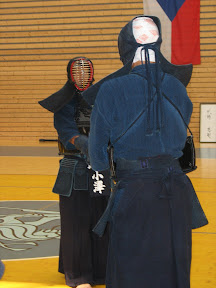
I then did jigeiko with Meguro-sensei, but I can't remember much detail from it. With Ozawa-Sensei I only got to do uchikomi-geiko, because it was getting late. Seeing that all the senseis were giving uchikomi-geiko, I invited Kei for a jigeiko. We had perhaps only 2 mins before the session was closed. She did straight men-cuts, and had extremely strong centre. So I didn't get any points. Anyhow, it was a short and enjoyable jigeiko.
After training
After the session finished I went to talk to Kuroda and introduced myself. He is a very approachable and relaxed person, which to some would be a suprise since senseis sitting on the other side of the dojo easily give people the impression of being serious. Speaking very slowly and choosing right words, we could communicate in English.
He teaches kendo and Mathematics at the girl's high school managed by Tokyo University of Science, the University where Ozawa-Sensei holds a professorship. I like his kendo very much, especially his posture, and the way he moves - very steady and yet mobile.
In the evening I joined the Berlin crowd to the city centre to have pizza and a drink. We spoke a mixture of German and English, and it was great fun. Kei after the dinner decided that we should go to the castle, which is situated at the top of the hill. Funnily, though I think most of the people would have prefered not to, no one objected. So, at 10pm, after a day of hard training, we climb up the hill to see the castle at night. We got there at the end though.
The morning's session (9am-12am) started with the same exercises as yesterday. Except at the end, Ozawa-Sensei announced, "The next exercise is more difficult, but if any mudansha also likes to try please step forwards." I, without a second thought, went forwards.
The exercise was ai-kakarigeiko, and the format was such that, everyone kiai and seme onto each other until Sensei blows the whitsle, at which moment the two should try to strike men as fast as possible and turn around and strike again until the next whitsle blow. The exercise was repeated many times. There were only 5 seconds between each blow of the whitsle, which normally allowed 3-4 men strikes. I practised with Baris Goek, and, after the rotation, with Kei Udagawa, both from Berlin.
Ai-kakarigeiko
During the lunch break I chatted with Kei. She lived in Germany already since 1 year old, and is currently a member of the national team.
Afternoon
The afternoon sesseion started at 2pm. We were divided into groups according to our levels: Dan, Kyu, women, and beginners. Since I don't officially hold a grade, I wasn't sure where I should be. So I said that I was a 4th Kyu. Well..., it turned out that I might have just as well claimed to be a 6th Kyu since the Kyu group was further divided into 1-3th Kyu and 4-6 Kyu groups.
We started with Kirikaeshi, slowly with a clear pause after each strike. Then men-uchi, and kote-men-uchi, with the breathing controll as explained yesterday. I tried to achieve ki-ken-tai-ichi and good posture with every strike and to work towards a consistent performance.
The group practise was followed by a 10 mins break, and then the yudansha stepped forward again as the motodachi, and we did kakari-geiko a few rounds, each time for 15 seconds. The yudansha then practise with each other, first kakari-geiko, then ai-kakari-geiko.
Jigeiko
Finally the jigeiko time. I queued up for Kuroda this time. Did a fairly long jigeiko with him. I couldn't get his kote so I mostly went for men. The feedback from him afterwards was: "Good match."
I then did jigeiko with Meguro-sensei, but I can't remember much detail from it. With Ozawa-Sensei I only got to do uchikomi-geiko, because it was getting late. Seeing that all the senseis were giving uchikomi-geiko, I invited Kei for a jigeiko. We had perhaps only 2 mins before the session was closed. She did straight men-cuts, and had extremely strong centre. So I didn't get any points. Anyhow, it was a short and enjoyable jigeiko.
After training
After the session finished I went to talk to Kuroda and introduced myself. He is a very approachable and relaxed person, which to some would be a suprise since senseis sitting on the other side of the dojo easily give people the impression of being serious. Speaking very slowly and choosing right words, we could communicate in English.
He teaches kendo and Mathematics at the girl's high school managed by Tokyo University of Science, the University where Ozawa-Sensei holds a professorship. I like his kendo very much, especially his posture, and the way he moves - very steady and yet mobile.
In the evening I joined the Berlin crowd to the city centre to have pizza and a drink. We spoke a mixture of German and English, and it was great fun. Kei after the dinner decided that we should go to the castle, which is situated at the top of the hill. Funnily, though I think most of the people would have prefered not to, no one objected. So, at 10pm, after a day of hard training, we climb up the hill to see the castle at night. We got there at the end though.
Wednesday, September 20, 2006
Off to Prague!
Just a quick note to say that I'm off to prague in a few hours to attend the seminar and Toru Giga Cup tournament lead by Hiroshi Ozawa-Sensei. Extremly looking forward to it! The schedule is as follows:
Wednesday Sep 20th:
17:00 – 21:00 evening practice
Thursday Sep 21st:
09:00 – 12:00 morning practice
12:00 – 14:00 lunch break
14:00 – 16:30 afternoon practice
18:00 – 19:00 Lecture "Essence of Training (Keiko) in Japanese Culture" by Hiroshi Ozawa
Friday Sep 22nd :
09:00 – 12:00 morning practice
12:00 – 14:00 lunch break
14:00 – 17:30 afternoon practice
19:00 – 24:00 "Thank you all" party
Saturday Sep 23rd:
09:00 – 18:00 15th Toru Giga Prague Kendo Cup
(Individual tournament with no sex /grade restriction, min age 15+)
19:00 – 22:00 free jigeiko
Sunday Sep 24th:
09:00 – 12:00 good-will jigeiko
Yesterday I had a warming-up training session. Not thing special to note. On Thursday Yanai Sensei, 7th Dan Kyoshi, who has lived in London for the past 8 years will come to Dresden to train with us. It's a pity that I'll miss out the opportunity to meet him, as I have heard of him before.
Aii~ wish me luck!
Wednesday Sep 20th:
17:00 – 21:00 evening practice
Thursday Sep 21st:
09:00 – 12:00 morning practice
12:00 – 14:00 lunch break
14:00 – 16:30 afternoon practice
18:00 – 19:00 Lecture "Essence of Training (Keiko) in Japanese Culture" by Hiroshi Ozawa
Friday Sep 22nd :
09:00 – 12:00 morning practice
12:00 – 14:00 lunch break
14:00 – 17:30 afternoon practice
19:00 – 24:00 "Thank you all" party
Saturday Sep 23rd:
09:00 – 18:00 15th Toru Giga Prague Kendo Cup
(Individual tournament with no sex /grade restriction, min age 15+)
19:00 – 22:00 free jigeiko
Sunday Sep 24th:
09:00 – 12:00 good-will jigeiko
Yesterday I had a warming-up training session. Not thing special to note. On Thursday Yanai Sensei, 7th Dan Kyoshi, who has lived in London for the past 8 years will come to Dresden to train with us. It's a pity that I'll miss out the opportunity to meet him, as I have heard of him before.
Aii~ wish me luck!
Subscribe to:
Posts (Atom)


