This is a blog that I started in April 2006, just after I first put on my bogu (kendo armour). It collects the advices given by more experienced kendo practitioners as well as those from my own experiences. Both technical and the mental aspects of kendo are written in the blog. I hope someone will find them useful or interesting at least!
With my calves still sore, typing an article on kendo training is like the cool down exercise for the mind.
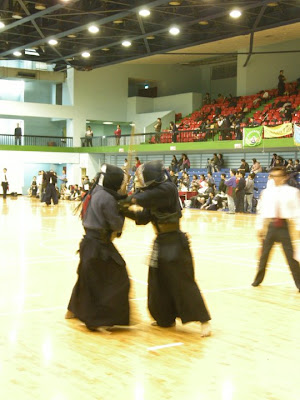
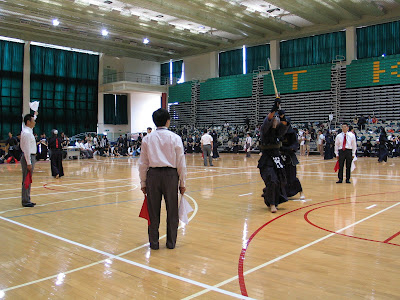
Last month on 7/31, we traveled down south to Tainan City to participate in the annual North-South Competition. The main event is the match between the North Team and the South Team, which consists of kendoka from the northern and the southern Taiwan, much like the idea of the Tosai (East-West) Competition.
Each team has almost 80 players, and there are two courts. 40 players from each team fights in one court with the "point-scoring" system, where one player fights with only one player (the most common system); The other 40 players fight in the other court with the "advancing" system, where one player stays on the court to fight the next if he wins.
There is also team competition between dojos. The North won overwhelmingly on the day, and the matches were exciting accompanied by lots of cheering.
I won two matches and lost one. Our dojo's team were not able to advance, and lost to a team whom we should have won. I think I played a big role in our defeat, because I was the Senpo and lost 2-0. My opponent wasn't impossible to win, but he was more experienced and calm. He made me think that I had the chance, so I launched a kote-men strike. He scored with a kaeshi-do. Then I became impatient, and wanted to get the point back. He caught a debana-kote.
It's a classic example of not being calm enough, making enough seme before striking. A good lesson to be learned!!
The event took place in a very special place called the Butokuden "武德殿". It's officially classified as a national heritage, and there's a similar one in Kao-Hsiung, where we also went for a competition 2 years ago. It was built during the Japanese occupation period for the police to train kendo and judo.
Though victory didn't smile upon us, we did had a bit of fun taking a day trip down south in a nice weather. And I did learned a lot from this competition!
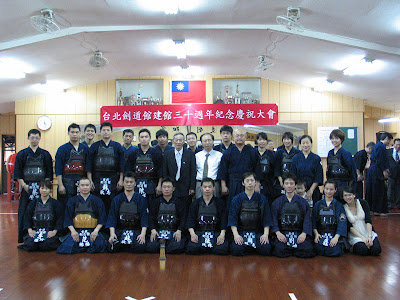
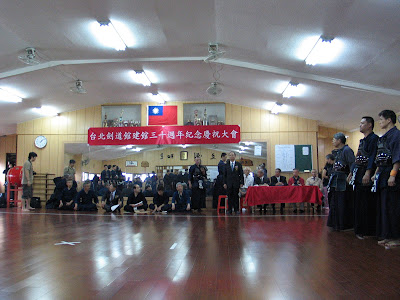
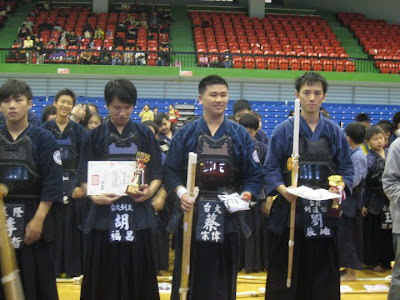
The 30th Anniversary celebration finished successfully. About 10 teams participated in the competition including 4 teams from Taipei Kendokan, 1 team (all japanese senseis) from Shang-Hai, 1 team from Renpeikan (Japan), 1 from the police, 1 from Yi-lan County, 1 from I-Shin Kendokan, and 1 from Hsin-Chu City. The winner was the Renpeikan team and the second was one of the Taipei Kendokan team. The joint third were Shang-Hai and Hsin-Chu.
My team lost to I-Shin Kendokan, though I won my match 1-0 as the jiho. I scored a debana-kote, however wasn't able to score a further point despite some attempts to strike men. I guess that they were too slow, and my opponent just saw them coming and blocked. And I almost didn't use any kote-men, fearing that it might be too slow. More practices required!
All in all it was a good atmosphere. I was stunned by the performance from our most experienced team (members consisting 4~5 dan) and the Japanese team (many are 7th Dan). The matches were really top-notch, which further encouraged me that there are so much room for me to improve and perhaps that, if I work hard enough one day I will be like that!
Last Sunday was the Taipei Cup, in which we had one team consisted of 7 people including me. We got the third place in the end, lost unexpectedly to the Taiwan University Alumni, who came the 2nd.
I was placed in the Jiho (the second place) in the match. My opponent scored a men-nuki-men first, when I carelessly striked men while my left foot was too far behind my right, meaning I couldn't jump far. Now 0-1. "Be calm..", as I told myself. Then after a few exchanges of strikes, he leapt in, and without thinking I took once small step behind to void it, and immediate striked his kote. "Kote-ari!", a men-nuki-kote. It was a 1-1 draw.
We lost the match 2-3. Ho Sensei was not happy about my performance of the day because I made many mistakes with basics. I need to:
always make sure I draw my left foot quickly when doing seme.
usemore hiki-waza.
do not bend my body when striking kote.
Of course the lack of practice lately was to blame. There is really no short cut but to do more suburi and more practice...
Kuroda-san and I met in Czech Republic about 4 years ago, when Ozawa Sensei was invited to Prague to hold a kendo seminar. Since then we've kept in touch, and met up for kendo and drink every time when I went to Japan. It all seemed like yesterday, and yet so far away. He is truly a special friend. Now I'm happy that he finally comes to Taiwan and visit me.
He arrived on Friday 3/29, and in the evening I took him to the Taipei Kendokan. As usual the training started with kihon, waza-geiko, mawari-geiko and jigeiko. Kuroda san's perfect body posture and balance could not be more familiar to me, and that's his uniqueness.
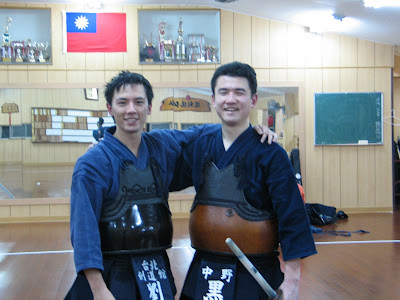
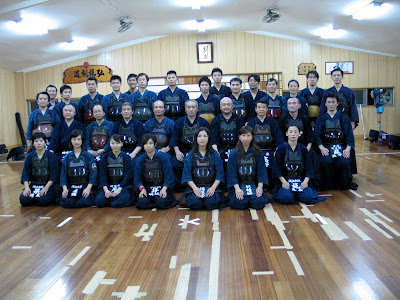
After the training at Taipei Kendokan.
My practice that evening was not so great as my right arm was too tense all the time. But it was nonetheless enjoyable to play kendo again with my old friend.
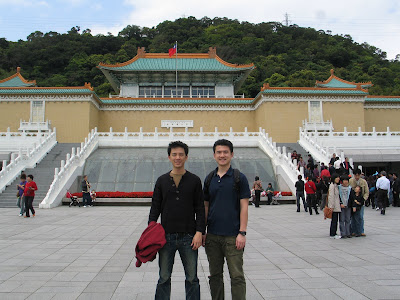
At the world-famous National Palace Museum.
Monday, 29th March
I took him to the Nation Chiao Tung University (NCTU) kendo club, and Kuroda san was asked to lead the session. The members who turned up for training were:
upon the point of contact between shinai and the men, the left arm is inclined with the shinai when looking from the side.
one should practise more large men-cuts. If one is good at large cuts, he/she is naturally good at small cuts.
Wednesday, 31st March
On Wednesday I took him to the National Tsing Hua University kendo club. The members who turned up that evening included many more advanced, who have trained for 2-3 years. Kuroda san was again asked to teach. So I told him that, and suggest he gave more tips on seme-techniques and correct attitudes as well as how to obtain them during training:
Kote strikes:
when practising kote, the kakarite should occupy the centerline first, and then the motodachi should push back at the same time create an opening while the kakarite makes the kote strike.
the kakarite should strike along the centerline.
Seme:
always keep in touch with the motodachi's shinai before striking.
when sliding the shinai against the opponent's shinai, the kensen should lower slightly, so that it is difficult for the opponent to move the shinai to the other side and hit kote.
Do-strikes:
To seme, move the body forwards and direct the tip of the shinai towards the opponent's kote at the same time pressing his shinai down. This makes him want to raise his shinai up. At this moment strike do.
For me, he gave me the following advices:
My seme is too quick, and the opponents raise shinai easily to block. I should make the movement more subtle and slower, in order to let him feel the pressure and strike first while I use oji-waza.
Relax my right arm.
I hope Kuroda-san comes again soon!!
Here is one short clip of our jigeiko. Note: At the end of the clip I struck men when he attempted a kaeshi-do, but didn't manage to block the men-strike.
Recently many Japanese senseis visited Taipei Kendokan, I was however busy and couldn't attend the practice most of the time. Fortunately, I made it to the practice this monday, when about 15 Japanese Senseis visited the dojo, including about four 8th Dan.
I was please with my performance in that evening. I even managed to hit the kote of a young 8th Dan Sensei! Somehow my body balance was very good, and could make straight and fast attacks. However, some senseis just knew what I was going to do. Like Yonekura (米倉) Sensei, he made me think that I could reach his men, but every time when I do that, he made kaeshi-do on me.
Tomorrow Kuroda san (5th Dan from Kobukan Tokyo) will finally visit me, I'm excited to meet my old friend again!!
As promised last year, Ozawa Sensei came again this winter, and brought Tanemichi Chiba Sensei 8th Dan Kyoshi (Kendo lecturer in the Japanese Imperial Guard), Takano Sensei 7th Dan Kyoshi (Kobukan) and Fukui Sensei 7th Dan Kyoshi (Noma Dojo).
[First dinner in Taiwan.]
They came for 5 days, three of which had kendo practices in the evening. The first one was at the Taipei Kendokan. I've wanted to invite Ozawa Sensei to come here because I feel it's one of the dojos that play the kendo style most similar to Japan, or international kendo, instead of some simple whacking-on-the-head activity. And the members here are dedicated to improving their kendo, and strong kenshis. Of course, certain aspects are still missing compared to what is considered "beautiful kendo" in Japan, but I so far I really haven't seen much that outside Japan.
I went to the airport to pick up the Senseis. When I saw Ozawa Sensei coming out from the arrival gate, I had the feeling of seeing an old friend again after a long while! Indeed it has been percisely a year since I saw him last time, during which I've moved from Germany to Taiwan, changed a new job, and moved from Taipei to Hsin-Chu, having lots of changes. It felt like a much longer time!
The next two days I took days off at work and accompanied with the senseis to travel.
Monday, 7th Dec
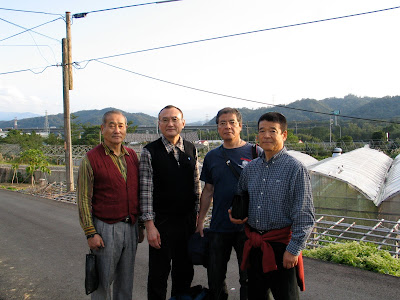
[Visiting the Hakka Cultural Heritage Center.]
[Presents for the Senseis.]
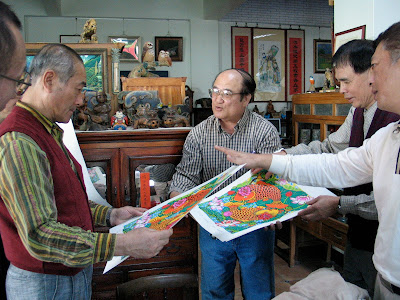
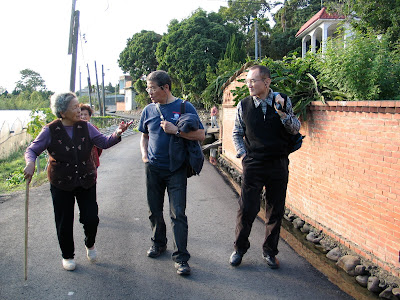
[Senseis had never tasted the dragon fruits.] [The old lady spoke fluent Japanese and chatted to the Senseis.]
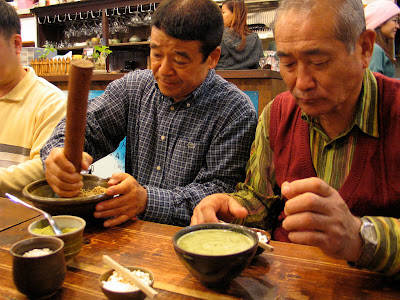
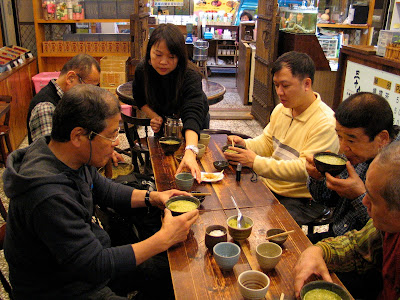
[Hakka traditional grinding tea.]
On Monday we went to the Taipei Kendokan. The turn out was good - about 20+ kenshis. I think everyone enjoyed practising with the 4 Japanese sensei. I was very glad about that.
Chiba Sensei gave us some feedbacks at the end of the training:
In kihon geiko, some people's men-strikes were too small. Kihon is very important, and one should try to strike properly.
One has to break the opponent's kamae before striking. This is achieved by applying pressure, or seme, and occupy the centerline. The most effective way to apply pressure is to direct the tip of the sword towards anypoint between the throat and the middle of his chest, and move in. This is the most uncomfortable place a person feels when something is approaching.
[At Taipei Kendokan]
[Listening to advices from Chiba Sensei.]
Tuesday, 8th Dec
On the next day, after some sight-seeing on the Yang-Ming Mountain, we went to the China University of Technology, where a shot seminar is to be held. [Yang-Ming Mountain]
I assisted Takano Sensei in teaching the beginners without the bogu, about kendo etiquette (reiho) and kamae. The most challanging thing was to translate what Takano Sensei was saying from Japanese into Chinese. I could manage most of it, since I knew roughly what he was saying. However, to tranlsate word by word would still be difficult. I need to study Japanese harder!
Ozawa Sensei and Fukui Sensei demonstrated the Mizoguchi-ha Itto-ryu kenjutsu. (click to view the full size)
Ozawa Sensei and Chiba Sensei demonstrated Kirikaeshi.
Wednesday, 9th Dec
On the Wednesday I had to go back to work, and only joined them in the evening practice at the Hsin-Chu Kendokan.
Ozawa Sensei and Fukui Sensei demonstrated again the Muzogushi-ha Itto-ryu kenjutsu. I feel I can appreciate more and more of its beauty every time I see it.
After the practice, I asked Ozawa Sensei how my jigeiko was. He said that I should relaxe my body more. I think I wanted so much to do my best in front of him that I tensed up my muscles too much. He then invited me come to the Thank-you Dinner from him and the other senseis.
Thursday, 10th Dec
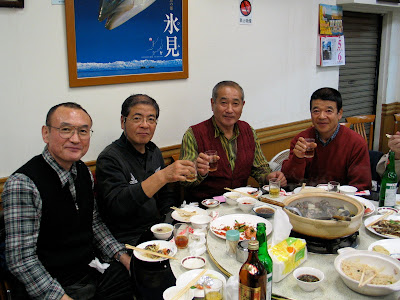
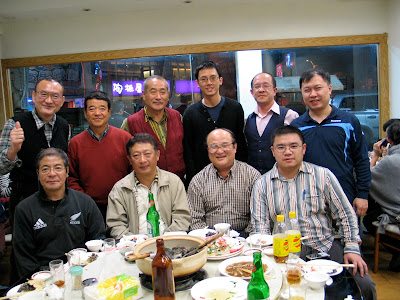
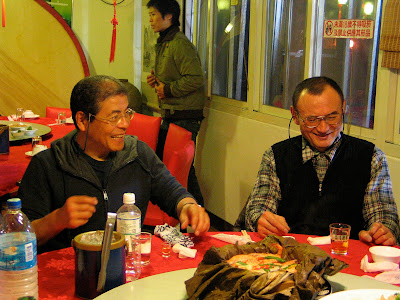
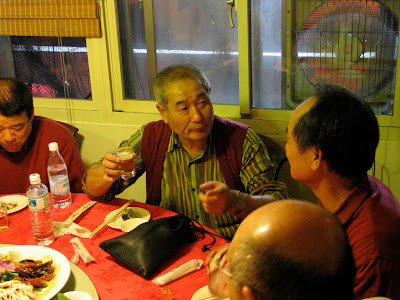
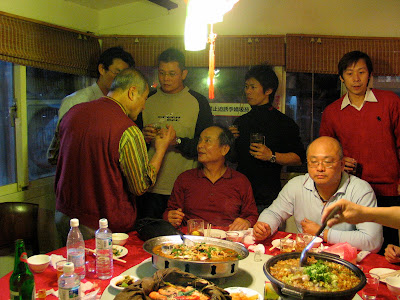
The whole was filled with meetings after meetings at work. Fortunately, the last meeting didn't drag on, so I could take the High Speed Railway to Taipei and take the dinner in time. We had good food and drink. At the end, when Chou-san took the senseis to the nearby night market for sight-seeing, Ozawa-Sensei invited me to stay and have some drink at the hotel bar.
We talked for 2 hours, which passed by very quickly, about kendo, travel, friends and life. He said one day he wants me to travel to England and Czech together. I said, "then I have to become very good in kendo!"
About kendo:
One has to learn the correct kendo forms and develop good seme techniques, instead of relying one's kendo on the stamina, like many players nowadays in All Japan Kendo Championship, and some of other competitions. So kihon is very important as well as waza-practices. It is not good to let winning in competition as one's main goal in kendo.
To strike small men, one should hold the shinai in chu-dan, and moving in with the hip without the shinai moving. At the correct distance (only towards the end), strike immediately. He said it is incorrect, like some people say, to extend the arms forwards from the begining when the body moves forwards.
It is bad to strike too small. He explicitly said that right wrist should also flex up and down as well as the left. Some people might say this creates debana moment for the opponent. For this he replied:
One should use seme and strike at the right moment, so that the opponent will not be able to execute debana kote.
To have good and strong seme, one relies on having confidence with one's own techniques, or WAZA. So we should improve our waza.
He also said, to learn men-strikes, there are three stages:
First raise the shinai above head, and then strike with the body moving fowards at the same time.
First raise the shinai above head, then move the body forwards, and lastly strike.
Keep the shinai in chu-dan while moving the body forwards, and strike.
This is a good reference for all the instructors when teaching the beginners.
Last Sunday I participated in the Hsin-Chu Cup which celebrated also the 10th anniversary of the Hsin-Chu Kendokan. The competition consisted of many catagories - team and north-against-south. The team is made up of 7 people, 2 female fighting first and the rest male. I fought along with the Taipei Kendokan friends and you know what? We were the Winner!!
Although I didn't fight in the final match, since I didn't perfom well enough on the day and I thought the opponents might be too strong for me, I didn't loose the earlier matches, and had two wins and a draw.
The north-south competition featured 39 kenshis from the northertn half of Taiwan and 39 kenshis from the southern half. Much like the Tozai (East-West) Competition in Japan. Being a mere Nidan I was placed as the second person to fight, or aka the jiho. I didn't know I had to go up so early, therefore it was a little shock to me. Anyhow, I won 2-1 with two kote points.
My performance on the day was unsatisfactory because my body was too tense, and at the same time my mind wasn't calm enough. It's only when there were large gaps between our kills could I perform clean cuts.
Some thoughts from the day:
Learn to analyse my opponent and adjust fighting strategy accordingly.
When facing an aggressive and young opponent, be calm and use oji-waza.
Need more shiai experience!!
Here are some videos from the final match, the red side is Taipei Kendokan, and the white is Hsin-Chu Kendokan.
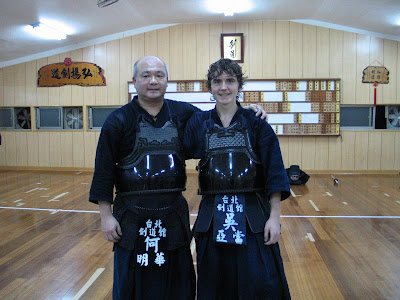
My young Czech friend Adam Urban had his last training in Taipei last Wednesday. He spent 2 months here and came to training regularly. I was very grateful that Ho Sensei took him in as one of his students and gave him a lot of advices. It was a pleasure also to see him improve. Keep it up Adam, and make us PROUD!!
Last Sunday I went to see the 24th All Taiwan University Championship International, which took place just 15 minutes away from my house. About 15-20 universities took part, mainly from the northern part of Taiwan. The level seemed very mixed, with the highest up to about 2nd-3rd Dan. For me, it was a great opportunity to see what the level of student kendo is like here. Though it's far below the Japanese university students, the large number of participants is very encouraging, and they all seemed to enjoy the event very much.