Last Friday seeing almost everyone blocks half of the time in jigeiko, I went ballistic and charged like mad into my opponents. I really want to tell everyone, fight the centre, and not blocking. If you have the centre you do not need to block. Blocking should happen only if it's intended as part of a waza.
Monday, April 28, 2008
Annoyed terribly
It really annoys me BIG TIME when my opponent simply raise his/her shinai to block my strike during practice. It's understandable if it's ippon-shobu or in shiai, but what's the point in normal practices? First, it looks bad, secondly, one never improves if he/she keeps doing that. Being hit makes one realise one's own mistakes, so he can improve faster.


Saturday, April 12, 2008
Breaking the wall
So how has it been since I came back to Dresden almost a month ago? It's interesting to come back having understood more about kendo, and practise with everyone. Obviously, Dresden kendo being so young, is it impossible to compare with the standards of some of the other dojos where there are many 6th Dan, 7th Dan or even 8th Dan kendoka. But I think we're doing amazingly well here. It only takes time.
The most important thing is that we should never forget to be open-minded and take other people's advices. There is a Chinese idiom - "a frog at the bottom of a well (井底之蛙 [Jing-Di-Ju-Wa])". A frog at the bottom of a well only sees a small patch of the sky. It describes someone who lives in a small world and only sees what's going on within, not knowing what he or she sees is only a tip of an iceberg.
A new delightful addition to Dresden kendo is Stephan Otto from Berlin Kokugikan. A nice guy with good kendo forms with whom I've enjoyed practising so far.
There are some main thoughts from the trainings in the past few times:
- Interestingly when seme is good, it does not matter if one strikes small or big men. No wonder Senseis always make large cuts and still win against the younger kenshi who use small cuts.
- Stephan pointed out that if I miss the target my upper body tend to lean forwards. I think there's something wrong with my balance during the strike, perhaps my hip wasn't following quickly enough. Have to correct...
Thursday, April 10, 2008
Shodan exam questions
I put here the answers to the written exams I had to do for the Shodan test. Discussions welcomed.
1. What do you understand by the term ki-ken-tai-itchi?
In the context of kendo, ki means the fighting spirit, a necessary element to overcoming one's opponent. It is most easily demonstrated by Kiai, or the shouting, to convey one's will to fight. Ken is the sword, a successful strike requires, of course, the targets to be struck accurately with the top one-third of the shinai, and the contact has to be strong and sharp. Tai is the body, without bringing the body forward with the strike, one looses his own posture and is prone to counter-techniques and from the aesthetic point of view, it is also unacceptable. The correct way of bringing the body forward is to put one's center of gravity at the lower abdomen, and keep the upper body up-right during the strike, using the left leg to propel the hip forwards. The fumigomi-ashi, which is the stomping of the right foot, should accompany the strike.
A valid strike in kendo requires these three elements together, and hence the phrase ki-ken-tai-itchi, literally meaning the unification of these three elements. This means that the striker has to make strong Kiai at the same time of an accurate strike while bringing his body forwards, with the correct posture mentioned above. These three elements together demonstrates one's skill, body balance and fluency, and further more, the commitment to a strike, which are fundamental in kendo.
2. Describe your relationship to your Sempai
In the dojo, Sempais are like the second teachers to me. They accumulated the experience of kendo over the years from various Senseis, and through practising with them, I learn these essential skills from them. I tend to pick someone in the dojo who has a much superior skill and a personality that I aspire to, and imitate his movements and postures. The personality side is equally important, in my opinion, because I do believe that one's kendo is closely connected to his personality. Therefore, it is important to learn a style of kendo that suits my personality.
I am always grateful for the constructive feedbacks given by my Sempais after the training. Then in the next training, I usually go to the same Sempai and practise with him, at the same time, making sure that I try my best to correct my previous mistakes.
Monday, April 07, 2008
I am Shodan
On Friday I took a BA flight to London for the grading on Sunday. As in Autumn last year when I took my Ikkyu test, I practised with the Imperial College Kendo Club on Friday evening. Luckily this time, Matsumoto-Sensei (7th Dan Kyoshi, British National team coach), Yung-Sensei (6th Dan Renshi), and Yoshikawa-Sensei (5th Dan), plus the members of the Mumeishi club. It was a hard training, where at the end I could hardly breathe.
Some exercises like keeping the distance with a partner in Kamae while moving in four directions were nice to check the body balance in Kamae.
Yung-Sensei pointed out that my sayu-men in kirikaeshi is not strong enough. Need to improve..
This time when doing jigeiko with Yung-Sensei I could get a couple of points. So I think my kendo has improved a lot since last Autumn. There was a female member from the Mumeishi club with name Gill, who is really good and fast. I couldn't quite keep up with her at times.
On Sunday - first thing when I woke up - snow, and it was bloody freezing. I spent a while trying to get to the examination venue, Kodokan. The sports hall is very modern and very well equipped. It must be nice practising there every time.
I met Trevor Chapman Sensei (5th Dan) again, whom I first met in Kobukan in Tokyo. It was a very good feeling to see him, who is a very good person. He was the on the judging panel for Ikkyu test.
I passed the exam without much trouble, though I was a bit nervous at the beginning while doing kirikaeshi, which I felt was not smooth enough. In the two jigeikos that I performed, I got many points, but I think too often I turned around to face the opponent immediately after the strike and jump backwards. It looks much nicer to run straight through first and then turn in an exam.
We did the first three forms of Kata, and I felt I did the best I could, which I was pleased about.
But in fact, I think anyone who could wake up to this freezing weather and goes to the examination should be given the grade straight away :)
I also watched the exams for the 2nd and the 3rd Dan. Many of them do superb kirikaeshi compared to mine, I should really improve on that. Specifically, some of them have very nice snapping sound from the sayu-men strikes. In the 2nd Dan jigeiko, I saw them taking more time to seme, and some used wazas, though mostly unsuccessfully. For the 3rd Dan, people in general have very good kamaes, and really tried to open up striking opportunities.
My current goal is: applications of waza in jigeiko.
Saturday, March 29, 2008
Team shiai-geiko
First week of training back in Dresden since last November. On Tuesday I lead the training at the university because Stephan and Georg both weren't there. Probably because I felt that many people here lack rigorous basics, I spent some time explaining just simple suburi, men-uchi and sayu-men uchi. Maybe spoke too much.. Leading practice session is quite fun, but in some sense it is also distracting because the leader has the responsibility to look after everyone.
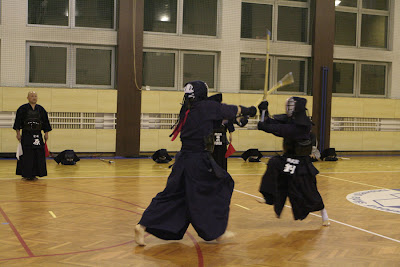
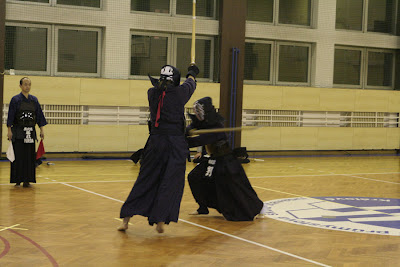
Yesterday's training was short but quite intersting. My left foot is now back in shape except minor soreness, but the left wrist is acting up. I couldn't do kirikaeshi properly because my left wrist couldn't rotate freely. Sucks... I hope the weekend-rest will do it good.
After some kihon we started jigeiko, and then team shiai-keiko, which was fun. I was the senpo in the 5-men team consisting (in fighting order) me, Patrick, Lilli, Tino and Stephan. The other team: Rico, Matthias, Daniel, Theo, Ralph and David, 6 people. The system is that the winner stays on the court and keeps fighting until he looses or draws. I won my first three matches but lost in the fourth from a "tsuba"-kote. Amazingly two flags were up. However, I couldn't get point because I was too tired and didn't put enough seme... more jigeiko needed.. I still need to work on my men-uchi as well. I wish that my matches were recorded on video so that I could see what I have to improve...
I found some photos of the Czech seminar taken by Czech photographer (please inform me so I can put your name here), here are picture of me in the shiai-geiko when I had just arrived.
Here I also found a video from the Paris Taikai this year, which is a big event that takes place every three years, each time involving many 8th Dan visitors. The video is the 36+ team shiai from Budo XI, the dojo I trained at. I know all the three Senpai and fought with them on at least one occasion. They are the red, Naito-san, Nori-san, and Labru Sensei. Very nice kendo. It's interesting to note that Nori-san has a distinctive kamae, namely, with wide feet separation.
Subscribe to:
Posts (Atom)


