Finally I managed to upload the video of the Nito kendoka, Yamana, at the 55th All Japan Kendo Championship this year. This is his first round, which he won with a clean kote point.
Thursday, November 29, 2007


Tuesday, November 27, 2007
Across the Atlantic 2
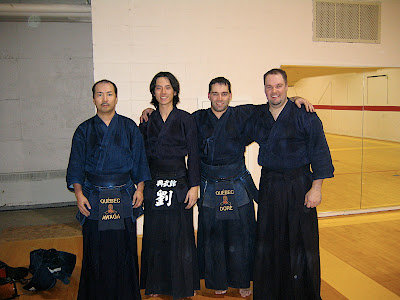
The training just got better and better. Yesterday more people turned up for training. We did a couple of interesting exercises apart from men- and kote-men-uchi. First of them was kote-taiatari-men-taiatari-kote-taiatari, and we executed it across the dojo from one end to the other. I really found that my taiatari was too weak, which was something I didn't train at all when I was in Tokyo. Back in Dresden, everyone else's taiatari improved a lot as well. Improving my taiatari might help bringing my hip forwards when doing strikes. The second exercise was kote-men-dou. Following from the previous exercise helps to keep the upper body straight during the continuous strikes. So it made complete sense to put the two exercises together. Kimura Sensei came to tell me that I should make my kiai louder.
After the kihon exercises we did a few rounds of jigeiko with rotations (mawari), before the free-jigeiko. I again went flat out fighting with Kimura Sensei and Awaga Sensei. At one point I was frustrated that his kensen was against my chest when I struck his men, despite that I waded his shinai off centre. So I continuously made the same strikes, but none of them succeeded, which made me even more frustrated!! He told me that very often I was too close, and at this distance his kensen is already in the middle. Our jigeiko finished with me doing kakarigeiko, and I made sure I gave the loudest possible kiai for my last strike.
There are many people here who have strong centres, and I think it is a good opportunity to explore different footworks during seme. I also want to make sure I strike kote in the way that, if it fails, I can immediate strike men. [Edit: Georg wrote in the comment a list of one can do when kote-strike fails, see below.]
Saturday, November 24, 2007
Across the Atlantic
Last night I practised with the Quebec Kendo Kai, based at the Laval University. Luckily, Shigeo Kimura Sensei (7th Dan) from Toronto visited QC and lead the training. It was one of the most exhausting practice I've had in a while. I had long jigeiko with Martin Dore (5th Dan), Hiroshi Awaga (5th Dan) and Kimura Sensei. With Awaga sensei I really couldn't do much, because he could almost predict my moves and had a very strong centre. When I was completely exhausted, he announced, "Ippon." Oh, my goodness me. But that was when the real training began. My fourth and last jigeiko was with a less senior member, with whom I had more successes.
Afterwards we went for a beer and some snacks in a nice cosy pub. Kimura Sensei said to me if I cannot make the training I should do suburi at home, so that my body remembers the movements, which will help the next training and make it more efficient. He said ideally one should train 4-5 times (!!)
The coldness in Quebec is just beyond words. It was -15 degrees last night, and it's just the beginning of the winter! The bunch here are very friendly and fun. They told me that they don't have visitors often, and I guess they are very curious about me!
Afterwards we went for a beer and some snacks in a nice cosy pub. Kimura Sensei said to me if I cannot make the training I should do suburi at home, so that my body remembers the movements, which will help the next training and make it more efficient. He said ideally one should train 4-5 times (!!)
The coldness in Quebec is just beyond words. It was -15 degrees last night, and it's just the beginning of the winter! The bunch here are very friendly and fun. They told me that they don't have visitors often, and I guess they are very curious about me!
Thursday, November 22, 2007
Shyugyo 9 - final thoughts

It's been a week since I left Tokyo. The time in Tokyo seems much too short, and the past week too long. I miss the people and the kendo at Kobukan, not to mention the great food and dynamics of the city. I think I quite simply haven't left there.
I want to write a small summary of the kendo-related things I came to realised while I was there.
I arrived in Kobukan with a very open mind, not very sure about what I was going to see, and how I could learn. In the first two weeks I was practising with 7th Dan Senseis during the kihon exercise and did only basic cuts, such as men, kote-men, kote-dou, and kote-men-dou, etc. Everyday I got up in the morning to first wipe the dojo floor and 500 suburis. I learned all over again how to do suburi and men-strikes. While from the Senseis I received simple yet important advices on the basic cuts, other sempais tend to give more specific comments on jigeiko and techniques. Kudora-san showed me many wazas and the related foot works. He trained often with me alone to improve my men-strikes, and told me I should use more kote-men in jigeiko. Akita-san told me the importance of never stepping back during practices. He said, "it is safer if you step backwards, but you'll never imporve." This quite applicable to life in general, I find.
I now could appreciate the importance and beauty of kata, and am able to do it up to the 7th form. Though not perfect, I received many helpful guidances.
Many Seneis gave me very positive feedbacks on the style of my kendo. They are all surprised that I have done kendo for no more than two years. Nonetheless, I am still a beginner to them.
So what should I do from now on?
Ozawa-sensei once told me I should do big men-cuts for 5 more years, and suburis everyday. Kuroda-san's effort on improving my men-strikes was very helpful. I couldn't yet strike a good enough men before I left, but I know what I should do, and I will continuously work on it until the next time we meet.
As Mr. Chow described, the kendo of Kobukan is one that never steps back. I will continue this spirit. Honda-Sensei encouraged me to continue what I was doing at Kobukan and continue the style of kendo I played.
Iinuma-san told me not to back down after striking kote. Kanji-Sensei told me when doing men cuts in kirikaeshi, I should put more kisei in.
The most important thing about kendo I learned was to be able to appreciate its true beauty. Before this, I had seen the videos of 8th Dan kendoka playing kendo, but never thought that this is the style I would like to try at this moment. However, from what I saw and was told by the Senseis, I realised that this is a goal that I can and should set for myself now.
What is beautiful kendo? In my humble opinion:
- Good kamae, good posture during and after strikes.
- Strong centre.
- Always apply pressure (seme) forwards. Never step back or move side ways without the intention to strike.
- No bending of head or body to avoid strikes.
- No meaning less strikes.
- Striking from issoku-itto-no-maai, instead of chikma (close distance), as Kuroda-san said.
Off again - to Quebec!
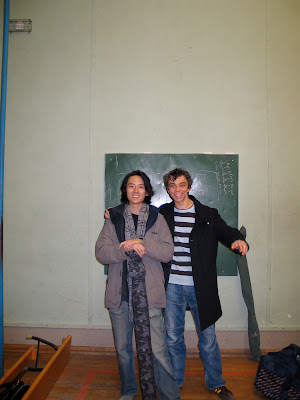
I have been to every training so far after coming back to Dresden. On Tuesday night the nastiness of my fellow Dresden kendo mates far exceeded my expectation :). They gave me another farewell training which involved again with me fighting five people. I won against Lilli, Martin and Jens, but lost to Tino and Georg. To me, it was sort of a trial to see if the kendo I had learned is actually applicable. I have to say I'm pretty happy with the result, not because of winning the matches but being able to maintain my posture and apply pressure forwards instead of hopping forwards and back all the time.
Two main things to improve:
- My hip is still not following me during strikes. Really need to work on that.
- React more quickly to seize the moment to apply oji-wazas.
My next stop:
21st Nov 07 - 6th Dec 07,
Quebec City, Canada
Quebec City, Canada
Here is a clip showing all the matches from Tuesday night (many thanks to Thomas, who took the video!):
Subscribe to:
Posts (Atom)


