About this blog..

This is a blog that I started in April 2006, just after I first put on my bogu (kendo armour). It collects the advices given by more experienced kendo practitioners as well as those from my own experiences. Both technical and the mental aspects of kendo are written in the blog. I hope someone will find them useful or interesting at least!

Tuesday, July 06, 2010

Fumigomi practice

Last Saturday I went to the morning keiko (Asageiko) at the Taipei Japanese School again, where Kamiyama (上山) Sensei (7th Dan Kyoshi) heads the training.

After the keiko he gave very valuable advices on the correct fumigomi and the practice for it, which I will describe in the following.

Step 1: Take one large step forward with the right foot. One main point is that when the right foot makes contact with the floor, there is a sheer-like force going, not straight down, but forward-down as shown in the picture below.


Step 2: Quickly draw the left foot to the right one, and stand on the soles of the feet, so that the body is going slightly up.


Step 3: Repeat the exercise.

This is really the tip that I have been looking for to improve my men-strikes, for a long time. So I'm eager to share with you guys here! Hope it helps!


Thursday, July 01, 2010

New Homepage of Taipei Kendokan

Check out the new English page for the Taipei Kendokan, that I made. Come to visit by all means when you are in Taiwan!!

Back to live in Taipei

I finally moved back to Taipei from Hsin-Chu, which means that I can go for training at the Taipei Kendokan more often. My goal is to train from twice a week moving gradually to three times a week. However, living in Taipei while working in Hsin-Chu means that I need to get up at 5:30 in the morning and go to bed at 10:30pm in order to catch the dedicated bus going to my company. Everyone awed at my new schedule, and some bet that I won't be able to last long, because it's too tough. Well I'm tough, too. ;-)

Speaking of toughness, the weather is becoming unbearable to train at the dojo. I need to make sure that I have enough water in-take well before the training. Last night I felt so dizzy towards the end of the training. When I practised in Europe, I thought taking break during the training was a shame. But I tell you, in this climate this is really a matter of life and death. We usually take a 5-10 mins break after 1hr, just before mawari-geiko and jigeiko.

Yesterday I put a lot of attention on my feet, making sure that they are not too far apart. And also their fluency when executing zanshin after the strike, for both forward strikes and hiki-men strikes. There should be a smooth coordination.

Looking forward to the next practise.

Sunday, June 13, 2010

First time at the Taipei Japanese School

On Friday we had a looong training from 8pm-10:30pm, because Ho Sensei wasn't there and So Sempai led the training. The extra time was due to additional program following the jigeiko, which included the kakarite executing kote-men-hiki-men/kote/do followed immediately by men-debana-kote.

  • In order to have enough time to hit the debana-kote, one needs a solid taiatari, which makes the motodachi pause.

At the end I was really exhausted, trying to keep on going. The movement however became more and more proper - always happens.

Saturday morning at the Taipei Japanese School

The lack of sleep didn't prevent me from getting to the Taipei Japanese School (TJS) at 7:30 in the morning. There Kimura-Sensei (now 7th Dan, a former student of Ozawa Sensei) was expecting me.


2007 Autumn - my first time in Tokyo. Ozawa Sensei, Kimura Sensei and me.

When I got there the children were practising kihon without the bogu. Three 7th Dan Japanese teachers and a few other adult ones were instructing them. It was interesting to see how they explained the basics, and of course I got to practise my Japanese listening skills! For almost every item, men-uchi and hiki-men etc, the children had to use the sliding footwork all the way across the hall after the strike. This really trains their leg muscles and fluency to the movements.

Afterwards we put on the bogu and became motodachis to the children. It was a new experience for me to have so many kids coming to practise with me, and to teach them. At the end it was mawari-geiko for the adults.

I got a few insightful advices from Kimura Sensei:

  • Try to communicate with the opponent with kensen from to-maai.
  • When doing seme, no matter how tall you or your opponent are, direct your movement downwards and not upwards.

The second advice I had never head before. However, it solves some of the questions I had in mind. So it was really a unexpected reward of this visit, as well as making a couple of new Japanese friends who are teachers at the school! I think I'll be back there soon!

Monday, May 31, 2010

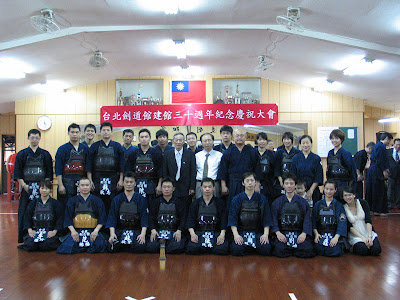
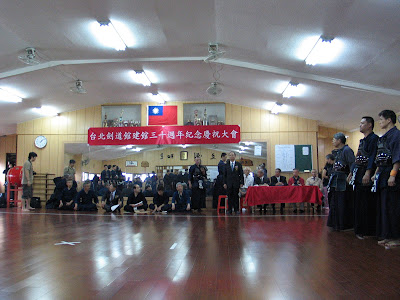
30th Anniversary Taikai


The 30th Anniversary celebration finished successfully. About 10 teams participated in the competition including 4 teams from Taipei Kendokan, 1 team (all japanese senseis) from Shang-Hai, 1 team from Renpeikan (Japan), 1 from the police, 1 from Yi-lan County, 1 from I-Shin Kendokan, and 1 from Hsin-Chu City. The winner was the Renpeikan team and the second was one of the Taipei Kendokan team. The joint third were Shang-Hai and Hsin-Chu.

My team lost to I-Shin Kendokan, though I won my match 1-0 as the jiho. I scored a debana-kote, however wasn't able to score a further point despite some attempts to strike men. I guess that they were too slow, and my opponent just saw them coming and blocked. And I almost didn't use any kote-men, fearing that it might be too slow. More practices required!


All in all it was a good atmosphere. I was stunned by the performance from our most experienced team (members consisting 4~5 dan) and the Japanese team (many are 7th Dan). The matches were really top-notch, which further encouraged me that there are so much room for me to improve and perhaps that, if I work hard enough one day I will be like that!